


As the presidential candidates canvass for votes on the streets by traveling in open-topped jeeps, National Security Bureau (NSB) Director Tsai Der-sheng (蔡得勝) yesterday said he has asked police to persuade people to only set off firecrackers before and after the candidates arrive to avoid startling them.
Tsai’s comments came after Democratic Progressive Party (DPP) presidential candidate Tsai Ing-wen (蔡英文) was startled by supporters’ fire-crackers when canvassing in Yunlin on Saturday.
Setting off firecrackers is not illegal, Tsai Der-sheng said, and as such police would only resort to persuasion.
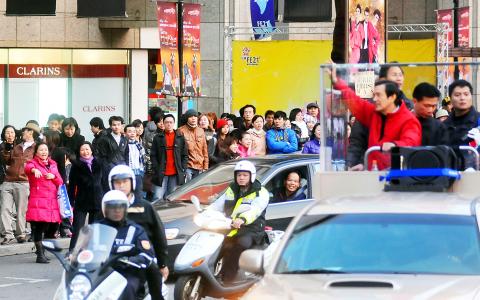
Photo: CNA
Tsai Der-sheng said the sound of firecrackers could cover the sound of a gunshot and interfere with the security of the candidates, adding that it would be best if firecrackers are not set off when the presidential candidates are present.
Tsai Der-sheng, who accompanied President Ma Ying-jeou (馬英九) on a canvassing activity in Taoyuan County yesterday afternoon, said the bureau had dispatched four police motorcycles to follow the president’s fleet.
The security measures for the motorcade included three panes of bulletproof glass at the rear of the president’s car that were provided by the NSB.
In other news, New Taipei City (新北市) Government officials said late on Saturday that two men were barred from approaching Ma during a Christmas Eve gala in the city after they were discovered to be carrying BB guns.
One of the men was stopped from entering a control area where Ma was arriving for the charity gala after he was discovered to be carrying a BB gun and a bottle of BB pellets in his bag, officials said.
The other man was stopped by security guards when trying to enter the same control area near citizens square in Banqiao District (板橋) minutes later. He was also found to be carrying a BB gun and a bottle of pellets, officials said.
At the entrance to another control area, a mother and child were barred from entering after the boy was found to be carrying a toy gun.
The gala drew about 80,000 people, with about 200 police and security personnel standing by to protect Ma, who is seeking re-election on Jan. 14.

The Centers for Disease Control (CDC) yesterday reported the first case of a new COVID-19 subvariant — BA.3.2 — in a 10-year-old Singaporean girl who had a fever upon arrival in Taiwan and tested positive for the disease. The girl left Taiwan on March 20 and the case did not have a direct impact on the local community, it said. The WHO added the BA.3.2 strain to its list of Variants Under Monitoring in December last year, but this was the first imported case of the COVID-19 variant in Taiwan, CDC Deputy Director-General Lin Ming-cheng (林明誠) said. The girl arrived in Taiwan on

South Korea is planning to revise its controversial electronic arrival card, a step Taiwanese officials said prompted them to hold off on planned retaliatory measures, a South Korean media report said yesterday. A Yonhap News Agency report said that the South Korean Ministry of Foreign Affairs is planning to remove the “previous departure place” and “next destination” fields from its e-arrival card system. The plan, reached after interagency consultations, is under review and aims to simplify entry procedures and align the electronic form with the paper version, a South Korean ministry official said. The fields — which appeared only on the electronic form

The Ministry of Foreign Affairs (MOFA) is suspending retaliation measures against South Korea that were set to take effect tomorrow, after Seoul said it is updating its e-arrival system, MOFA said today. The measures were to be a new round of retaliation after Taiwan on March 1 changed South Korea's designation on government-issued alien resident certificates held by South Korean nationals to "South Korea” from the "Republic of Korea," the country’s official name. The move came after months of protests to Seoul over its listing of Taiwan as "China (Taiwan)" in dropdown menus on its new online immigration entry system. MOFA last week
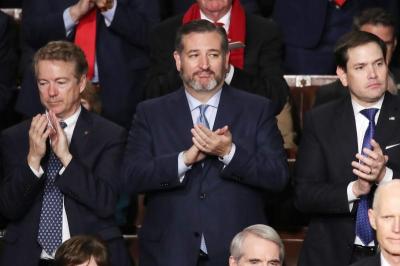
A bipartisan group of US senators has introduced a bill to enhance cooperation with Taiwan on drone development and to reduce reliance on supply chains linked to China. The proposed Blue Skies for Taiwan Act of 2026 was introduced by Republican US senators Ted Cruz and John Curtis, and Democratic US senators Jeff Merkley and Andy Kim. The legislation seeks to ease constraints on Taiwan-US cooperation in uncrewed aerial systems (UAS), including dependence on China-sourced components, limited access to capital and regulatory barriers under US export controls, a news release issued by Cruz on Wednesday said. The bill would establish a "Blue UAS


 RSS
RSS