


Former vice president Lien Chan (連戰), who served as President Ma Ying-jeou’s (馬英九) envoy to the APEC summit in Yokohama, Japan, over the weekend, yesterday dismissed criticism that Taiwan would be denigrating itself if it “communicated” with China on its wish to participate in international events or organizations.
However, one of the nation’s top officials on non-governmental organization (NGO) affairs did not agree.
Lien said some people mistook or misconstrued what Chinese President Hu Jintao (胡錦濤) called “communications” between Taipei and Beijing as just a one-way street, while in effect they were bilateral.
“There was no such thing as self-deprecation, because the communications were conducted under the principles of dignity, reciprocity and equality,” Lien said.
“The two sides discuss issues based on facts rather than emotion, so we can avoid wasting our energy on internal friction or upsetting each other,” he said.
Lien made the remarks during a press conference at the Presidential Office after briefing Ma on his APEC trip, which he described as “successful.”
Lien said Taiwan’s desire to participate in international organizations and activities would require that Taipei and Beijing communicate and negotiate.
The situation has improved over the past two years, Lien said, citing the examples of the country’s participation — as an observer — at the World Health Assembly, as well as in the Government Procurement Agreement and APEC.
Lien said he mentioned the matter to Hu during their meeting on Saturday, and Hu replied the two sides should negotiate to avoid unnecessary trouble.
Ma told Lien yesterday that many Taiwanese and civic groups were concerned about international participation and that his administration would make an effort to address the problem.
Not everybody agrees with Lien’s assessment.
Wu Rong-chuan (吳榮泉), vice chairman of the Ministry of Foreign Affairs’ NGO Affairs Committee, denied that Taipei would negotiate with Beijing about Taiwan’s participation in international NGOs and activities.
“The Republic of China is a sovereign country. Negotiation on this subject is out of the question,” he said.
On the Trans-Pacific Partnership (TPP), Ma said it was the administration’s policy to join the pan-regional free-trade agreement. As interested economies planned to meet in New Zealand next month to discuss the issue, Lien urged the administration to pay close attention to those developments.
Lien said he told world leaders during the TPP negotiations, including US President Barack Obama, that he hoped to see “open regionalism” and for Taiwan to have “broadly based participation.”
Four countries have signed up for the TPP — Brunei, Chile, Singapore and New Zealand — but five others are in talks to join the group: the US, Australia, Malaysia, Peru and Vietnam. The pact would require members to drop tariffs and other trade barriers.
On the Economic Cooperation Framework Agreement (ECFA) that Taipei and Beijing signed in June, Lien said his “impression” was that Beijing also wanted to expedite negotiations on subsequent agreements.
The pact stipulates that the two sides should begin negotiating four more agreements after the ECFA comes into force, covering traded goods, trade in services, investment protection and economic cooperation.
Meanwhile, since the Chinese Communist Party will celebrate the 100th anniversary of the Wuchang Revolution next year, Lien said that revolution “bore historic significance for the Chinese nation” because the Qing Dynasty was overthrown and the Republic of China (ROC) established, moving one more step toward Sun Yat-sen’s (孫中山) ideal of invigorating the “Chinese nation.”
Lien said although Taipei and Beijing could not hold joint celebrations to commemorate the Wuchang Revolution, the ROC would “reach the same goal by different means,” since the government will mark the 100th anniversary of the founding of the ROC next year through a series of activities and events.
ADDITIONAL REPORTING BY SHIH HSIU-CHUAN AND STAFF WRITER
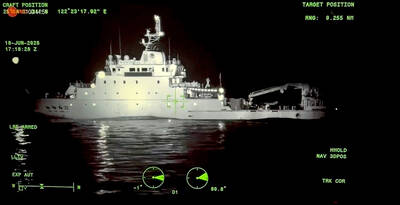
EXCUSES: Beijing is using government and research vessels as a pretext to harass the nation and enter its EEZ, and engage in ‘hegemonic expansion,’ the coast guard said The Coast Guard Administration yesterday said it drove away Chinese oceanographic research vessel Xiang Yang Hong 22 (向陽紅33) from restricted waters after warning it that it was in Taiwan’s exclusive economic zone (EEZ). The Chinese vessel entered restricted waters off the coast of Yilan County’s Suao (蘇澳) at 11:35pm on Thursday, the coast guard said, adding that it dispatched the Lanyu patrol vessel and the boat PP-10077 to shadow the Chinese ship and issue radio warnings ordering it to leave. China has no sovereignty over waters off Taiwan’s east coast, Lanyu’s crew told Xiang Yang Hong 22 over the radio, and demanded
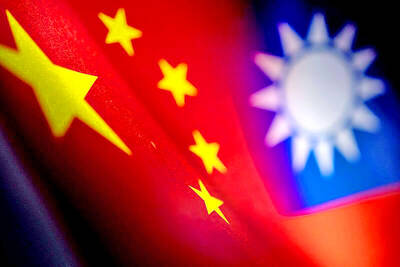
BAIT AND SWITCH: Allowing KMT-run counties to sell to China while the threat of abrupt cancelations hangs overhead is another form of coercion, officials said Beijing is using agricultural purchase offers announced during the Straits Forum to deepen Taiwan’s dependence on the Chinese market, a Taiwanese official said yesterday as they criticized the Taitung County commissioner’s participation in the initiative. During the Straits Forum held in Xiamen on Saturday, Chinese officials announced a sales and purchase agreement for agricultural products from some counties led by the Chinese Nationalist Party (KMT). Taitung County Commissioner Yao Ching-ling (饒慶鈴), who was barred from attending the event in person by the Mainland Affairs Council, participated via video. Under the agreement, China would purchase atemoyas, pomeloes, tea and grouper harvested in Taitung,
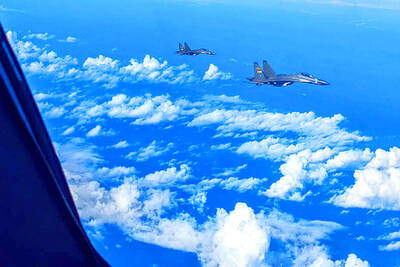
SHIFTING FIRE: While the tempo of purely military exercises around Taiwan has gone down somewhat, Beijing is working to isolate Lai diplomatically from support abroad Chinese President Xi Jinping (習近平) is shifting tactics in his campaign to pressure Taiwan, ramping up diplomatic isolation of the nation while dialing down provocative displays of military aggression. Taiwan recorded a daily average of five Chinese military aircraft crossing the Taiwan Strait’s buffer line with China through May this year — half the number logged in the same period last year. In March, Beijing did not send a single fighter jet near Taiwan for seven days, the longest absence on record outside of typhoon season. In comparison, China sent 153 planes near Taiwan during one day at its peak in
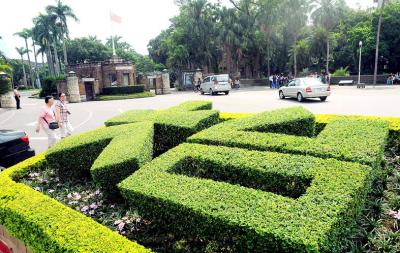
Four Taiwanese universities have been ranked among the world's top 200 institutions in the Quacquarelli Symonds (QS) World University Rankings for next year, the highest Taiwan has ever placed in the category, with National Taiwan University (NTU) achieving its best performance at 54th globally and 17th in Asia. The four Taiwanese institutions in the global top 200 are NTU (54th), National Tsing Hua University (142nd), National Yang Ming Chiao Tung University (177th) and National Cheng Kung University (191st), the rankings showed. All four universities achieved their highest-ever global rankings this year, QS data showed. National Cheng Kung University entered the top 200 for


 RSS
RSS