


The Mainland Affairs Council (MAC) yesterday was evasive on why the administration was reluctant to protest Chinese vessels venturing into waters off the Diaoyutai islands (釣魚台), which Taiwan considers its territory.
MAC Deputy Minister Liu Te-shun (劉德勳) said the government’s position was clear and consistent and that the administration would do whatever it could to protect the life, property and interests of fishermen.
Taiwan lodged a protest against Tokyo on Tuesday after a Taiwanese fishing boat heading to the islands was turned back by seven Japanese patrol vessels.
Meanwhile, Liu denied speculation that Beijing was attempting to reach a political consensus with Taipei that both sides would focus on resolving economic issues through an institutionalized negotiation platform.
Liu said the most pressing matter at the moment was building mutual trust. President Ma Ying-jeou (馬英九) has made it clear that the two sides would not tackle political issues during his presidency, he said.
On the Economic Cooperation Framework Agreement, Liu said the council on Wednesday had authorized the Straits Exchange Foundation (SEF) to begin negotiations on upcoming high-level cross-strait talks and on the formation of a cross-strait economic cooperation committee.
SEF Chairman Chiang Pin-kung (江丙坤) and his Chinese counterpart, Association for Relations Across the Taiwan Strait Chairman Chen Yunlin (陳雲林), are planning to sign an investment protection pact and an agreement on medical and health cooperation later this year.
Chiang, who left yesterday for a four-day visit to Shanghai and Kunshan, Jiangsu Province, said that the main purpose of the visit was to meet with Taiwanese businesspeople there.
He also plans to visit the Taiwan Pavilion at the Shanghai World Expo and preside over a ceremony to erect a statue at a Taiwan-built Matsu temple in Kunshan.
In related news, Civil Aeronautics Administration Director General Yin Chen-pong (尹承篷) confirmed yesterday that China had approved applications by Taiwanese carriers for new weekly flights to Shenzhen, Fuzhou and Xiamen, adding that the matter of “red eye flights,” which had derailed plans to launch the new routes, had been resolved after Chinese airlines yielded some time slots.
ADDITIONAL REPORTING BY SHELLEY SHAN AND CNA
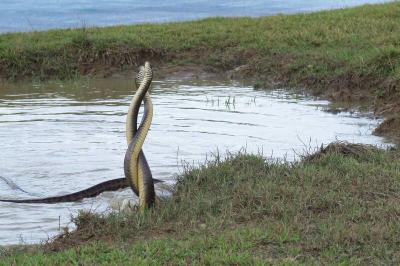
Kenting National Park service technician Yang Jien-fon (楊政峰) won a silver award in World Grand Prix Photography Awards Spring Season for his photograph of two male rat snakes intertwined in combat. Yang’s colleagues at Kenting National Park said he is a master of nature photography who has been held back by his job in civil service. The awards accept entries in all four seasons across six categories: architectural and urban photography, black-and-white and fine art photography, commercial and fashion photography, documentary and people photography, nature and experimental photography, and mobile photography. Awards are ranked according to scores and divided into platinum, gold and
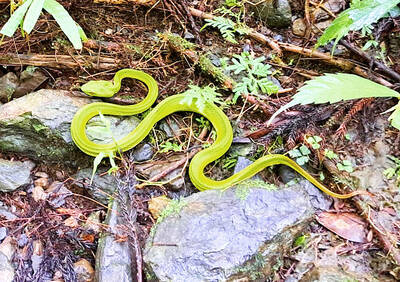
More than half of the bamboo vipers captured in Tainan in the past few years were found in the city’s Sinhua District (新化), while other districts had smaller catches or none at all. Every year, Tainan captures about 6,000 snakes which have made their way into people’s homes. Of the six major venomous snakes in Taiwan, the cobra, the many-banded krait, the brown-spotted pit viper and the bamboo viper are the most frequently captured. The high concentration of bamboo vipers captured in Sinhua District is puzzling. Tainan Agriculture Bureau Forestry and Nature Conservation Division head Chu Chien-ming (朱健明) earlier this week said that the
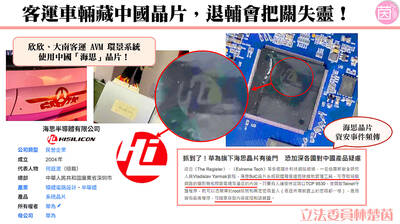
BREACH OF CONTRACT: The bus operators would seek compensation and have demanded that the manufacturer replace the chips with ones that meet regulations Two bus operators found to be using buses with China-made chips are to demand that the original manufacturers replace the systems and provide compensation for breach of contract, the Veterans Affairs Council said yesterday. Democratic Progressive Party Legislator Michelle Lin (林楚茵) yesterday said that Da Nan Bus Co and Shin-Shin Bus Co Ltd have fielded a total of 82 buses that are using Chinese chips. The bus models were made by Tron-E, while the systems provider was CYE Electronics, Lin said. Lin alleged that the buses were using chips manufactured by Huawei subsidiary HiSilicon Co, which presents a national security risk if the

The National Immigration Agency has banned two Chinese from returning to Taiwan, after they published social media content it described as disrespectful to national sovereignty. The agency imposed a two-month ban on a Chinese man surnamed Liang (梁) and a permanent ban on a woman surnamed Yang (楊), an influencer with 23 million followers, in October last year and last week respectively. Minister of the Interior Liu Shyh-fang (劉世芳) yesterday said on the sidelines of a legislative meeting that Chinese visitors to Taiwan are required to comply with the rules and regulations governing their entry permits. The government has handled the ban and


 RSS
RSS