


Taiwan’s service sector industries are expected to operate in China after a proposed trade pact is signed, an official familiar with the negotiations said yesterday.
Taiwanese and Chinese negotiators reached an agreement during the third round of talks on a proposed economic cooperation framework agreement (ECFA) to include the industries on Taiwan’s “early harvest” list to be granted market access by China, the official said. The third round of talks concluded on Sunday.
The industries include the conference sector, computer services, medical services, architecture and fashion design services, and the civil aviation equipment maintenance and repair industry.
China agreed to allow Taiwan’s air cargo firms to set up solely owned companies in China, exempting them from China’s regulations that foreign investment cannot exceed 50 percent of an enterprise’s total investment, the official said.
China’s opening up to Taiwan’s civil aviation sector will allow air cargo companies to capitalize on business opportunities related to direct cross-strait flights, he said.
With Taiwan’s higher standard of medical care, China also promised to let Taiwan medical institutions set up hospitals in areas with high concentrations of Taiwanese businesses, such as Guangdong Province, to allow them to expand operations in China and to care for China-based Taiwanese businesspeople seeking medical attention.
China, however, did not agree with a proposal to increase the number of Taiwanese films released in China. China only approves 10 Taiwanese films each year for cinematic viewing, the official said.
Meanwhile, the Mainland Affairs Council (MAC) yesterday reiterated the government’s goal to sign the cross-strait pact this month or early next month.
MAC Chairwoman Lai Shin-yuan (賴幸媛) said it remains uncertain how many items will be covered by the agreement’s “early harvest” program as discussions are still going ongoing.
Details will be made public as soon as they are finalized, she said.
In the third formal round of ECFA talks that ended in Beijing on Sunday, China agreed to Taiwan’s list of 500 items that will be entitled to preferential tariff treatment as soon as the ECFA is signed, in comparison to the 200-odd Chinese items accepted by Taiwan.
Chinese Premier Wu Den-yih (吳敦義) said on Thursday that the number of products on Taiwan’s list will be increased to around 510, while the number on China’s will be boosted to 260 or 270.
MAC officials said the two sides are currently reviewing the conclusions reached during the third round of ECFA talks and it remains unclear if they will need to hold a fourth round before signing the agreement.

Kenting National Park service technician Yang Jien-fon (楊政峰) won a silver award in World Grand Prix Photography Awards Spring Season for his photograph of two male rat snakes intertwined in combat. Yang’s colleagues at Kenting National Park said he is a master of nature photography who has been held back by his job in civil service. The awards accept entries in all four seasons across six categories: architectural and urban photography, black-and-white and fine art photography, commercial and fashion photography, documentary and people photography, nature and experimental photography, and mobile photography. Awards are ranked according to scores and divided into platinum, gold and

More than half of the bamboo vipers captured in Tainan in the past few years were found in the city’s Sinhua District (新化), while other districts had smaller catches or none at all. Every year, Tainan captures about 6,000 snakes which have made their way into people’s homes. Of the six major venomous snakes in Taiwan, the cobra, the many-banded krait, the brown-spotted pit viper and the bamboo viper are the most frequently captured. The high concentration of bamboo vipers captured in Sinhua District is puzzling. Tainan Agriculture Bureau Forestry and Nature Conservation Division head Chu Chien-ming (朱健明) earlier this week said that the
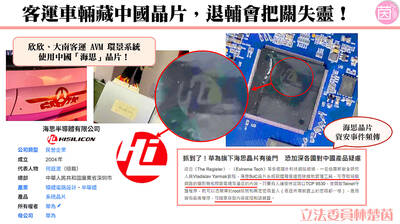
BREACH OF CONTRACT: The bus operators would seek compensation and have demanded that the manufacturer replace the chips with ones that meet regulations Two bus operators found to be using buses with China-made chips are to demand that the original manufacturers replace the systems and provide compensation for breach of contract, the Veterans Affairs Council said yesterday. Democratic Progressive Party Legislator Michelle Lin (林楚茵) yesterday said that Da Nan Bus Co and Shin-Shin Bus Co Ltd have fielded a total of 82 buses that are using Chinese chips. The bus models were made by Tron-E, while the systems provider was CYE Electronics, Lin said. Lin alleged that the buses were using chips manufactured by Huawei subsidiary HiSilicon Co, which presents a national security risk if the

The National Immigration Agency has banned two Chinese from returning to Taiwan, after they published social media content it described as disrespectful to national sovereignty. The agency imposed a two-month ban on a Chinese man surnamed Liang (梁) and a permanent ban on a woman surnamed Yang (楊), an influencer with 23 million followers, in October last year and last week respectively. Minister of the Interior Liu Shyh-fang (劉世芳) yesterday said on the sidelines of a legislative meeting that Chinese visitors to Taiwan are required to comply with the rules and regulations governing their entry permits. The government has handled the ban and


 RSS
RSS