


A group of animal rights activists yesterday called on the US government to reject a proposal by the Columbia University-affiliated Lamont-Doherty Earth Observatory (L-DEO) to conduct earthquake studies on Taiwan’s sea floor, saying that air guns used in the project would harm the near-extinct Chinese white dolphins living in the area.
“Taiwan’s population of Chinese white dolphins (Sousa chinensis) was rated ‘critically endangered’ by the International Union for Conservation of Nature (IUCN) in 2008; currently, we estimate that less than 100 animals exist,” said Allen Chen (陳昭倫), spokesperson for the East Taiwan Strait Sousa Technique and Advisory Working Group.
Chen, who is an assistant research fellow at Academia Sinica’s Research Center for Biodiversity, said that although Chinese white dolphins are also found along the coasts of China, India and east Africa, “studies have revealed that [the Chinese white dolphin] population in Taiwan never crosses the Taiwan Strait and therefore is independent from the rest of the Chinese white dolphins in the world.”
SEA FLOOR
Earlier last month, Chen’s group and the Wild at Heart Legal Defense Association (WaH), an environmental group, found a public announcement on the US’ National Marine Fisheries Service Web site saying that the L-DEO planned to conduct a sea floor investigation project in the exclusive economic zone that includes Taiwan, China, Japan and the Philippines for its earthquake research, Chen said.
“The transect line will hit the dolphin’s habitat from Hsinchu to Yunlin along the island’s west coast,” he said.
“Air guns that are 265 decibels [dB], multibeam echosounders and sub-bottom profilers will be used under the sea in the project,” said WaH founder Robin Winkler (文魯彬), adding that the noise level of an exploding atomic bomb is about 300db.
Chen said although L-DEO had applied for Incidental Harassment Authorization under the condition that only Level B Harassments (potential disturbances) based on the US’ Marine Mammal Protection Act would be done to the mammal stock, Level A Harassments (potential injuries) are in fact highly likely.
“To the dolphins, this is like firing gigantic ‘firecrackers’ in their homes ... As dolphins navigate with sound waves, this will grossly disturb their movement, in addition to shocking the animals,” he said.
‘POORLY DONE’
Chen also said the environmental impact assessment on the project was poorly done.
“All data were drawn from existing documents and guesstimates from past experiences, instead of sending researchers to Taiwan to investigate life in the seas,” he said.
“We acknowledge that [earthquake] investigations are very important and know that many technologies are used to make the world a better place. However, when a technology threatens existing ecosystems, its implementation needs to be reconsidered, and alternative options explored,” Green Party Taiwan Secretary-General Pan Han-shen (潘翰聲) said.
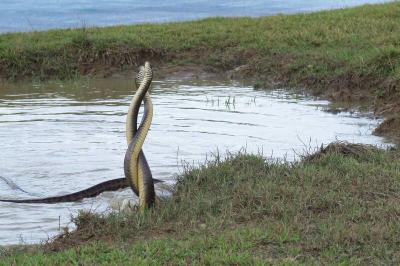
Kenting National Park service technician Yang Jien-fon (楊政峰) won a silver award in World Grand Prix Photography Awards Spring Season for his photograph of two male rat snakes intertwined in combat. Yang’s colleagues at Kenting National Park said he is a master of nature photography who has been held back by his job in civil service. The awards accept entries in all four seasons across six categories: architectural and urban photography, black-and-white and fine art photography, commercial and fashion photography, documentary and people photography, nature and experimental photography, and mobile photography. Awards are ranked according to scores and divided into platinum, gold and
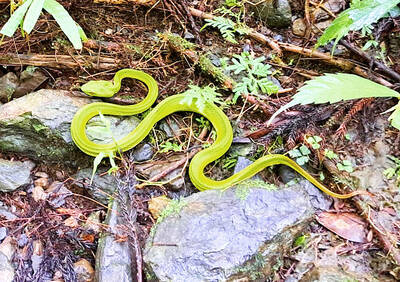
More than half of the bamboo vipers captured in Tainan in the past few years were found in the city’s Sinhua District (新化), while other districts had smaller catches or none at all. Every year, Tainan captures about 6,000 snakes which have made their way into people’s homes. Of the six major venomous snakes in Taiwan, the cobra, the many-banded krait, the brown-spotted pit viper and the bamboo viper are the most frequently captured. The high concentration of bamboo vipers captured in Sinhua District is puzzling. Tainan Agriculture Bureau Forestry and Nature Conservation Division head Chu Chien-ming (朱健明) earlier this week said that the
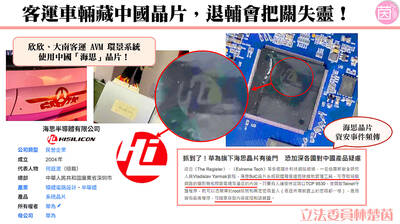
BREACH OF CONTRACT: The bus operators would seek compensation and have demanded that the manufacturer replace the chips with ones that meet regulations Two bus operators found to be using buses with China-made chips are to demand that the original manufacturers replace the systems and provide compensation for breach of contract, the Veterans Affairs Council said yesterday. Democratic Progressive Party Legislator Michelle Lin (林楚茵) yesterday said that Da Nan Bus Co and Shin-Shin Bus Co Ltd have fielded a total of 82 buses that are using Chinese chips. The bus models were made by Tron-E, while the systems provider was CYE Electronics, Lin said. Lin alleged that the buses were using chips manufactured by Huawei subsidiary HiSilicon Co, which presents a national security risk if the

The National Immigration Agency has banned two Chinese from returning to Taiwan, after they published social media content it described as disrespectful to national sovereignty. The agency imposed a two-month ban on a Chinese man surnamed Liang (梁) and a permanent ban on a woman surnamed Yang (楊), an influencer with 23 million followers, in October last year and last week respectively. Minister of the Interior Liu Shyh-fang (劉世芳) yesterday said on the sidelines of a legislative meeting that Chinese visitors to Taiwan are required to comply with the rules and regulations governing their entry permits. The government has handled the ban and


 RSS
RSS