


At the request of civic groups and academics, the Control Yuan will launch an investigation into whether National Police Agency (NPA) and National Security Bureau (NSB) heads broke the law during the visit of Association for Relations Across the Taiwan Strait Chairman Chen Yunlin (陳雲林) and his delegation earlier this month.
Twenty-five civic groups and 218 academics filed a petition with the Control Yuan yesterday, calling for an investigation into the actions of NPA Director-General Wang Cho-chiun (王卓鈞), NSB Director Tsai Chao-ming (蔡朝明) and National Security Council Secretary-General Su Chi (蘇起).
The petitioners accused the NPA and NSB of violating civil liberties when executing “Operation Concord” to protect Chen and his delegation during their Nov. 3 to Nov. 7 visit.
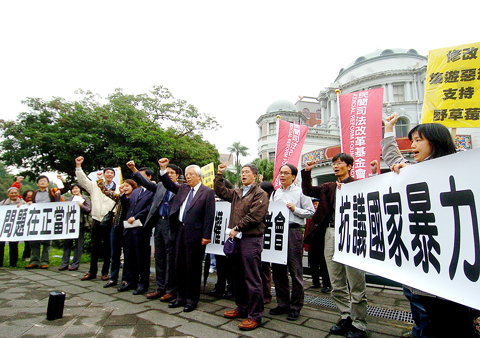
PHOTO: LU CHUN-WEI, TAIPEI TIMES
Chen arrived in Taiwan to sign four agreements with Straits Exchange Foundation Chairman Chiang Pin-kung (江丙坤) aimed at enhancing cross-strait ties.
“In executing ‘Operation Concord,’ [the NSB and the NPA] violated people’s freedom of movement and the right to be at public places, taking excessive measures such as closing off the airport, public roads, sidewalks and hotels, all in the name of ‘protecting Chen’s personal safety,’” the petition said.
“In our constitutional history, the government has never closed off public spaces on such a large scale or so seriously restricted freedom of movement. The aforementioned agencies have obviously violated several laws,” it said.
The petition also cited various incidents of abuse that allegedly occurred during Chen’s stay.
In several cases, individuals wearing T-shirts calling Taiwan a sovereign country, holding the Republic of China or Tibetan flags, or shouting pro-independence slogans were forcibly removed by police and prohibited from walking past buildings in which Chen was at the time.
In other cases, a woman was taken to a police station for videotaping Chen’s convoy leaving a hotel, while several anti-China demonstrators who protested peacefully were beaten by police and severely injured.
“There should already be some mechanism in our government system — for example, prosecutors — to assess such abuses of power, but nothing has been done so far,” Yen Chueh-an (顏厥安), a National Taiwan University law professor, told a press conference outside the Control Yuan before submitting the petition.
“Sadly, nothing has happened and we suspect that something went wrong in our government system. That’s why we are taking this [petition] to the Control Yuan,” Yen said.
“We brought proof of the NPA and the NSB’s wrongdoing, including videos recorded by the media and individuals on the scene, pictures, injury reports and police reports,” said Chiu Hei-yuan (瞿海源), a sociology research fellow at Academia Sinica.
Control Yuan member Huang Huang-hsiung (黃煌雄) accepted the petition and said he would investigate.
“I will ask the concerned parties to explain what happened and summon them to appear in person if necessary,” Huang said. “If everything goes well, the investigation should be completed in three months.”
According to the Constitution, Wang, Tsai and Su could face impeachment if the Control Yuan finds them guilty.

The Centers for Disease Control (CDC) yesterday reported the first case of a new COVID-19 subvariant — BA.3.2 — in a 10-year-old Singaporean girl who had a fever upon arrival in Taiwan and tested positive for the disease. The girl left Taiwan on March 20 and the case did not have a direct impact on the local community, it said. The WHO added the BA.3.2 strain to its list of Variants Under Monitoring in December last year, but this was the first imported case of the COVID-19 variant in Taiwan, CDC Deputy Director-General Lin Ming-cheng (林明誠) said. The girl arrived in Taiwan on

South Korea is planning to revise its controversial electronic arrival card, a step Taiwanese officials said prompted them to hold off on planned retaliatory measures, a South Korean media report said yesterday. A Yonhap News Agency report said that the South Korean Ministry of Foreign Affairs is planning to remove the “previous departure place” and “next destination” fields from its e-arrival card system. The plan, reached after interagency consultations, is under review and aims to simplify entry procedures and align the electronic form with the paper version, a South Korean ministry official said. The fields — which appeared only on the electronic form

The Ministry of Foreign Affairs (MOFA) is suspending retaliation measures against South Korea that were set to take effect tomorrow, after Seoul said it is updating its e-arrival system, MOFA said today. The measures were to be a new round of retaliation after Taiwan on March 1 changed South Korea's designation on government-issued alien resident certificates held by South Korean nationals to "South Korea” from the "Republic of Korea," the country’s official name. The move came after months of protests to Seoul over its listing of Taiwan as "China (Taiwan)" in dropdown menus on its new online immigration entry system. MOFA last week
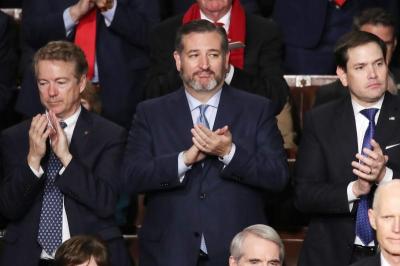
A bipartisan group of US senators has introduced a bill to enhance cooperation with Taiwan on drone development and to reduce reliance on supply chains linked to China. The proposed Blue Skies for Taiwan Act of 2026 was introduced by Republican US senators Ted Cruz and John Curtis, and Democratic US senators Jeff Merkley and Andy Kim. The legislation seeks to ease constraints on Taiwan-US cooperation in uncrewed aerial systems (UAS), including dependence on China-sourced components, limited access to capital and regulatory barriers under US export controls, a news release issued by Cruz on Wednesday said. The bill would establish a "Blue UAS


 RSS
RSS