


The Presidential Office yesterday tried to downplay expectations after reports that President Ma Ying-jeou (馬英九) said that the country might join the World Health Assembly (WHA) next year, adding that it was the administration’s policy to work toward that goal.
Presidential Office Spokesman Wang Yu-chi (王郁琦) said that the aggressive approach adopted by the former Democratic Progressive Party administration over the past eight years had proven unfeasible and impractical.
With the Chinese Nationalist Party (KMT) in power, a more flexible strategy will be used, Wang said.
The odds of joining the international body should be higher as a result of the new government’s approach, he said.
As Ma has said that “Chinese Taipei” would be a suitable name to apply to the body, Wang yesterday said that the proposed name was an option and that it could be the bottom line.
“But the bottom line is not necessarily the name we will use,” he said, adding that the Ministry of Foreign Affairs would be responsible for mapping out a plan for application.
Wang made the remarks in response to reports published in several Chinese-language newspapers quoting Ma as saying that there should be hope for Taiwan to participate in the WHA next year. Ma made the remarks during a visit to the ministry on Monday.
Wang said yesterday that Ma was merely talking about the change of foreign policy and he expected to see the ministry formulate concrete measures and put them into practice.
Ma’s foreign policy of modus vivendi is working, Wang said, and improvements in cross-strait relations were proof.
Under a foreign policy based on “reconciliation” and “diplomatic truce” with Beijing and improvement of cross-strait relations, Wang said it was foreseeable that the odds of joining the WHA would better.
However, he did not mention the campaign to join the WHO.
Since 1997, Taiwan has sought to re-enter the organization by applying for observer status at the WHA, the supreme decision-making body of the WHO.
Hong Kong’s Wen Wei Po newspaper reported that China’s Taiwan Affairs Office Chairman Wang Yi (王毅) had said that although China would continue to block Taiwan’s applications to the WHO, it would look into setting up an international network that would be a “new framework” independent of the WHO to include Taiwan in information on disease outbreaks.
Ma announced last night during a state banquet held for Nauruan President Marcus Stephen that the third Taiwan-South Pacific Allies leaders’ summit will be canceled.
Citing “time constraints,” Ma said the event, scheduled to take place in Kaohsiung this year, will be held in the Solomon Islands next year.
The summit, established by former president Chen Shui-bian (陳水扁), was first held in Palau in 2006.
The country has six Pacific allies.
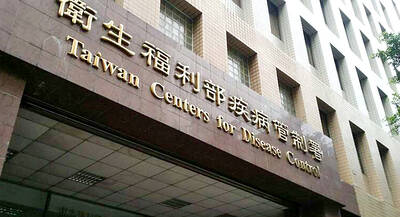
FUKUOKA SITUATION: Japanese media reported that the pathogen is expected to be identified by the summer, while the CDC downplayed the idea that it was hMPV A “mysterious cold-like illness” reported in Japan’s Fukuoka Prefecture does not seem to be a new disease, but Japanese authorities have been asked about the situation, the Centers for Disease Control (CDC) said yesterday. The Fukuoka Prefectural Medical Association on Wednesday told a news conference that a “mystery cold” that has become a hot topic on social media is “highly likely to be caused by some kind of viral infection,” Japan’s KBC News reported. “Many people are experiencing symptoms starting with a sore throat, followed by a runny nose, phlegm and a severe cough,” KBC News reported, citing association officials. Health authorities are
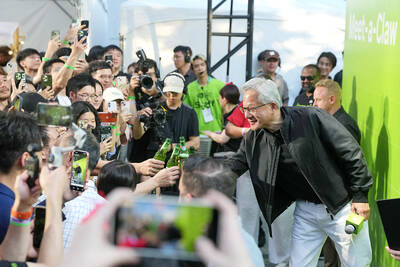
Nvidia Corp CEO Jensen Huang (黃仁勳) arrived in Taiwan yesterday ahead of upcoming AI and technology events, saying he plans to meet with clients and Taiwan Semiconductor Manufacturing Co Chairman C.C. Wei (魏哲家) during his visit. After landing at Taipei Songshan Airport, Huang posed for photos with fans and handed out Yakult drinks to reporters and supporters waiting at the scene, saying he has “a lot to do” during the trip. Asked about reports that Nvidia’s planned headquarters site in Taipei’s Beitou Shilin Technology Park could break ground on May 27, Huang said that if the company holds an event, he would
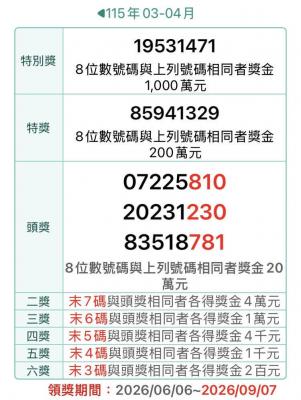
The Ministry of Finance this afternoon announced the winning numbers for the March-April uniform invoice lottery. The winning number for the NT$10 million (US$318,060) special prize is 19531471, and the winning number for the NT$2 million grand prize is 85941329. Three numbers were drawn for the NT$200,000 first prize: 07225810, 20231230 and 83518781. Those with receipts matching the last seven digits of any of the first-prize numbers will win the NT$40,000 second prize, while those matching the last six digits will win the NT$10,000 third prize. Those whose receipts match the last five digits of the first-prize numbers can claim the NT$4,000 fourth prize,
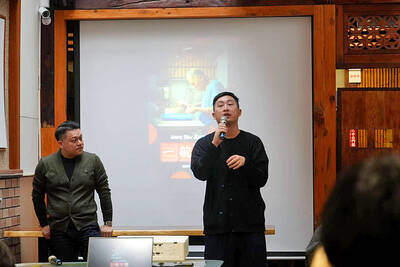
Taiwan Travelogue (臺灣漫遊錄), which earlier this week became the first Taiwanese novel to win the International Booker Prize, is to be adapted into a television series through a Taiwan-Japan coproduction, producer Chang Chen-yu (張辰漁) said yesterday. Chang, a producer at World Softest Production Film Co, wrote on Facebook that the company had been searching for projects with international appeal that retain a strong Taiwanese identity after colleagues and Japanese partners strongly recommended the novel. After reading the book, Chang said he immediately decided to pursue the screen rights. “A great story has the power to transcend time and borders, and connect countless people,”


 RSS
RSS