


Democratic Progressive Party (DPP) Chairman Frank Hsieh (謝長廷) and his vice presidential candidate in March’s presidential election, Su Tseng-chang (蘇貞昌), will not attend president-elect Ma Ying-jeou’s (馬英九) inauguration on Tuesday.
Hsieh said he was planning to join Ma’s inauguration, but he changed his mind after Ma and vice president-elect Vincent Siew (蕭萬長) failed to apologize for the possibility that they might not be able to deliver on two of their campaign pledges.
“[Ma and Siew] had said that they would raise the economic growth rate to 6 percent and commence their cross-strait charter flights plan on July 4. Now they have [said] that they might not be able to make them come true, but they didn’t offer an apology for this,” Hsieh said.
When addressing members of the US Chamber of Commerce on April 29, Ma said he might not be able to achieve the economic goals.
Chiang Pin-kung (江丙坤), the designated-chairman of Straits Exchange Foundation, said on May 8 that the incoming KMT administration is pushed for time to implement charter flights by July 4.
“Those were all important planks in the election. It is bad that [politicians] disregard policies after an election and don’t apologize for failing to put them into effect,” Hsieh said, adding that his attendance at the inauguration would foster that culture.
Su said he had already arranged to attend other events before receiving the invitation from Ma’s office.
Meanwhile, outgoing President Chen Shui-bian (陳水扁) and Vice President Annette Lu (呂秀蓮) will not participate in the ceremony either, the Presidential Office said yesterday.
The Presidential Office said Chen will serve as a one-day volunteer at the Tzu Chi Foundation’s resource recycling station in Neihu, Taipei.
In related news, the Taipei Economic and Cultural Representative Office’s office in Los Angeles yesterday said the inauguration would be broadcast live on the Internet.
The Webcast will be available from 8:30am to 11:45am on May 20 on pages english.www.gov.tw and www.gio.gov.tw. The Webcast will include the swearing-in inside the Presidential Office, the celebrations at the Taipei Arena and the inaugural speech.
Additional reporting by staff writer
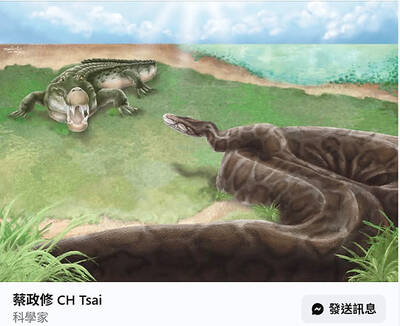
Taiwanese paleontologists have discovered fossil evidence that pythons up to 4m long inhabited Taiwan during the Pleistocene epoch, reporting their findings in the international scientific journal Historical Biology. National Taiwan University (NTU) Institute of Ecology and Evolutionary Biology associate professor Tsai Cheng-hsiu (蔡政修) led the team that discovered the largest snake fossil ever found in Taiwan. The single trunk vertebra was discovered in Tainan at the Chiting Formation, dated to between 400,000 and 800,000 years ago in the Middle Pleistocene, the paper said. The area also produced Taiwan’s first avian fossil, as well as crocodile, mammoth, saber-toothed cat and rhinoceros fossils, it said. Discoveries

Taiwanese paleontologists have discovered fossil evidence that pythons up to 4m long inhabited Taiwan during the Pleistocene epoch, reporting their findings in the international scientific journal Historical Biology. National Taiwan University (NTU) Institute of Ecology and Evolutionary Biology associate professor Tsai Cheng-hsiu (蔡政修) led the team that discovered the largest snake fossil ever found in Taiwan. A single trunk vertebra was discovered in Tainan at the Chiting Formation, dated to between 800,000 to 400,000 years ago in the Middle Pleistocene, the paper said. The area also produced Taiwan’s first avian fossil, as well as crocodile, mammoth, sabre-toothed cat and rhinoceros fossils, it said. Discoveries
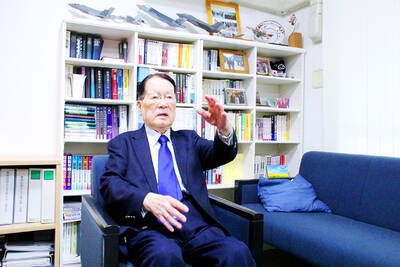
Whether Japan would help defend Taiwan in case of a cross-strait conflict would depend on the US and the extent to which Japan would be allowed to act under the US-Japan Security Treaty, former Japanese minister of defense Satoshi Morimoto said. As China has not given up on the idea of invading Taiwan by force, to what extent Japan could support US military action would hinge on Washington’s intention and its negotiation with Tokyo, Morimoto said in an interview with the Liberty Times (sister paper of the Taipei Times) yesterday. There has to be sufficient mutual recognition of how Japan could provide
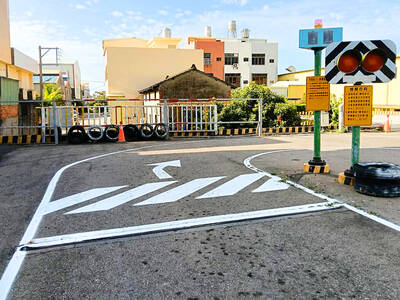
UPDATED TEST: The new rules aim to assess drivers’ awareness of risky behaviors and how they respond under certain circumstances, the Highway Bureau said Driver’s license applicants who fail to yield to pedestrians at intersections or to check blind spots, or omit pointing-and-calling procedures would fail the driving test, the Highway Bureau said yesterday. The change is set to be implemented at the end of the month, and is part of the bureau’s reform of the driving portion of the test, which has been criticized for failing to assess whether drivers can operate vehicles safely. Sedan drivers would be tested regarding yielding to pedestrians and turning their heads to check blind spots, while drivers of large vehicles would be tested on their familiarity with pointing-and-calling


 RSS
RSS