


Responding to the concerns of fishermen, Minister of National Defense Lee Jye (李傑) yesterday assured them that the navy will play a closer supporting role in protecting their safety at sea.
"Althogh the coast guard plays the leading role in protecting fishermen, and the navy plays a supporting role, the navy has never relaxed in its efforts to protect fishermen, although it is very poor at adversing it," he said. "If the Coast Guard Aministration feels any need for our help at any time, we are just a phone call away, and we will waste no time rushing to the area to let the fishermen see our presence."
Lee made the remarks yesterday morning during a meeting with Legislative Speaker Wang Jin-pyng (
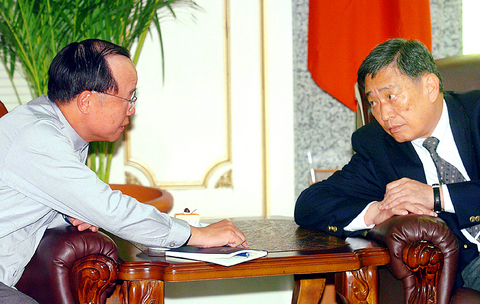
PHOTO: CHIEN JUNG-FENG, TAIPEI TIMES
Fearing that its annual budget and the arms procurement plan would be cut, Lee yesterday promised to send ships to the waters near the Diaoyutais.
He, however, emphasized that it may take them a while to map out a comprehensive plan before making the trip, which may include circumventing the 200-nautical-mile economic zone.
Lee made the pledge in response to a request filed by People First Party (PFP) Legislator Lin Yu-fang (
Lee also said that the MND would allow lawmakers from the Defense committee onboard navy vessels, including Lin.
However, he complained about Lin's threat to cut the ministry's annual budget and to block the arms procurement plan, painting it as "emotional." Lin then criticized the ministry's attitude in the matter, saying that it was because of the MND's contempt for the committee and the legislature that it rejected his request earlier.
The MND said on Wednesday that it had no intention of getting involved into the fishing dispute with Japan, in response to Lin's demand.
Lin claimed that the ministry had agreed to send a 3,500-tonne Knox-class frigate to the disputed waters today, with him and other lawmakers on board.
Lin also attacked a remark made by an MND staff officer, who told reporters on Wednesday that if a war broke out with Japan, Taiwan would lose.
Lee added his own insights, saying that although Japan has more ships and more advanced weaponry, it takes more than lots of state-of-the-art weapons to win a battle.
Commenting on Lin's request to send ships to the disputed waters, Democratic Progressive Party (DPP) caucus whip Lai Ching-te (
Shi promised to expand the coast guard's patrol lines to the 200-nautical-mile mark if fishermen made such a request via the fishermen's associations. The area the navy patrols is from 20 to 60 nautical miles (37km to 111km) off the coast.
He, however, said that the military's embarrassing situation of limited resources required it to request that the legislature grant more funding to improve its equipment.
VANDALISM
Meanwhile, police said yesterday they had stepped up patrols around the Japanese Interchange Association (JIA) office in Taipei after unknown vandals sprayed asphalt emulsion at its entrance.
The JIA is a quasi-official organization authorized by the Japanese government to handle exchanges with Taiwan in the absence of formal diplomatic ties.
Initial investigations show that four unidentified persons arrived at the JIA office early that morning, sprayed asphalt emulsion at the JIA's main gate and ran off.
To ensure the JIA's security, police said they will strengthen patrols in the region from late night through the early morning hours.

Considering that most countries issue more than five denominations of banknotes, the central bank has decided to redesign all five denominations, the bank said as it prepares for the first major overhaul of the banknotes in more than 24 years. Central bank Governor Yang Chin-lung (楊金龍) is expected to report to the Legislative Yuan today on the bank’s operations and the redesign’s progress. The bank in a report sent to the legislature ahead of today’s meeting said it had commissioned a survey on the public’s preferences. Survey results showed that NT$100 and NT$1,000 banknotes are the most commonly used, while NT$200 and NT$2,000

The Centers for Disease Control (CDC) yesterday reported the first case of a new COVID-19 subvariant — BA.3.2 — in a 10-year-old Singaporean girl who had a fever upon arrival in Taiwan and tested positive for the disease. The girl left Taiwan on March 20 and the case did not have a direct impact on the local community, it said. The WHO added the BA.3.2 strain to its list of Variants Under Monitoring in December last year, but this was the first imported case of the COVID-19 variant in Taiwan, CDC Deputy Director-General Lin Ming-cheng (林明誠) said. The girl arrived in Taiwan on

South Korea is planning to revise its controversial electronic arrival card, a step Taiwanese officials said prompted them to hold off on planned retaliatory measures, a South Korean media report said yesterday. A Yonhap News Agency report said that the South Korean Ministry of Foreign Affairs is planning to remove the “previous departure place” and “next destination” fields from its e-arrival card system. The plan, reached after interagency consultations, is under review and aims to simplify entry procedures and align the electronic form with the paper version, a South Korean ministry official said. The fields — which appeared only on the electronic form

The Ministry of Foreign Affairs (MOFA) is suspending retaliation measures against South Korea that were set to take effect tomorrow, after Seoul said it is updating its e-arrival system, MOFA said today. The measures were to be a new round of retaliation after Taiwan on March 1 changed South Korea's designation on government-issued alien resident certificates held by South Korean nationals to "South Korea” from the "Republic of Korea," the country’s official name. The move came after months of protests to Seoul over its listing of Taiwan as "China (Taiwan)" in dropdown menus on its new online immigration entry system. MOFA last week


 RSS
RSS