


The Consumers' Foundation yesterday urged the public to be alert for house fires after it revealed that the majority of blazes take place in the home.
According to the Taiwan Architecture Fire Prevention Association (建築防火學會), of the 64 fire accidents that killed more than three people last year, the majority of them started in the home.
"Residents should regularly check their electric circuits, put fire extinguishers in the home and install fire detectors to ensure safety," said Cheng Jen-hung (程仁宏), secretary-general of the foundation.
According to Cheng, consumers should pay particular attention to extension cords in order to prevent voltage overload.
"Electric appliances, such as heaters, which require a high voltage, should be plugged into a separate extension cord from other electric appliances. Voltage overload may easily cause overheating and result in fires," Cheng said.
Cheng also warned consumers not to place flammable material, such as cotton clothes, on electric heaters, as it could easily catch fire.
"Many people tend to dry their damp clothing on electric heaters and let it sit overnight. As a result, many fires tend to break out in the middle of the night during wintertime," Cheng said.
Chen Hung-yi (陳弘毅), the head of the Fire Construction Department at Wu-Feng Institute of Technology, said that metal-bar windows may be deadly in the event of a fire.
"Although metal-bar windows might prevent burglary, they do not allow people to escape easily even if there is the presence of a small opening, which is often locked," Chen said.
Chen also said that prevention is more important than rescue.
"If a home is equipped with the necessary fire hazard equipment and the family members are aware of fire safety, people living in such a home have a better chance of surviving in the event of fire," Chen said.

LOUD AND PROUD Taiwan might have taken a drubbing against Australia and Japan, but you might not know it from the enthusiasm and numbers of the fans Taiwan might not be expected to win the World Baseball Classic (WBC) but their fans are making their presence felt in Tokyo, with tens of thousands decked out in the team’s blue, blowing horns and singing songs. Taiwanese fans have packed out the Tokyo Dome for all three of their games so far and even threatened to drown out home team supporters when their team played Japan on Friday. They blew trumpets, chanted for their favorite players and had their own cheerleading squad who dance on a stage during the game. The team struggled to match that exuberance on the field, with
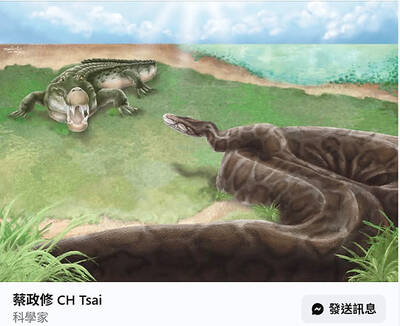
Taiwanese paleontologists have discovered fossil evidence that pythons up to 4m long inhabited Taiwan during the Pleistocene epoch, reporting their findings in the international scientific journal Historical Biology. National Taiwan University (NTU) Institute of Ecology and Evolutionary Biology associate professor Tsai Cheng-hsiu (蔡政修) led the team that discovered the largest snake fossil ever found in Taiwan. The single trunk vertebra was discovered in Tainan at the Chiting Formation, dated to between 400,000 and 800,000 years ago in the Middle Pleistocene, the paper said. The area also produced Taiwan’s first avian fossil, as well as crocodile, mammoth, saber-toothed cat and rhinoceros fossils, it said. Discoveries

Taiwanese paleontologists have discovered fossil evidence that pythons up to 4m long inhabited Taiwan during the Pleistocene epoch, reporting their findings in the international scientific journal Historical Biology. National Taiwan University (NTU) Institute of Ecology and Evolutionary Biology associate professor Tsai Cheng-hsiu (蔡政修) led the team that discovered the largest snake fossil ever found in Taiwan. A single trunk vertebra was discovered in Tainan at the Chiting Formation, dated to between 800,000 to 400,000 years ago in the Middle Pleistocene, the paper said. The area also produced Taiwan’s first avian fossil, as well as crocodile, mammoth, sabre-toothed cat and rhinoceros fossils, it said. Discoveries

Whether Japan would help defend Taiwan in case of a cross-strait conflict would depend on the US and the extent to which Japan would be allowed to act under the US-Japan Security Treaty, former Japanese minister of defense Satoshi Morimoto said. As China has not given up on the idea of invading Taiwan by force, to what extent Japan could support US military action would hinge on Washington’s intention and its negotiation with Tokyo, Morimoto said in an interview with the Liberty Times (sister paper of the Taipei Times) yesterday. There has to be sufficient mutual recognition of how Japan could provide


 RSS
RSS