


DPP Legislator Chien Chao-tung (
"A key factor in Taiwan's bid to obtain World Health Organization (WHO) membership this year would be the international community getting fed-up with China's savage behavior in covering-up the country's real SARS-infection situation and its unreasonableness in excluding Taiwan from the world's collaboration against the epidemic," he said.
Chien said that, after long observing the situation,Taiwan is increasing its chances to attain its goal this time.
He said that resentment of Beijing's dishonesty in concealing the severity of the SARS outbreak led to a number of countries reconsidering Taiwan's position. They feel that the country could not be excluded from international health discussions simply because of politics, as health-care concerns have no political boundaries, he added.
The rampant spreading of the pneumonia-like illness in Taiwan, Chien continued, reminded the world that toleration of China's opposition to the country joining the WHO could mean more countries would experience outbreaks if Taiwan failed to contain the virus on its own.
Chien said he learned from the ministry of foreign affairs that authorities from Japan, the US and EU had pledged their consolidated support for Taiwan's bid after witnessing the country's isolation.
He noted the improved response from Japan in particular. "More Japanese people endorse Taiwan's participation because they know that in these days of international travel, the mere three-hour flight separating the countries actually bring them very close to one another," Chien saidd.
"At this year's assembly, a few unexpected countries are likely to announce their full backing for Taiwan's bid, as Beijing's dishonesty had angered many countries."
But he said that tougher attempts at suppression were expected from China.
"The Chinese delegation headed by the `iron maiden' Wu Yi (
He quoted another message from the Ministry of Foreign Affairs that the Chinese government is demanding from its overseas missions to reinforce the one-China policy to their diplomatic allies.
Trying for the seventh time to become a member of the UN health agency, Chien was optimistic that this goal is within reach.
"Besides striving to get observer status under the title `health entity,' we found another way to be accepted by the health body after two precedents have been set. Cook Island and Niue, a South Pacific island country, had been acknowledged by the WHO despite not being members of the UN.
The legislator however said that Taiwanese individuals can do more than they have done to advance the objective.
"The country's business community does not use its profound influence and achievements on the international stage to call for Taiwan to be accepted, in order to contribute to advanced medicines technology and combating disease," he said.
Support for Taiwan's bid was high at a health seminar held in Europe, which highlighted Taiwan's isolation during the SARS outbreak, Chien said.
Many medical associations expressed regrets about the sacrifices Taiwanese health workers have made during the SARS epidemic.
Department of Health (DOH)officials led by Lee Lung-teng (李龍騰), deputy director-general of the DOH, arrived in Geneva yesterday to further lobby WHO member countries.

LOUD AND PROUD Taiwan might have taken a drubbing against Australia and Japan, but you might not know it from the enthusiasm and numbers of the fans Taiwan might not be expected to win the World Baseball Classic (WBC) but their fans are making their presence felt in Tokyo, with tens of thousands decked out in the team’s blue, blowing horns and singing songs. Taiwanese fans have packed out the Tokyo Dome for all three of their games so far and even threatened to drown out home team supporters when their team played Japan on Friday. They blew trumpets, chanted for their favorite players and had their own cheerleading squad who dance on a stage during the game. The team struggled to match that exuberance on the field, with
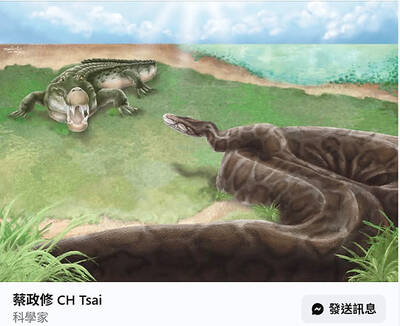
Taiwanese paleontologists have discovered fossil evidence that pythons up to 4m long inhabited Taiwan during the Pleistocene epoch, reporting their findings in the international scientific journal Historical Biology. National Taiwan University (NTU) Institute of Ecology and Evolutionary Biology associate professor Tsai Cheng-hsiu (蔡政修) led the team that discovered the largest snake fossil ever found in Taiwan. The single trunk vertebra was discovered in Tainan at the Chiting Formation, dated to between 400,000 and 800,000 years ago in the Middle Pleistocene, the paper said. The area also produced Taiwan’s first avian fossil, as well as crocodile, mammoth, saber-toothed cat and rhinoceros fossils, it said. Discoveries

Taiwanese paleontologists have discovered fossil evidence that pythons up to 4m long inhabited Taiwan during the Pleistocene epoch, reporting their findings in the international scientific journal Historical Biology. National Taiwan University (NTU) Institute of Ecology and Evolutionary Biology associate professor Tsai Cheng-hsiu (蔡政修) led the team that discovered the largest snake fossil ever found in Taiwan. A single trunk vertebra was discovered in Tainan at the Chiting Formation, dated to between 800,000 to 400,000 years ago in the Middle Pleistocene, the paper said. The area also produced Taiwan’s first avian fossil, as well as crocodile, mammoth, sabre-toothed cat and rhinoceros fossils, it said. Discoveries
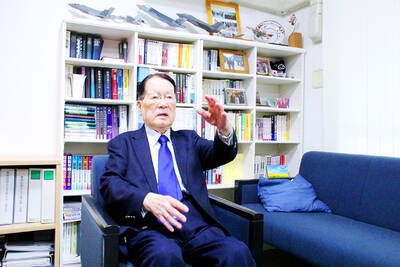
Whether Japan would help defend Taiwan in case of a cross-strait conflict would depend on the US and the extent to which Japan would be allowed to act under the US-Japan Security Treaty, former Japanese minister of defense Satoshi Morimoto said. As China has not given up on the idea of invading Taiwan by force, to what extent Japan could support US military action would hinge on Washington’s intention and its negotiation with Tokyo, Morimoto said in an interview with the Liberty Times (sister paper of the Taipei Times) yesterday. There has to be sufficient mutual recognition of how Japan could provide


 RSS
RSS