


PFP legislative whip Liu Wen-hsiung (
After a court recently denied Soong's request to replace former president Lee Teng-hui (
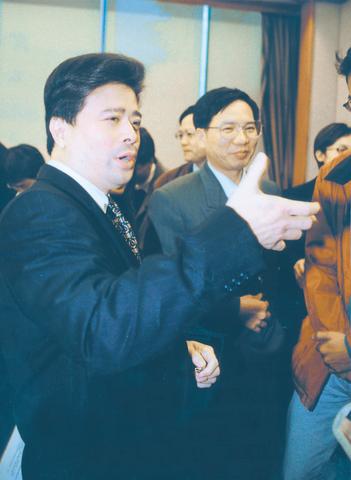
TAIPEI TIMES FILE PHOTO
In 1999, the KMT accused Soong of pocketing its funds during his stint as the party's secretary-general in the early 1990s. The scandal came to light after a large sum of money was found in the bank account of his son.
The scandal is believed to have cost Soong the presidency in 2000, though he insisted Lee put the money in his trust to conduct party operations.
"The court's decision attests to a relationship of trust between Lee and Soong years ago," Liu said last Thursday. "This is why it would not allow anyone else to collect the money."
In an effort to demonstrate his integrity, Soong deposited NT$240 million, including alleged interest payments, with a Taipei court after Lee refused to take the money and blasted Soong's claims as "outright lies."
A week earlier, Liu berated as nonsense a half-page ad by former film director Liu Chia-chang (
"It is apparently a political gambit paid for by people intent on ruining the KMT-PFP alliance," Liu Wen-hsiung said. "The film director played similar tricks during the 2000 presidential campaign."
Born to a soldier father who fled to Taiwan during the Chinese civil war, Liu Wen-hsiung, 48, made Soong's acquaintance when he was a member of the now-defunct Provincial Assembly between 1989 and 1998.
Zealous and direct, he has gone out of his way to help Soong pursue his political ambitions.
To that end, he criticized Ma for being arrogant and ungrateful after the Taipei mayor declined to share the stage with Soong at a PFP campaign rally.
The second largest opposition party had hoped to take advantage of the event to boost the prospect of its Taipei City Council candidates.
"A front-runner in the race, Ma is most likely to win a second term," Liu said two days before the Dec 7 vote. "Let's not give him too many ballots lest he should take PFP support for granted and grow conceited."
Colleagues said worries that Ma may threaten Soong's 2004 presidential bid prompted the PFP lawmaker to level criticism against the KMT star.
The tactic backfired, however, as Ma supporters flooded PFP headquarters with protest calls. Soong later went down on bended knee at a rally that same evening to plead for pan-blue unity.
The next day, a solemn-looking Liu told reporters he regretted making the remarks about Ma and echoed the need to stay united.
Eager to help Soong in a second attempt for the presidency, Liu will inevitably have more clashes with KMT officials who endeavor to help their boss gain the same political trophy.
Neither Soong nor Lien is willing to play second fiddle, though the two opposition leaders have recently agreed to join forces in unseating President Chen Shui-bian (
Like most other PFP stalwarts, Liu is a former KMT member who broke away to follow Soong after the former provincial governor entered the 2000 presidential race as an independent.
"Once Soong throws his hat into the ring, I will help him the best I can," he said in June 1999.
True to his words, Liu has since fervently defended Soong on TV talk shows and is considered a core member of the Soong clique.
Long before Liu's formal ouster from the KMT, colleagues in the former ruling party had called his loyalty into question.
In 1997, he lost the election for Keelung mayor to DPP candidate Lee Chin-yung (
Two years earlier, Liu encouraged former Judicial Yuan president Lin Yang-kang (
As a provincial assemblyman, he endorsed a friend of his, Yang Wen-hsin (
Indeed, Liu has repeatedly allowed his loyalty to friends to influence his professional judgment during his 13-year political career.
Soon after entering the legislature in 1999, he attached a "gambling clause" to the lottery law permitting the issuance of lottery tickets alongside major sports events.
The disputed clause was introduced at the urging of Yang, whose family owns Ever Fortune Group and was eyeing the lucrative market.
Years earlier, Liu helped a business partner obtain more than NT$900 million in bank loans. The partner later defaulted an interest payment.
"Liu likes to play the role of a big brother and help solve problems for people he knows," said PFP lawmaker Chiu Yi (邱毅). "His zeal makes him a busybody sometimes."

Actor Darren Wang (王大陸) was sentenced to six months in prison, commutable to a fine, by the New Taipei District Court today for contravening the Personal Data Protection Act (個人資料保護法) in a case linked to an alleged draft-dodging scheme. Wang allegedly paid NT$3.6 million (US$114,380) to an illegal group to help him evade mandatory military service through falsified medical documents, prosecutors said. He transferred the funds to Chen Chih-ming (陳志明), the alleged mastermind of a draft-evasion ring, although he lost contact with him as he was already in detention on fraud charges, they said. Chen is accused of helping a

UNREASONABLE SURVEILLANCE: A camera targeted on an road by a neighbor captured a man’s habitual unsignaled turn into home, netting him dozens of tickets The Taichung High Administrative Court has canceled all 45 tickets given to a man for failing to use a turn signal while driving, as it considered long-term surveillance of his privacy more problematic than the traffic violations. The man, surnamed Tseng (曾), lives in Changhua County and was reported 45 times within a month for failing to signal while driving when he turned into the alley where his residence is. The reports were filed by his neighbor, who set up security cameras that constantly monitored not only the alley but also the door and yard of Tseng’s house. The surveillance occurred from July

SECURITY: Starlink owner Elon Musk has taken pro-Beijing positions, and allowing pro-China companies to control Taiwan’s critical infrastructure is risky, a legislator said Starlink was reluctant to offer services in Taiwan because of the nation’s extremely high penetration rates in 4G and 5G services, the Ministry of Digital Affairs said yesterday. The ministry made the comments at a meeting of the legislature’s Transportation Committee, which reviewed amendments to Article 36 of the Telecommunications Management Act (電信管理法). Article 36 bans foreigners from holding more than 49 percent of shares in public telecommunications networks, while shares foreigners directly and indirectly hold are also capped at 60 percent of the total, unless specified otherwise by law. The amendments, sponsored by Chinese Nationalist Party (KMT) Legislator Ko

A Japan Self-Defense Forces vessel entered the Taiwan Strait yesterday, Japanese media reported. After passing through the Taiwan Strait, the Ikazuchi was to proceed to the South China Sea to take part in a joint military exercise with the US and the Philippines, the reports said. Japan Self-Defense Force vessels were first reported to have passed through the strait in September, 2024, with two further transits taking place in February and June last year, the Asahi Shimbun reported. Yesterday’s transit also marked the first time since Japanese Prime Minister Sanae Takaichi took office that a Japanese warship has been sent through the Taiwan


 RSS
RSS