


Despite plans to buy the P-3C as the next-generation anti-submarine aircraft, the navy is still bent on extending the life of its aging S-2T planes, which have been in use for 26 years, defense sources said yesterday.
The life-extension program is expected to lengthen the service ceiling of the S-2T to 2008.
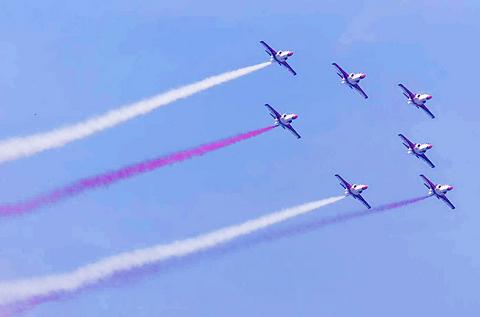
PHOTO: TSENG HUNG-JU, TAIPEI TIMES
The program, which has yet to kick off, is to be focused on renewing the electronic equipment on board the S-2T. It is scheduled to be completed in two years.
The navy has 26 S-2Ts in operation. The S-2Ts were initially in service with the air force, but were transferred to the navy in 1999 as part of the forces of then newly established navy aviation command.
The S-2Ts were upgraded from the S-2E and S-2G planes that the air force bought from the US in 1976.
A total of 27 S-2Ts have become operational since 1990, with one lost in a deadly crash in 1996 in a mountainous area in Kaohsiung.
Between 1990 and 2000, the service records of the S-2Ts were not outstanding but acceptable, with several successful discoveries of foreign submarines off the island.
But problems began to surface two years ago as the navy admitted in public that the combat readiness ratio of the S-2Ts had dropped to less than 30 percent, with only six of the 26 aircraft capable of flying at the time.
Some naval officials blamed the air force for not taking good care of the S-2Ts before giving them to the navy.
The conditions of the S-2Ts are worse than what the navy dares to openly admit. Most of these planes have lost anti-submarine capabilities since relevant equipment on board is no longer usable, sources said.
Lack of spare parts has been identified as one of the major factors causing the bad conditions of the S-2Ts. The navy has had trouble, however, finding enough spare parts for the S-2Ts, since this type of aircraft is out of production in the US.
With the S-2Ts in bad condition, the navy had initially planned to replace them with the P-3C, which the US agreed to sell to Taiwan last year.
But after second thoughts, the navy found the P-3C too expensive at around US$35 million each; it might not be able to afford to buy 12 P-3Cs if the current budgetary situation continues.
Former navy commander-in-chief Admiral Li Chieh (李傑) had been undecided over whether to buy the P-3C aircraft before he took over the position of the chief of the general staff in March.
At the time, a group of naval leaders proposed the life-extension program for the S-2Ts as an alternative to the purchase of the 12 P-3Cs.
Now that the P-3C has been listed as one of the items to buy over the next 10 years, the navy has not forgot its initial plan to extend the life of the S-2Ts, which could be used till the operation of the P-3Cs in Taiwan.
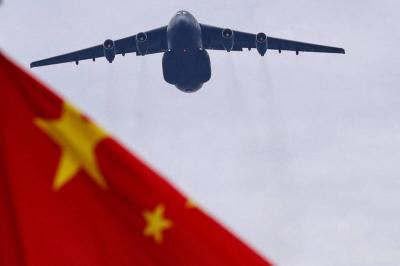
Beijing could eventually see a full amphibious invasion of Taiwan as the only "prudent" way to bring about unification, the US Department of Defense said in a newly released annual report to Congress. The Pentagon's "Annual Report to Congress: Military and Security Developments Involving the People's Republic of China 2025," was in many ways similar to last year’s report but reorganized the analysis of the options China has to take over Taiwan. Generally, according to the report, Chinese leaders view the People's Liberation Army's (PLA) capabilities for a Taiwan campaign as improving, but they remain uncertain about its readiness to successfully seize

Taiwan is getting a day off on Christmas for the first time in 25 years. The change comes after opposition parties passed a law earlier this year to add or restore five public holidays, including Constitution Day, which falls on today, Dec. 25. The day marks the 1947 adoption of the constitution of the Republic of China, as the government in Taipei is formally known. Back then the Chinese Nationalist Party (KMT) governed China from Nanjing. When the KMT, now an opposition party in Taiwan, passed the legislation on holidays, it said that they would help “commemorate the history of national development.” That

Taiwan has overtaken South Korea this year in per capita income for the first time in 23 years, IMF data showed. Per capita income is a nation’s GDP divided by the total population, used to compare average wealth levels across countries. Taiwan also beat Japan this year on per capita income, after surpassing it for the first time last year, US magazine Newsweek reported yesterday. Across Asia, Taiwan ranked fourth for per capita income at US$37,827 this year due to sustained economic growth, the report said. In the top three spots were Singapore, Macau and Hong Kong, it said. South

Snow fell on Yushan (Jade Mountain, 玉山) yesterday morning as a continental cold air mass sent temperatures below freezing on Taiwan’s tallest peak, the Central Weather Administration (CWA) said. Snowflakes were seen on Yushan’s north peak from 6:28am to 6:38am, but they did not fully cover the ground and no accumulation was recorded, the CWA said. As of 7:42am, the lowest temperature recorded across Taiwan was minus-5.5°C at Yushan’s Fengkou observatory and minus-4.7°C at the Yushan observatory, CWA data showed. On Hehuanshan (合歡山) in Nantou County, a low of 1.3°C was recorded at 6:39pm, when ice pellets fell at Songsyue Lodge (松雪樓), a


 RSS
RSS