


As it is the issue that receives the most legislative inquiries, Taiwan's sovereignty was the focus of the two-day hearings to confirm the appointees for Examination Yuan member posts.
Bian Yu-yuan (邊裕淵), 55, who described her birthplace in China's Zhejiang Province as "picturesque," was grilled by TSU lawmakers over where her allegiance lies.
"Which side do you love more, Taiwan or China?" TSU Legislator Liao Pen-yen (
Bian, who retains friendly ties with the opposition KMT, praised Lee as being "Mr. Democracy" though he failed to adopt sufficient measures to tackle problems arising from the country's democratization during his term.
She did not elaborate on that point and promised not to participate in any partisan activities if appointed.
Back in 1998, Bian had stumped for then-KMT nominee Ma Ying-jeou (
The legislature is due to vote next week on all 19 nominees for Examination Yuan positions.
Taking an assertive stand, former legislator Lee Ching-hsiung (
Opposition lawmakers have threatened to vote him down, saying that he would not be a neutral official, as is required by the Constitution, given his pro-independence background.
Free-thinker
But Lee Ching-hsiung, 64, said that all people, including Examination Yuan members, are free to form opinions on the cross-strait dilemma and that his beliefs never influenced his performance as a lawmaker.
He pledged to withdraw from all partisan activities after taking office but that he would have no regret if his pro-independence stance should become a stumbling block to that plan.
Opinions over the nation's political parties and their leaders emerged as another favorite topic during the confirmation hearings.
Tsai Bih-hwang (蔡壁煌), head of a KMT think-tank, was requested by PFP lawmaker Chiu Yi (邱毅) to compare President Chen Shui-bian (陳水扁) with his predecessor, Lee Teng-hui. Tsai, 57, who has a Ph.D. in education from Stanford University, said he appreciated Chen's appointment as president and that he had no choice but to criticize him when he was a KMT spokesman.
Tsai called the former president his patron to whom he owed what he is today.
"I am not an ungrateful person," he said emphatically. "To this day, I have a lot of respect for Lee and I am grateful to him. The fact that Chen awarded me the nomination will not change my feelings for the former president."
Denying that he is power-hungry, Tsai said he felt no excitement at the appointment and that he did not beg Chen for the position.
Some opposition lawmakers have branded him a traitor and planned to punish his betrayal. Independent lawmaker Chiu Chuang-liang (邱創良), on the other hand, caricatured the Examination Yuan as a club for a bunch of has-beens.
He criticized most nominees as unqualified, saying only one showed substantial knowledge about the government's streamlining project.
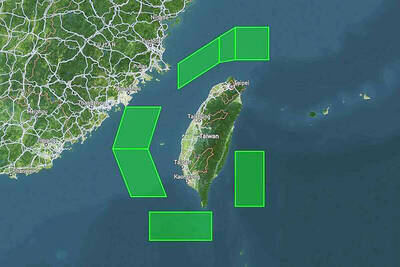
The disruption of 941 flights in and out of Taiwan due to China’s large-scale military exercises was no accident, but rather the result of a “quasi-blockade” used to simulate creating the air and sea routes needed for an amphibious landing, a military expert said. The disruptions occurred on Tuesday and lasted about 10 hours as China conducted live-fire drills in the Taiwan Strait. The Civil Aviation Administration (CAA) said the exercises affected 857 international flights and 84 domestic flights, affecting more than 100,000 travelers. Su Tzu-yun (蘇紫雲), a research fellow at the government-sponsored Institute for National Defense and Security Research, said the air
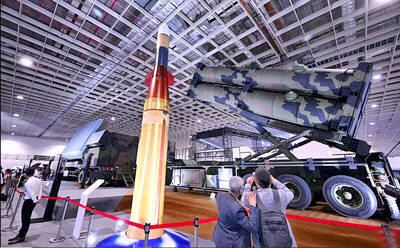
Taiwan is to commence mass production of the Tien Kung (天弓, “Sky Bow”) III, IV and V missiles by the second quarter of this year if the legislature approves the government’s NT$1.25 trillion (US$39.78 billion) special defense budget, an official said yesterday. Commenting on condition of anonymity, a defense official with knowledge of the matter said that the advanced systems are expected to provide crucial capabilities against ballistic and cruise missiles for the proposed “T-Dome,” an advanced, multi-layered air defense network. The Tien Kung III is an air defense missile with a maximum interception altitude of 35km. The Tien Kung IV and V
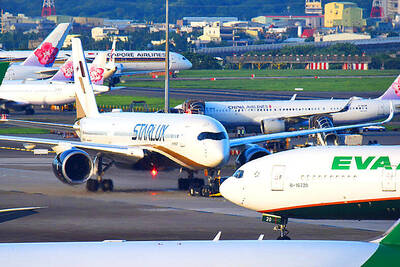
Trips for more than 100,000 international and domestic air travelers could be disrupted as China launches a military exercise around Taiwan today, Taiwan’s Civil Aviation Administration (CAA) said yesterday. The exercise could affect nearly 900 flights scheduled to enter the Taipei Flight Information Region (FIR) during the exercise window, it added. A notice issued by the Chinese Civil Aviation Administration showed there would be seven temporary zones around the Taiwan Strait which would be used for live-fire exercises, lasting from 8am to 6pm today. All aircraft are prohibited from entering during exercise, it says. Taipei FIR has 14 international air routes and
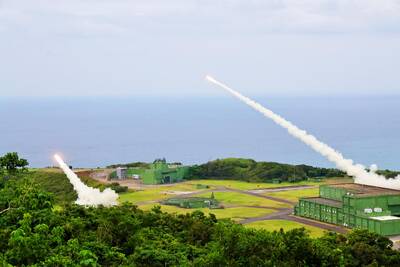
Taiwan lacks effective and cost-efficient armaments to intercept rockets, making the planned “T-Dome” interception system necessary, two experts said on Tuesday. The concerns were raised after China’s military fired two waves of rockets during live-fire drills around Taiwan on Tuesday, part of two-day exercises code-named “Justice Mission 2025.” The first wave involved 17 rockets launched at 9am from Pingtan in China’s Fujian Province, according to Lieutenant General Hsieh Jih-sheng (謝日升) of the Office of the Deputy Chief of the General Staff for Intelligence at the Ministry of National Defense. Those rockets landed 70 nautical miles (129.6km) northeast of Keelung without flying over Taiwan,


 RSS
RSS