


Fierce infighting in the World League for Freedom and Democracy (WLFD), the only Taiwan-based organization accredited as a non-governmental organization (NGO) of the UN, heated up yesterday as two would-be leaders rallied for what they said was their "legitimate" position as president of the league.
During the past week, the league has held two meetings under the same title in Taipei.
The meetings, however, were arranged by two different groups of people who claim to be the legitimate leaders of the league, one headed by the Legislative Yuan's Vice Speaker Yao Eng-chi (
President Chen Shui-bian (陳水扁) delivered a speech at a meeting organized by Chang yesterday, marking the beginning of a four-day conference. Chang said the president's move was indicative of his support for Chang's "legitimate" position as the league's leader.
"Since there's a dispute about the WLFD in Taipei, the one which is recognized and chosen by the president to deliver a speech to is the one which is genuine, real and legal," Chang said before introducing Chen to the platform to deliver his speech, triggering a roomful applause among participants.
Chang also said later that Chen's endorsement of his position could be further evidenced by the president's scheduled tea party this afternoon to welcome the conference's participants.
"The president's endorsement means that we are the legitimate and the real WLFD," Chang said, adding that it's impossible for him to accept Yao's claim to be the new president of the league.
In earlier remarks at the conference, Chang expressed his determination to retain his post as the league's leader.
"Ever since Feb. 22, 1999, when I was unanimously elected to be the president of the current WLFD by all the members present at the WLFD Executive Committee Meeting, I have always remembered the significance of my mission," Chang said.
"Since I was elected to serve a four-year term, I will safeguard the mission and the dignity of the WLFD Charter," Chang said.
To defend his position, Yao held a press conference yesterday afternoon, claiming his position as the president of the NGO was in strict accordance with the league's charter.
"Yao took up the position as president of the league after two-thirds of the members of the WLFD's executive board agreed to the arrangement and after participants in the general conference of the League applauded to support the motion. The process was in accordance with the charter and was indeed legitimate," a press release stated.
Yao claimed Chang and he had agreed to hold the conference separately this year, and Chang would convene all the league's executive board members to settle the dispute after the end of the meetings.
But the strained atmosphere triggered by the infighting among the Taiwanese politicians was in no way diminishing as some participants remained either tight-lipped or reserved in commenting on the dispute.
"I am not sure if there is any dispute. But if there is a dispute, it really should be resolved by you Taiwanese," Ceferino Valdez Peralta, Paraguay's Ambassador to Taiwan, told the Taipei Times, during the meeting.
In his New Year press conference on Monday, Minister of Foreign Affairs Tien Hung-mao (田弘茂), also urged politicians and supporters behind the scenes that were involved in the dispute to resolve the issue as soon as possible.
The league has enjoyed a longstanding government subsidy throughout its 40-year history, and the current fiasco may pose a threat as to where the subsidy should go, further weakening the operations of the organization.
The stated mission of the global organization, comprised of 144 national chapters and affiliated international organizations, is to spotlight and encourage political freedom through the strengthening of democratic principles in all countries.
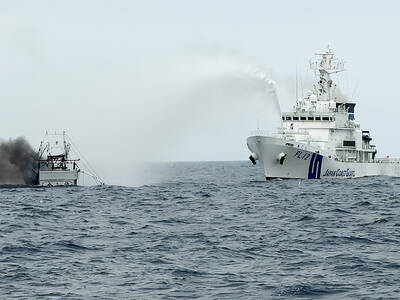
CREDIT-GRABBER: China said its coast guard rescued the crew of a fishing vessel that caught fire, who were actually rescued by a nearby Taiwanese boat and the CGA Maritime search and rescue operations do not have borders, and China should not use a shipwreck to infringe upon Taiwanese sovereignty, the Coast Guard Administration (CGA) said yesterday. The coast guard made the statement in response to the China Coast Guard (CCG) saying it saved a Taiwanese fishing boat. The Chuan Yu No. 6 (全漁6號), a fishing vessel registered in Keelung, on Thursday caught fire and sank in waters northeast of Diaoyutai Islands (釣魚台). The vessel left Keelung’s Badouzih Fishing Harbor (八斗子漁港) at 3:35pm on Sunday last week, with seven people on board — a 62-year-old Taiwanese captain surnamed Chang (張) and six
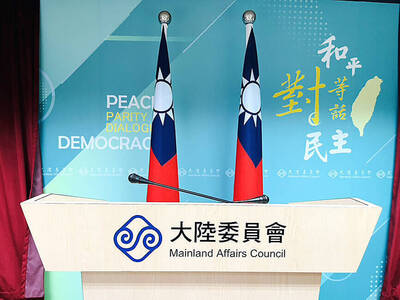
RISKY BUSINESS: The ‘incentives’ include initiatives that get suspended for no reason, creating uncertainty and resulting in considerable losses for Taiwanese, the MAC said China’s “incentives” failed to sway sentiment in Taiwan, as willingness to work in China hit a record low of 1.6 percent, a Ministry of Labor survey showed. The Directorate-General of Budget, Accounting and Statistics (DGBAS) also reported that the number of Taiwanese workers in China has nearly halved from a peak of 430,000 in 2012 to an estimated 231,000 in 2024. That marked a new low in the proportion of Taiwanese going abroad to work. The ministry’s annual survey on “Labor Life and Employment Status” includes questions respondents’ willingness to seek employment overseas. Willingness to work in China has steadily declined from

The Legislative Yuan’s Finance Committee yesterday approved proposed amendments to the Amusement Tax Act (娛樂稅法) that would abolish taxes on films, cultural activities and competitive sporting events, retaining the fee only for dance halls and golf courses. The proposed changes would set the maximum tax rate for dance halls and golf courses at 50 and 20 percent respectively, with local governments authorized to suspend the levies. Article 2 of the act says that “amusement tax shall be levied on tickets sold or fees charged by amusement places, facilities or activities” in six categories: “Cinema; professional singing, story-telling, dancing, circus, magic show, acrobatics
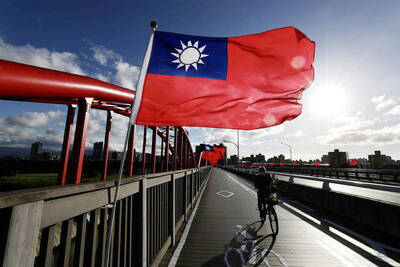
INFLATION UP? The IMF said CPI would increase to 1.5 percent this year, while the DGBAS projected it would rise to 1.68 percent, with GDP per capita of US$44,181 The IMF projected Taiwan’s real GDP would grow 5.2 percent this year, up from its 2.1 percent outlook in January, despite fears of global economic disruptions sparked by the US-Iran conflict. Taiwan’s consumer price index (CPI) is projected to increase to 1.5 percent, while unemployment would be 3.4 percent, roughly in line with estimates for Asia as a whole, the international body wrote in its Global Economic Outlook Report published in the US on Monday. The figures are comparatively better than the IMF outlook for the rest of the world, which pegged real GDP growth at 3.1 percent, down from 3.3 percent


 RSS
RSS