

歡迎閱讀《週末科學版》!我們每週六都要為你介紹可以在家中進行的有趣科學實驗。你可以在《科學日誌》中記錄自己做了哪些活動,這樣就可以將所學的記錄下來,比較這些結果,也許還可以利用它們來設計新的實驗!先看一下《科學日誌》的點子再開始吧。展開實驗之前,記得要獲得大人許可喔!


Although you may not be aware of it, your body goes through several changes in a 24-hour period. The purpose of these changes is to keep your body in harmony with the environment, specifically changes in daylight. These changes are attributed to the circadian rhythm. Some of the bodily functions that are affected by the circadian rhythm are body temperature, reaction times, blood pressure and muscle strength.
In today’s experiment you will attempt to find out how your own circadian rhythm affects your body temperature and reaction times.
You will need: a thermometer, a notebook and access to the Internet.

PHOTO: AFP
(JOHN PHILLIPS, STAFF WRITER)
你可能不知道,你的身體一天二十四小時中會經歷好幾個階段的變化。這些為了讓身體能適應環境變化,特別是日光變化的轉變,即為「生理時鐘」。受生理時鐘調控的生理機能包含體溫、反應時間、血壓及肌力等。
實驗所需:一個溫度計、一本筆記本和網路。
(翻譯:袁星塵)
METHODOLOGY
You are going to take your temperature and test your reaction times four times per day over a three-day period. You should aim to do the tests at the same time each day, so before you start, make sure you’ll be free at those times. Suggested times for the tests are 7.30am, 12am, 5pm and 9pm.
In your notebook, draw a results table. Try not to do anything immediately before the tests that might affect the results. For example, eating a large meal will slow down your reactions, whereas drinking a caffeinated drink will speed them up.
Step 1: At 7.30am, take your temperate using the thermometer. Digital thermometers are more accurate, but not essential. Record the results in your results table.
Step 2: The best way to test your reaction times is to use an online test. Search for “reaction times test” using your favorite search engine and you should be presented with dozens of suitable tests. Try a few of them until you settle on one that you like.
Step 3: Test your reaction times using the online test. Record the result in the results table.
Step 4: Repeat step 1-3 at 7.30am 12am, 5pm and 9pm for three consecutive days.
方法
你將進行一項為期三天的實驗,在這三天中,你每天都要測量你的體溫和反應時間四次。每天都儘可能在同一時間進行測量,所以開始實驗之前,最好先確定你有空的時段。我們建議的時間為上午七點半、中午十二點、下午五點和晚上九點。
在筆記本中畫下記錄結果的表格。盡量不要在測試前從事可能會影響結果的活動,例如吃大餐可能會減緩反應時間,喝含有咖啡因的飲料則會加速反應時間。
步驟一:早上七點半,用溫度計測量體溫。電子溫度計的結果較為精準,但並非非它不可。在你做的表格中記下測量結果。
步驟二:測量反應時間最好的方式是利用線上測驗。用你平時愛用的搜尋引擎上網搜尋「reaction time test」,你應該可以找到一大堆合適的線上測驗。試試其中幾種,直到選定一種你最喜歡的測驗。
步驟三:利用選定的線上測驗測試你的反應時間,並將結果記錄在表格中。
步驟四:連續三天在上午七點半、中午十二點、下午五點和晚上九點重複步驟一至步驟三。
ANALYZE THE RESULTS
結果分析
Put your findings in a graph. When was your body temperature highest? When were your reactions quickest? Perhaps there was no pattern. Why do you think that was? Think of ways to make the test more comprehensive. You could include more people or you could also test for muscle strength and blood pressure.
將你的測試結果製成圖表。你的體溫哪個時候最高?你的反應何時最快?結果可能沒有固定的模式,你認為原因為何?想想看有什麼方式可以讓這個測驗更全面性?你可以請更多人一起進行測試,或者也針對肌力及血壓進行測量。
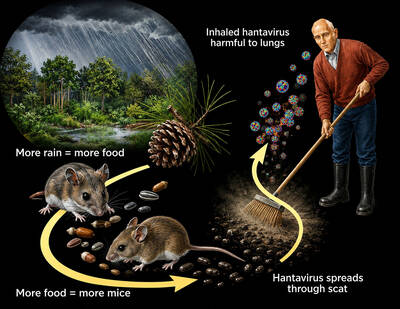
An outbreak aboard a cruise ship of a rare rodent-borne illness called hantavirus has left three passengers dead and sickened others, but global health officials say the risk to the general public remains low because the germ does not easily spread between people. “This is not the next COVID, but it is a serious infectious disease,” said Maria Van Kerkhove, director of epidemic and pandemic preparedness at the World Health Organization (WHO). “Most people will never be exposed to this.” The virus usually spreads when people inhale contaminated residue of rodent droppings. Hantaviruses have been around for centuries and are thought to

Have you ever wondered how people navigate the world when they can’t see a map? For individuals with visual impairments, conventional maps are nearly impossible to use. This is where tactile maps come in — essential tools that allow people to “see” the world through touch. A tactile map is specially designed with raised lines, textures, and symbols to represent geographical features such as roads, rivers, and buildings. Users explore it with their fingertips. However, these maps are not exclusively for people with visual disabilities. They serve as valuable multisensory learning tools that enhance spatial understanding for everyone, making

1. 他病了三天。 ˇ He has been sick for three days. χ He has been sick since three days. 註︰這裡現在完成時態 have / has been 表示從過去某一時日到現在的一段時間存在的行為或狀態,與它連用的時間副詞應為 「for +若干時」,如 for a year, for three hours 等,意思是歷時多少。 2. 他自從星期三以來都很忙。 ˇ He has been busy since Wednesday. χ He has been busy from Wednesday. 註︰「自從……以來」,該用 since。說從某一天(某一時刻)到某一天(某一時刻)才用 from,如 from Monday till Friday。 3. 房間角落裡散放著一些零星物件。 ˇ There were some odds and ends lying in the corner of the room. χ There were some odds and ends lying at the corner of the room. 註︰「在房間角落裡」該用介詞 in。例如: He stood in the corner. There is a lamp in the corner of the room. at the corner 指房子外部的拐角。例如: A little boy

A: In early May, there were concerts by Icyball, Chyi Yu, Korea’s EXO and Japan’s Anisama, but I missed them all. What a shame. B: That’s OK. There are shows coming up by various artists, including Power Station, Accusefive, Japanese singer Mika Nakashima, Chinese-Icelandic jazzer Laufey, and even Singaporean diva Stefanie Sun. A: After a 12-year hiatus, Stefanie is finally returning to Taipei again. B: In late May, there will be more shows by Crowd Lu, WeiBird, Korea’s Donghae, 2AM, EXID, and Thailand’s BUS. A: The Thai boyband is so popular. It looks like “T-pop” is catching up with J-pop


 RSS
RSS