


Alfonso Wong (王家禧), known for his Chinese-language comic books Old Master Q (老夫子), died in California on Sunday of multiple organ failure. He was 93.
OMQ ZMedia Ltd (老夫子哈媒體) founder Wong Chak (王澤), who is Wong’s son, announced his death in the US.
Alfonso Wong used the pen name Wong Chak to publish the Old Master Q comic books.

Photo: Huang Yao-cheng, Taipei Times
“My life was like a comic book, so I tried to let Old Master Q, which is me, do funny things to entertain readers,” Alfonso Wong said.
Wong Chak, a retired architecture professor from Shih Chien University, continued his father’s comic book legacy by taking over his creative work in 1995.
He said that his father was a artist who was filled with vitality and imagination.
“The Old Master Q that he created is an illustration of everyday life and a wild imagination,” Wong Chak said in a statement published by OMQ ZMedia.
To distinguish between Wong and his son, readers often addressed Alfonso Wong as “Wong Chak Senior” or “Wong Chak the cartoonist.” Wong Chak was often called “Wong Chak Junior” or “Wong Chak the architect.”
Born in Tianjin, China, in 1925, Alfonso Wong relocated to Hong Kong in 1956. Prior to publishing Old Master Q, he used different pen names in newspapers and magazines in Hong Kong while working as an illustrator for a church publication.
OMQ ZMedia said the Old Master Q comic book series was loved by readers of different generations because each character is distinctive.
“Alfonso Wong drew inspiration from his years as a student studying Western art at Fu Jen Catholic University when it was still in Beijing. He was interested in swimming, diving, figure skating and hunting. Because of this he was able to portray these characteristics in his characters when they were playing sports or fishing or sculpting,” the company said.
From the 1960s to the 1980s, Alfonso Wong’s comics took a critical, yet humorous view on the changes facing Hong Kong, including the transfer of sovereignty to China in 1997.
The company said that Alfonso Wong was ambidextrous because of his training as a drummer. When he moved to California, he developed an interest in fishing and pottery, the company said.
Despite the popularity of Old Master Q spanning five decades, critics in China have accused Alfonso Wong of plagiarizing the work of Chinese comic book artist Peng Ti (朋弟), who they said first created characters like Old Master Q and Big Sweet Potato (大番薯) in his comic books.
According to Chinese critics, Ti’s comic books were popular between 1937 and 1943.
He published his first comic titled Old White Potato in 1938.
However, the artist was forced to abandon drawing in the 1950s after being labeled a right-winger by the Chinese Communist Party.
Critics say that Alfonso Wong must have read Ti’s comic books and claimed the characters as his own.
While Alfonso Wong was extremely popular, critics said that Ti was poor and sick until he died alone.
OMQ ZMedia have denied all allegations questioning the originality of Alfonso Wong’s work.
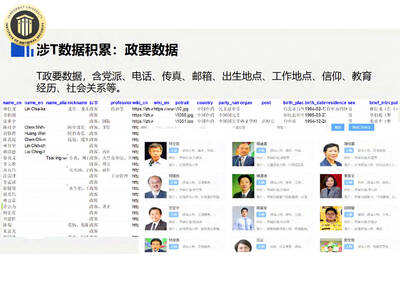
NETWORK-MAPPING PROJECT: The database contains 170 detailed files of Taiwanese politicians and about 23 million records of household registration data in Taiwan China has developed a network-mapping project targeting political figures and parties in Taiwan to monitor public opinion during elections and to craft tailored influence campaigns aimed at dividing Taiwanese society, according to documents leaked by Chinese technology firm GoLaxy (中科天璣). The documents, collected by Taipei-based Doublethink Lab, showed a database was specifically created to gather detailed information on Taiwanese political figures, including their political affiliations, job histories, birthplaces, residences, education, religion and a brief biography about them. Several notable Taiwanese politicians are in the database, including President William Lai (賴清德), former president Tsai Ing-wen (蔡英文), Minister of Foreign Affairs Lin Chia-lung (林佳龍),

KEY INDUSTRY: The vice premier discussed a plan to create a non-red drone supply chain by next year, which has been allocated a budget of more than NT$7.2 billion The government has budgeted NT$44.2 billion (US$1.38 billion) to cultivate Taiwan’s uncrewed aerial vehicle (UAV) industry over the next five years, which would make the nation a major player in the industry’s democratic supply chain in the Asia-Pacific region, Premier Cho Jung-tai (卓榮泰) said yesterday. Cho made the remarks during a visit to the facilities of Cub Elecparts Inc (為升電裝). Democratic Progressive Party (DPP) Legislator Chen Su-yueh (陳素月) and Chinese Nationalist Party (KMT) Legislator Hsieh Yi-fong (謝依鳳) also participated in the trip. Cub Elecparts has transitioned from the automotive industry to the defense industry, which is the top priority among the nation’s
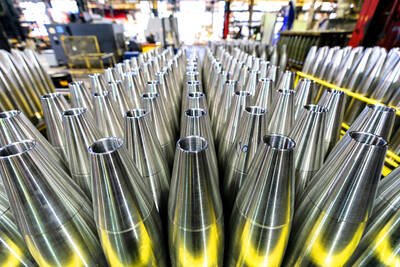
UPGRADED MISSILE: The Chungshan Institute of Science and Technology is reportedly to conduct a live-fire test of the Hsiung Feng III anti-ship missile on Thursday next week The US Army is planning to build new facilities to boost explosives production and strengthen its supply chain, a move aimed at addressing munitions shortages and supporting obligations to partners including Taiwan, Ukraine and Israel, Defense News reported. The army has issued a sources sought notice for a proposed Center of Excellence at the Blue Grass Army Depot in Kentucky, the report said. The facility would serve as a hub within the US industrial base for the production of key military explosives, including research department explosives (RDX) and high melting explosives (HMX), while also supporting research and development of next-generation materials. The proposed
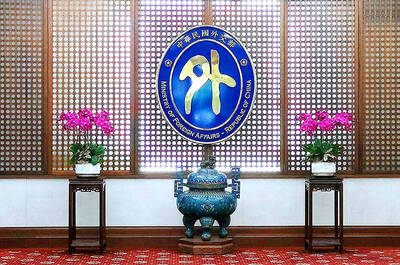
SOUTH KOREA DISPUTE: If Seoul continues to ignore its request, Taiwan would change South Korea’s designation on its arrival cards, the foreign ministry said If South Korea does not reply appropriately to a request to correct Taiwan’s name on its e-Arrival card system before March 31, the government would take corresponding measures to change how South Korea is labeled on the online Taiwan Arrival Card system, the Ministry of Foreign Affairs said yesterday. South Korea’s e-Arrival card system lists Taiwan as “China (Taiwan)” in the “point of departure” and “next destination” fields. Taipei has asked Seoul to change the wording. Since March 1, South Koreans who hold government-issued Alien Resident Certificates (ARC) have been identified as from “South Korea” rather than the “Republic of Korea,” the


 RSS
RSS