


After hosting a haunted-house party for Halloween on Thursday, a dozen students from Tainan’s Chia Nan University of Pharmacy and Science experienced acute discomfort that some attributed to possession by malicious spirits, and the students were subsequently rushed to a nearby temple to undergo a mass exorcism.
In response to speculation on social media, Chia Nan University secretary-general Wan Meng-wei (萬孟瑋) on Saturday said that the afflicted students were members of the Chia Nan University Student Association who were working as staff at the haunted-house party, and no other participant at the event reported any symptoms.
According to the student association, its members prepared for one month for Thursday’s event and many staff members dressed up as ghosts and vampires.
Acknowledging the air at the venue “was a bit stifling,” the association said that screens put up to give the venue a gloomy effect might have obstructed the free flow of air in the building.
After the event concluded, 12 association members reported feeling nausea, vertigo and weakness as well as tightness in their chests, the association said.
As it was late, the association said it could not find a clinic for the students, adding that some members voiced concerns that their discomfort might have been caused by malicious spirits.
One parent present at the event happened to be a regular worshiper at Chinwang Temple (清王宮) — about 300m from the university — and proposed to move those fearing spirit possession to the sanctuary of the temple.
The students were delivered to the Chingwang Temple in cars and scooters, to the bemusement of one staff member, who said the visitors treated the place of worship as “as if it were an emergency room.”
After helping students who were unable to walk into the sanctuary and consulting the temple’s deity San Fu Qian Sui (三府千歲), four temple staff members performed a traditional Taoist shou ching (收驚) ritual — which uses a blessed palanquin to drive out any lurking evil spirits — which the temple said was immediately effective, adding that five of the students later took offerings of fruit to thank the temple god.
The student association on Saturday said university staff and security guards went with the students to the temple, and that although one student was in fact terrified and in tears, online rumors alleging that “possessed” students were “screaming in a hysterical state” were “wild exaggerations.”
Almost all of the stricken students made a full recovery, except for a few who reported mild fevers and later sought medical treatment, the association said.
University officials said that while the school at the time decided to respect the decision of the students to seek help from the temple, it would review its procedures and put policies intplace to deal with future medical emergencies.
Chimei Medical Center Department of Psychiatry doctor Kao Pei-hsin (高霈馨) said “cramming excessive numbers of people into a closed space with poor ventilation might induce panic attacks.”
Ko recommended that anyone fearing they might be suffering a panic attack move to an open space, take deep breaths, drink water, rest, and seek medical attention if the symptoms do not improve.
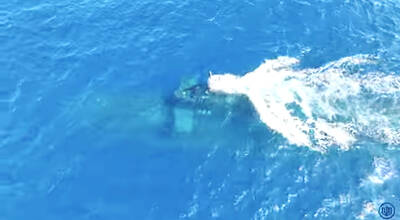
CSBC Corp, Taiwan (台灣國際造船) yesterday released the first video documenting the submerged sea trials of Taiwan’s indigenous defense submarine prototype, the Hai Kun (海鯤), or Narwhal, showing underwater navigation and the launch of countermeasures. The footage shows the vessel’s first dive, steering and control system tests, and the raising and lowering of the periscope and antenna masts. It offered a rare look at the progress in the submarine’s sea acceptance tests. The Hai Kun carried out its first shallow-water diving trial late last month and has since completed four submerged tests, CSBC said. The newly released video compiles images recorded from Jan. 29 to
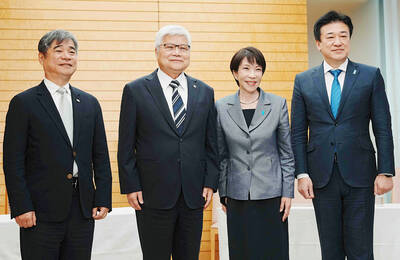
Taiwan Semiconductor Manufacturing Co (TSMC, 台積電) plans to make advanced 3-nanometer chips in Japan, stepping up its semiconductor manufacturing roadmap in the country in a triumph for Japanese Prime Minister Sanae Takaichi’s technology ambitions. TSMC is to adopt cutting-edge technology for its second wafer fab in Kumamoto, company chairman C.C. Wei (魏哲家) said yesterday. That is an upgrade from an original blueprint to produce 7-nanometer chips by late next year, people familiar with the matter said. TSMC began mass production at its first plant in Japan’s Kumamoto in late 2024. Its second fab, which is still under construction, was originally focused on
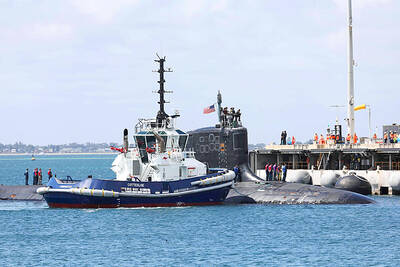
DETERRENCE EFFORTS: Washington and partners hope demonstrations of force would convince Beijing that military action against Taiwan would carry high costs The US is considering using HMAS Stirling in Western Australia as a forward base to strengthen its naval posture in a potential conflict with China, particularly over Taiwan, the Wall Street Journal reported on Saturday. As part of its Indo-Pacific strategy, Washington plans to deploy up to four nuclear-powered submarines at Stirling starting in 2027, providing a base near potential hot spots such as Taiwan and the South China Sea. The move also aims to enhance military integration with Pacific allies under the Australia-UK-US trilateral security partnership, the report said. Currently, US submarines operate from Guam, but the island could

The partisan standoff over President William Lai’s (賴清德) proposed defense budget has raised questions about the nation’s ability to adequately fund its own defense, the US Congressional Research Service (CRS) said in a report released on Tuesday. The report, titled Taiwan: Defense and Military Issues, said the government has increased its defense budget at an average annual rate of 5 percent from 2019 to 2023, with about 2.5 percent of its GDP spent on defense in 2024. Lai in November last year proposed a special budget of about US$40 billion over eight years, and said he intends to increase defense spending to


 RSS
RSS