

Chinese Nationalist Party (KMT) Chairman Eric Chu (朱立倫) yesterday said that the possibility of him making a trip to the US in KMT presidential nominee Hung Hsiu-chu’s (洪秀柱) stead would need to be further discussed by the party’s campaign headquarters.
Chu had said Hung might visit the US in August or September, but Hung said it is up to her to decide whether she would make any visit, which local media reports have called “a slap in the face” for Chu.
“[Whether I will be going to the US in Hung’s stead] would have to be first fully discussed within the election campaign headquarters,” Chu said.

Photo: Sam Yeh, AFP
When asked whether that means there is a possibility that he could make the trip, he stressed that the discussion has not yet taken place.
Separately yesterday, the authenticity of Hung’s master’s degree was questioned by radio host Clara Chou (周玉蔻), who said a program Hung attended at what was then called Northeast Missouri State University was merely a summer credit program.
Hung said that the program was indeed a “summer or winter credit program,” but added: “The diploma is real.”
“Although it was not recognized by the Ministry of Education, the study and the diploma are both real,” Hung said.
“It signifies the spirit of life-long learning, which is not done to gain promotion, but to extend my own learning,” she said, adding that a person’s academic qualifications do not indicate their capabilities, while political candidates should emphasize their policy platforms.
The ministry said later yesterday that the university, which is now called Truman State University, is on its listing of US colleges.
Department of Higher Education Director-General Huang Wen-ling (黃雯玲) said only those who plan to apply for higher degree programs or for public office and teaching positions would need the ministry to have their foreign degrees certified, which is a rigorous process.
A master’s degree, for example, would entail a minimum of eight months of full-time study to complete, Huang said.
However, if the degree was conferred by the university, it would be authentic even if it was ineligible for recognition in Taiwan because of the eight-month criterion, Huang added.
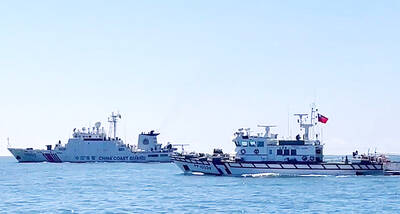
China deployed a record number of coast guard, scientific research and other ships near Taiwan’s waters last month, the Coast Guard Administration (CGA) said, as Beijing dials up pressure on Taipei. The coast guard warned of an increasingly severe situation, as analysts say the increased activity is part of China’s bid to map the region for submarine warfare. The number of Chinese ships detected around Taiwan proper soared to a record 244 last month — an average of nearly eight every day, official data showed. That compares with 55 ships detected in June and 30 in May, and 58 in July last year. In

The Hualien District Prosecutors’ Office yesterday launched an investigation following allegations by a former foreign correspondent in Taiwan of widespread vote-buying in Hualien County. In an interview with Formosa TV (FTV, 民視) aired on Saturday, former Financial Times Taiwan correspondent Kathrin Hille spoke about Taiwan’s democracy and said that she now lives in rural Hualien, where “all the votes are bought.” Neighbors would talk about who had come by and leave cash on the table showing “how much each vote was worth that year,” Hille said. The practice needs to be addressed, considering Taiwan has been a democracy for many
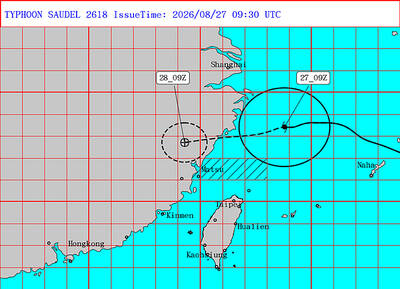
Taiwan is bracing for heavy rain in the south and rough seas around outlying Lienchiang County (Matsu), as Typhoon Saudel passes north toward eastern China, with forecasters yesterday warning of localized flooding over the next two days. Saudel is expected to pass closest to Taiwan today, when its outer rain bands are forecast to brush past Matsu, before making landfall at about noon in China’s Zhejiang Province and weakening significantly, the Central Weather Administration said. The storm’s outer bands, combined with strengthening southwesterly winds, are expected to bring heavy rain to southern and southeastern Taiwan today, it said. As the storm approaches Matsu,

LIMITED: The bill’s NT$40bn annual spending cap would prevent Taiwan from effectively building up its drone combat capabilities, National Defense Minister Wellington Koo said The legislature yesterday rejected the Executive Yuan’s NT$210 billion (US$6.62 billion) special budget proposal to buy military drones and instead passed its own plan, which earmarks NT$40 billion per year over six consecutive years. The Executive Yuan said its plan to buy about 210,000 drones by 2031 could not wait, as the wars in Ukraine and Iran showed the importance of uncrewed systems in modern warfare amid a rising threat from China. However, the Chinese Nationalist Party (KMT) and Taiwan People’s Party (TPP) used their opposition majority to pass a bill providing NT$240 billion through annual budgets over six years, with annual


 RSS
RSS