


Opposition lawmakers were demanding answers from the judiciary and aviation authorities yesterday after a private jet belonging to the owners of Ting Hsin International Group (頂新集團), which is under investigation for the ongoing cooking oil scandal, flew from Taiwan to China.
Civil Aeronautics Administration (CAA) Director-General Shen Chi (沈啟) confirmed yesterday that a Gulfstream G450 private jet belonging to the Wei family departed from Taipei International Airport (Songshan airport) at about 9pm on Wednesday headed for China.
Answering questions at the legislature in Taipei, Shen also confirmed that Wei Ying-chou (魏應州), a senior Ting Hsin executive and eldest of the four Wei brothers, was on board the private aircraft.
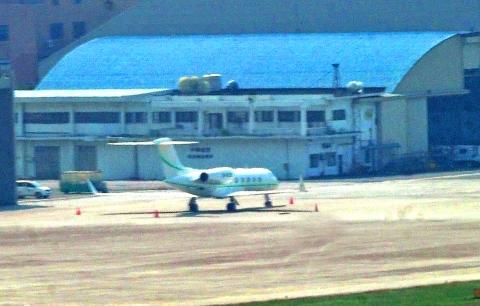
Photo: Fang Pin-chao, Taipei Times
According to a Ting Hsin statement, Wei Ying-heng (魏應行), the youngest Wei brother, had left Taiwan for Beijing on board another of the family’s Gulfstream jets a few days ago.
The news sparked a furor because it was seen as an attempt by the Wei brothers to evade prosecution and remove their assets from Taiwan — the two Gulfstream G450 jets have a combined market value of US$50 million.
The four Wei brothers are the principal owners and senior executives of Ting Hsin and Wei Chuan Foods Corp (味全食品工業), which have been found to have sold adulterated oil and food products for many years.
Democratic Progressive Party Legislator Tsai Huang-liang (蔡煌瑯) was furious.
“The Wei family’s private jets flew to China in front of everyone’s eyes. It is a clear attempt to hide their assets before the judiciary seizes them,” Tsai said.
Tsai said that it had been known a few days earlier that the two private jets were at the airport, but the second aircraft left Taiwan just before prosecutors applied to seize the Wei family’s assets on Wednesday evening.
“The Ministry of Justice allowed them to escape. It’s gross negligence by the government,” Tsai said.
Tsai added that he and other legislators had requested that prosecutors apply to seize the two jets on Monday, yet nothing had been done.
In response, CAA officials explained that the two jets were registered in China and as long as they complied with regulations, the aircraft could land and take off at the airport.
The CAA had contacted the Taiwan High Prosecutors’ Office on Wednesday after receiving the jet’s flight plan and were told the jet was not on the list of assets for seizure and that no one onboard was under investigation, officials said.
Besides the prosecutors’ office, CAA officials said that prior to the jet’s departure they also informed the Ministry of Justice and the National Immigration Agency, and after receiving consent and clearance the jet was allowed to fly to China.
The Ministry of Justice issued a statement yesterday saying that if prosecutors apply to seize the jets, the ministry can request the assistance of the Chinese government to detain the aircraft.
In a surprise move last night, one of the jets returned to Taipei International Airport from China at 8:30pm, Shen said.
Ting Hsin also confirmed the news, but it declined to reveal who was on board.

The nation’s fastest supercomputer, Nano 4 (晶創26), is scheduled to be launched in the third quarter, and would be used to train large language models in finance and national defense sectors, the National Center for High-Performance Computing (NCHC) said. The supercomputer, which would operate at about 86.05 petaflops, is being tested at a new cloud computing center in the Southern Taiwan Science Park in Tainan. The exterior of the server cabinet features chip circuitry patterns overlaid with a map of Taiwan, highlighting the nation’s central position in the semiconductor industry. The center also houses Taiwania 2, Taiwania 3, Forerunner 1 and
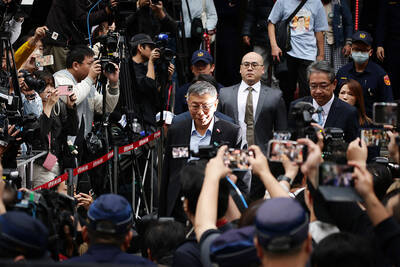
FIRST TRIAL: Ko’s lawyers sought reduced bail and other concessions, as did other defendants, but the bail judge denied their requests, citing the severity of the sentences Former Taipei mayor Ko Wen-je (柯文哲) was yesterday sentenced to 17 years in prison and had his civil rights suspended for six years over corruption, embezzlement and other charges. Taipei prosecutors in December last year asked the Taipei District Court for a combined 28-year, six-month sentence for the four cases against Ko, who founded the Taiwan People’s Party (TPP). The cases were linked to the Core Pacific City (京華城購物中心) redevelopment project and the mismanagement of political donations. Other defendants convicted on separate charges included Chinese Nationalist Party (KMT) Taipei City Councilor Angela Ying (應曉薇), who was handed a 15-year, six-month sentence; Core Pacific
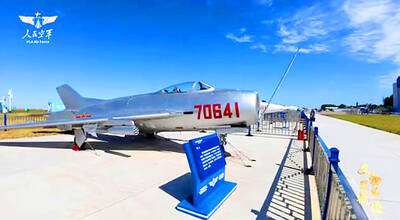
J-6 REMODEL: The converted drones are part of Beijing’s expanding mix of airpower weapons, including bombers with stand-off missiles and UAV swarms, the report said China has stationed obsolete supersonic fighters converted to attack drones at six air bases close to the Taiwan Strait, a report published this month by the Arlington, Virginia-based Mitchell Institute for Aerospace Studies said. Satellite imagery of the airfields from the institute’s “China Airpower Tracker” shows what appear to be lines of stubby, swept-winged aircraft matching the shape of J-6 fighters that first flew with the Chinese People’s Liberation Army (PLA) Air Force in the 1960s. Since their conversion to drones, the aircraft have been identified at five bases in China’s Fujian Province and one in Guangdong Province, the report said. J.

China used fake LinkedIn profiles to harvest sensitive data from NATO and EU institutions by soliciting information from staff, a European security source said on Friday. The operation, allegedly orchestrated by the Chinese Ministry of State Security, targeted dozens of employees at the military alliance or EU organizations through fictitious accounts, the source said, confirming reports in French and Belgian media. Posing as recruiters on the online professional networking platform, Chinese spies would initially request paid reports before later soliciting non-public or even classified information. One particularly active fake profile used the name “Kevin Zhang,” claiming to be the head


 RSS
RSS