


An army AH-64E Apache helicopter crashed into a residential area in Taoyuan County at about 10am yesterday during a routine training flight, slightly injuring the copilot. No one on the ground was hurt in the incident.
The copilot suffered slight facial injuries and was taken to hospital along with the pilot for examination. Initial reports said both men had been injured.
The helicopter had to make a forced landing on top of a three-story building because of an emergency situation, the army said, adding that the aircraft was mostly intact despite the rough landing.
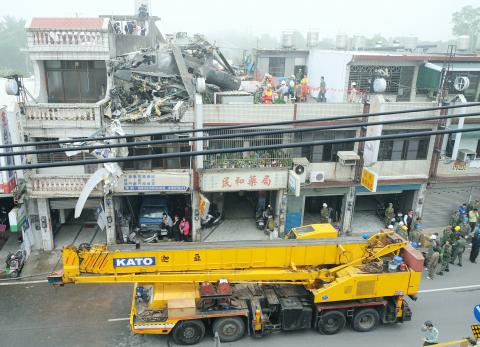
Photo: Sam Yeh, AFP
Television reports showed uniformed men inspecting the wreckage on top of the building, which was partly damaged by the impact along with two adjoining buildings.
The accident occurred during a flight supervised by Major Chen Lung-chien (陳龍謙), an instructor who received Apache flight training in the US, the army said.
Lieutenant Colonel Liu Ming-hui (劉銘輝), the 35-year-old copilot, was in control of the aircraft at the time of the crash, the Army Aviation Special Forces Command said.
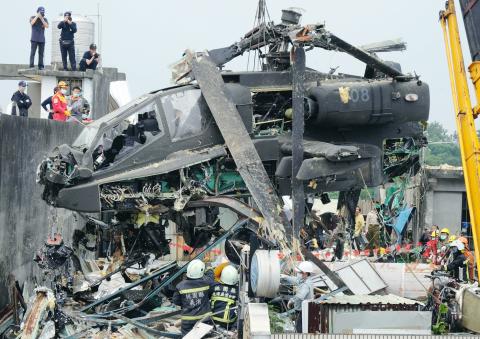
Photo: Sam Yeh, AFP
The army said it has formed a joint investigation team with technical representatives from the US to look into possible causes of the accident.
The chopper “was in clouds and mist and my cockpit window fogged, I could not see the location of the aircraft. It all happened very fast. I suddenly saw a row of barriers,” Chen told a press conference.
He and Liu tried to retain control of the helicopter to reduce the chance of injuries, Chen said, before returning to a hospital for a follow-up examination.
Chen has 1,247 hours of flying time, including 350 hours in an AH-64E, while Liu has 1,034 hours total flying time and is learning how to fly the Apache, military sources said.
The army has apologized to the building owners and said it will pay compensation for the damages.
Army deputy commander Lieutenant General Wang Hsing-wei (王興尉) said all Apache helicopters were grounded for inspection after the accident.
This is the second time that the helicopters have been grounded since the military began to take delivery of the aircraft in November last year. The transmission boxes of the first 12 helicopters to be delivered were removed and sent back to the US due to a mechanical problem reported in December last year.
The military has received 18 of the helicopters so far. They are part of an order of 30 bought for about US$2.5 billion under a deal announced in 2008 by then-US president George W. Bush.

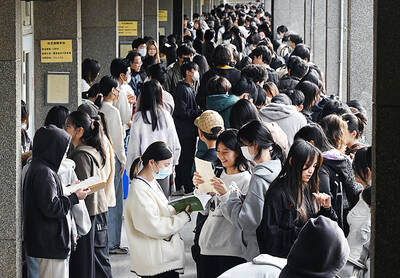
A global survey showed that 60 percent of Taiwanese had attained higher education, second only to Canada, the Ministry of the Interior said. Taiwan easily surpassed the global average of 43 percent and ranked ahead of major economies, including Japan, South Korea and the US, data from the Organisation for Economic Co-operation and Development (OECD) for 2024 showed. Taiwan has a high literacy rate, data released by the ministry showed. As of the end of last year, Taiwan had 20.617 million people aged 15 or older, accounting for 88.5 percent of the total population, with a literacy rate of 99.4 percent, the data

NEW LOW: The council in 2024 based predictions on a pessimistic estimate for the nation’s total fertility rate of 0.84, but last year that rate was 0.69, 17 percent lower An expected National Development Council (NDC) report expects the nation’s population to drop below 12 million by 2065, with the old-age dependency ratio to top 100 percent sooner than 2070, sources said yesterday. The council is slated to release its latest population projections in August, using an ultra-low fertility model, the sources said. The previous report projected that Taiwan’s population would fall to 14.37 million by 2070, but based on a new estimate of the total fertility rate (TFR) — the average number of children born to a woman over her lifetime — the population is expected to reach 12 million by
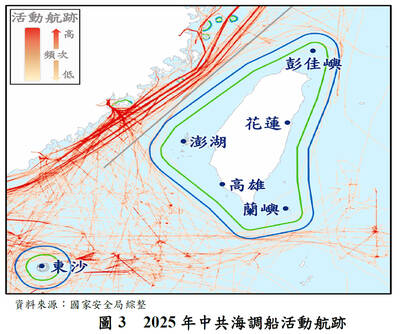
INTENSIFYING THREATS: Beijing’s tactics include massive attacks on the government service network, aircraft and naval vessel incursions and damaging undersea cables China is prepared to interfere in November’s nine-in-one local elections by launching massive attacks on the Taiwanese government’s service network (GSN), a report published by the National Security Bureau showed. The report was submitted to the Legislative Yuan ahead of the bureau’s scheduled briefing at the Foreign Affairs and National Defense Committee tomorrow. The national security team has identified about 13,000 suspicious Internet accounts and 860,000 disputed messages, the bureau said of China’s cognitive warfare against Taiwan. The disputed messages focus on major foreign affairs, national defense and economic issues, which were produced using generative artificial intelligence (AI) and distributed through Chinese

COUNTERING HOSTILITY: The draft bill would require the US to increase diplomatic pressure on China and would impose sanctions on those who sabotage undersea cable networks US lawmakers on Thursday introduced a bipartisan bill to bolster the resilience of Taiwan’s submarine cables to counter China’s hostile activities. The proposal, titled the critical undersea infrastructure resilience initiative act, was cosponsored by Republican representatives Mike Lawler and Greg Stanton, and Democratic Representative Dave Min. US Senators John Curtis and Jacky Rosen also introduced a companion bill in the US Senate, which has passed markup at the chamber’s Committee on Foreign Relations. The House’s version of the bill would prioritize the deployment of sensors to detect disruptions or potential sabotage in real-time and enhance early warning capabilities through global intelligence sharing frameworks,


 RSS
RSS