


President Ma Ying-jeou (馬英九) issued a statement yesterday to mark the 23rd anniversary of China’s 1989 Tiananmen Square Massacre in which he expressed hope that China would improve its human rights record and initiate democratic development.
For more than two decades, China’s economy has grown rapidly and people’s lives have greatly improved as the country has become increasingly competitive, Ma said.
However, the emotional scars left by the massacre that took place in Beijing on June 4, 1989, have yet to heal and the incident has given the international community an impression of China’s human rights development that has stayed virtually unchanged since then, he said.
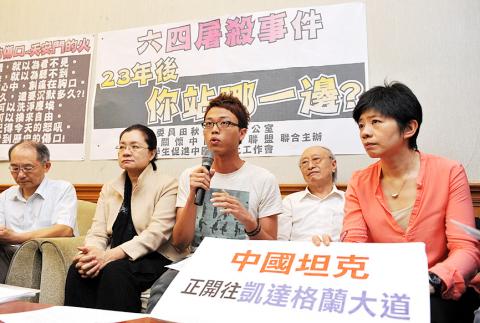
Photo: Chien Jung-fong, Taipei Times
“Most ethnic Chinese societies believe that China today is more mature and in a better position to transform into a more diverse and open democratic society. Dealing with the trauma of the June 4 Incident could be the first step toward political reform,” he said.
Ma said Taiwanese and Chinese are all of Chinese origin and share the same cultural heritage, including the concepts of freedom, democracy and human rights.
“We once again reiterate that we cherish the peace created by the two sides over the past four years and hope that the positive interaction will continue,” Ma added.
However, Taiwan and China still differ in human rights development, and these differences will need to be overcome before the two sides can enter a deeper phase of interaction, Ma said.
Taiwan’s experience in becoming a democratic society has proven that democracy can take root and grow in a Chinese culture, he said, adding that he has great hopes for improvements in human rights and democracy in China and that the two sides of the Taiwan Strait can begin dialogue in the fields of democratic rule and human rights protection, with the shared culture between Taiwan and China as a foundation.
Ma also said he would continue to express concern over democratic development in China, which he described as the best way to help reduce the psychological distance between the people of the two sides of the Strait.
The Mainland Affairs Council had issued a statement on Sunday, calling on Beijing to adopt the idea of “people first” as the core principle of its administration, and to promote political reforms based on self-reflection on the 1989 “incident” and its reform experiences over the past years.
Democratic Progressive Party (DPP) Legislator Tuan Yi-kang (段宜康) yesterday called both Ma’s and the council’s statements ineffectual and superficial.
Pointing to the US Department of State’s statement on Sunday urging China “to release all those still serving sentences for their participation in the demonstrations; to provide a full public accounting of those killed, detained or missing; and to end the continued harassment of demonstration participants and their families,” Tuan asked why the council did not dare make any concrete demands of China.
In comparison with the US Department of State’s statement, Ma’s and the council’s statements are “shameful,” Tuan said.
Separately yesterday, former DPP chairperson Tsai Ing-wen (蔡英文) urged her party and the Chinese people to keep fighting for democracy in China in a message to commemorate the anniversary.
“June 4, 1989, marks an historic point in time of a bloody crackdown, as well as an attempt at seeking democratic reform by the previous generation of Chinese. What it means to the Chinese people will be determined by how the current generation of Chinese do on the road to democratization,” Tsai wrote on her Facebook page.
Since the Chinese Nationalist Party (KMT) has neither shouldered the responsibility to promote democratization in a rapidly changing China, nor shown any intention to do so, the DPP will have to embrace the challenge and responsibility, she said, adding that the Chinese government has not changed after 23 years, as Beijing still refuses to listen to the public’s voice and engage in introspection on its use of state violence.
Translated by Jake Chung, staff writer

The nation’s fastest supercomputer, Nano 4 (晶創26), is scheduled to be launched in the third quarter, and would be used to train large language models in finance and national defense sectors, the National Center for High-Performance Computing (NCHC) said. The supercomputer, which would operate at about 86.05 petaflops, is being tested at a new cloud computing center in the Southern Taiwan Science Park in Tainan. The exterior of the server cabinet features chip circuitry patterns overlaid with a map of Taiwan, highlighting the nation’s central position in the semiconductor industry. The center also houses Taiwania 2, Taiwania 3, Forerunner 1 and
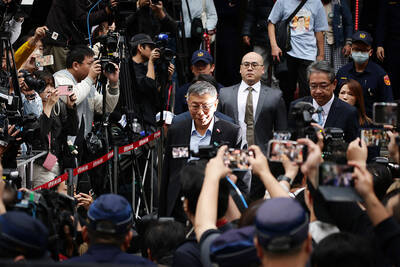
FIRST TRIAL: Ko’s lawyers sought reduced bail and other concessions, as did other defendants, but the bail judge denied their requests, citing the severity of the sentences Former Taipei mayor Ko Wen-je (柯文哲) was yesterday sentenced to 17 years in prison and had his civil rights suspended for six years over corruption, embezzlement and other charges. Taipei prosecutors in December last year asked the Taipei District Court for a combined 28-year, six-month sentence for the four cases against Ko, who founded the Taiwan People’s Party (TPP). The cases were linked to the Core Pacific City (京華城購物中心) redevelopment project and the mismanagement of political donations. Other defendants convicted on separate charges included Chinese Nationalist Party (KMT) Taipei City Councilor Angela Ying (應曉薇), who was handed a 15-year, six-month sentence; Core Pacific
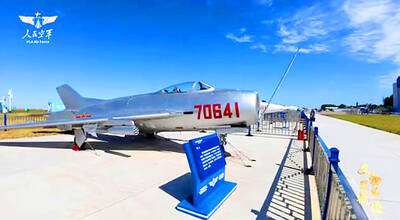
J-6 REMODEL: The converted drones are part of Beijing’s expanding mix of airpower weapons, including bombers with stand-off missiles and UAV swarms, the report said China has stationed obsolete supersonic fighters converted to attack drones at six air bases close to the Taiwan Strait, a report published this month by the Arlington, Virginia-based Mitchell Institute for Aerospace Studies said. Satellite imagery of the airfields from the institute’s “China Airpower Tracker” shows what appear to be lines of stubby, swept-winged aircraft matching the shape of J-6 fighters that first flew with the Chinese People’s Liberation Army (PLA) Air Force in the 1960s. Since their conversion to drones, the aircraft have been identified at five bases in China’s Fujian Province and one in Guangdong Province, the report said. J.

China used fake LinkedIn profiles to harvest sensitive data from NATO and EU institutions by soliciting information from staff, a European security source said on Friday. The operation, allegedly orchestrated by the Chinese Ministry of State Security, targeted dozens of employees at the military alliance or EU organizations through fictitious accounts, the source said, confirming reports in French and Belgian media. Posing as recruiters on the online professional networking platform, Chinese spies would initially request paid reports before later soliciting non-public or even classified information. One particularly active fake profile used the name “Kevin Zhang,” claiming to be the head


 RSS
RSS