


Western and Arab nations were set to demand yesterday that Syria allow aid to be delivered to desperate civilians in the absence of any international resolve to intervene to end a crackdown on a near year-old revolt against Syrian President Bashar al-Assad.
Foreign ministers from more than 50 countries were in Tunis for the first meeting of the “Friends of Syria” group, against the backdrop of a surge in government attacks on the city of Homs and mounting world outrage over violence that has claimed thousands of lives during the uprising.
In Homs, Syrian government artillery fire killed five people in the city’s Baba Amro district, opposition activists said, as the bombardment of opposition-held neighborhoods entered its third week yesterday.
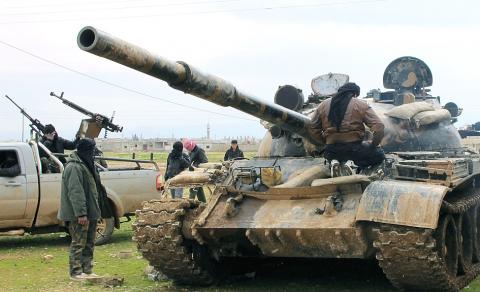
Photo: Reuters
“Baba Amro is being hit with 122mm artillery directed at it from surrounding villages. A father and his 14-year-old son were among those killed. They were trying to flee the shelling when shrapnel hit them in the street,” Mohammad al-Homsi said.
US Secretary of State Hillary Rodham Clinton has warned that Syria’s opposition would ultimately arm itself and go on the offensive if diplomacy failed, but with moves for tough action in the UN Security Council stymied by Russian and Chinese vetoes, and a lack of appetite for military action to end al-Assad’s crackdown, delegates in Tunis had limited options.
German Foreign Minister Guido Westerwelle said: “It is very important that the first contact group is taking place today, because it sends a message to the Syrian people that we support them in their struggle for freedom.”
An updated draft declaration from the meeting called on Syria to “immediately cease all violence” to allow the UN access to Homs and to let agencies deliver aid to civilians affected by the violence.
The “Friends of Syria” pledged, in the latest version of the draft, to deliver humanitarian supplies within 48 hours if Syria’s government “stopped its assault on civilian areas and permitted access.”
In a sign the international community is seeking ways around the Security Council deadlock, UN Secretary-General Ban Ki-moon said he would dispatch former UN chief Kofi Annan to Syria as a joint UN-Arab League envoy.
The draft communique did not mention any foreign military intervention along the lines of the NATO bombing campaign that helped force out former Libyan leader Muammar Qaddafi.
Instead, it called for further diplomatic pressure on al-Assad to step down and endorsed an Arab League plan that sees him handing power to a deputy as a prelude to elections.
Western diplomats said it had not yet been possible to recover the bodies of Marie Colvin, an American working for British newspaper the Sunday Times, and French photographer Remi Ochlik.
Two journalists wounded in the same attack were also awaiting evacuation from Homs, where activists say the army is blocking medical supplies and electricity is cut off for 15 hours a day.
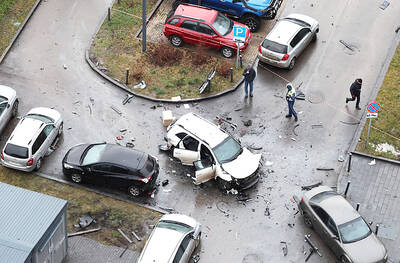
A car bomb killed a senior Russian general in southern Moscow yesterday morning, the latest high-profile army figure to be blown up in a blast that came just hours after Russian and Ukrainian delegates held separate talks in Miami on a plan to end the war. Kyiv has not commented on the incident, but Russian investigators said they were probing whether the blast was “linked” to “Ukrainian special forces.” The attack was similar to other assassinations of generals and pro-war figures that have either been claimed, or are widely believed to have been orchestrated, by Ukraine. Russian Lieutenant General Fanil Sarvarov, 56, head

SAFETY FIRST: Double the number of police were deployed at the Taipei Marathon, while other cities released plans to bolster public event safety Authorities across Taiwan have stepped up security measures ahead of Christmas and New Year events, following a knife and smoke bomb attack in Taipei on Friday that left four people dead and 11 injured. In a bid to prevent potential copycat incidents, police deployments have been expanded for large gatherings, transport hubs, and other crowded public spaces, according to official statements from police and city authorities. Taipei Mayor Chiang Wan-an (蔣萬安) said the city has “comprehensively raised security readiness” in crowded areas, increased police deployments with armed officers, and intensified patrols during weekends and nighttime hours. For large-scale events, security checkpoints and explosives
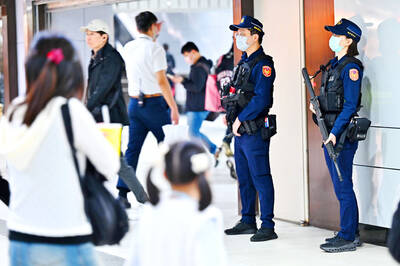
PUBLIC SAFETY: The premier said that security would be tightened in transport hubs, while President Lai commended the public for their bravery The government is to deploy more police, including rapid response units, in crowded public areas to ensure a swift response to any threats, President William Lai (賴清德) said yesterday after a knife attack killed three people and injured 11 in Taipei the previous day. Lai made the remarks following a briefing by the National Police Agency on the progress of the investigation, saying that the attack underscored the importance of cooperation in public security between the central and local governments. The attack unfolded in the early evening on Friday around Taipei Main Station’s M7 exit and later near the Taipei MRT’s Zhongshan
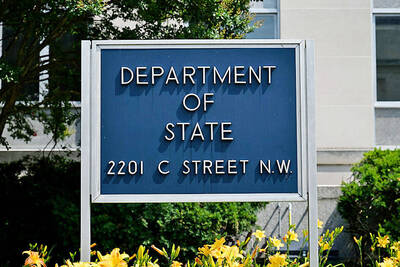
REBUFFED: In response to Chinese criticism over recent arms sales, Washington urged Beijing to engage in meaningful dialogue instead of threats and intimidation Washington’s long-term commitment to Taiwan would not change, the US Department of State said yesterday, urging Beijing to stop pressuring Taiwan and engage in meaningful bilateral dialogues. The remarks came in response to a backlash from Beijing about Washington’s latest approval of arms sales to Taiwan. The US Defense Security Cooperation Agency said in a statement on Wednesday that the Taipei Economic and Cultural Representative Office in the US has asked to purchase an arms package, including Tactical Mission Network Software; AH-1W helicopter spare and repair parts; M109A7 self-propelled howitzers; HIMARS long range precision strike systems; tube-launched, optically tracked, wire-guided missiles; Javelin


 RSS
RSS