


Masses of Tunisians marched in peaceful triumph on Saturday to mark the one-year anniversary of the revolution that ended the rule of former Tunisian president Zine El Abidine Ben Ali — and sparked uprisings around the Arab world.
Tunisia greeted the anniversary with prudent optimism, amid worries about high unemployment that cast a shadow over their pride at transforming the country.
Now a human rights activist is president and a moderate Islamist jailed for years by the old regime is prime minister at the head of a diverse coalition, after the freest elections in Tunisia’s history.
Tunisia’s uprising began on Dec. 17, 2010, when a desperate fruit vendor set himself on fire, unleashing pent-up anger and frustration among his compatriots, who staged protests that spread nationwide. Within less than a month, longtime leader Ben Ali was forced out of power and he fled to Saudi Arabia on Jan. 14 last year.
Boisterous marches on Saturday reflected the country’s new atmosphere.
On a crisp, sunny day in Tunisia’s capital, Islamists shouted: “Allahu Akbar.”
Alongside them were leftists and nationalists celebrating freedom and mourning the more than 200 people killed in the month-long uprising.
The new leadership, to mark the anniversary, pardoned 9,000 convicts and converted the sentences of more than 100 prisoners from the death penalty to life in prison, state news agency TAP reported.
As the country that started the Arab Spring, Tunisia appears to be the farthest along in its transformation.
However, political analysts warn that further gains will not be easy or painless.
Heykel Mahfoudh, a law professor and adviser to the Geneva Centre for the Democratic Control of Armed Forces, said in an interview that Tunisia is entering its second post-Ben Ali year “in a paradoxically necessary phase of turbulence.”
Mahfoudh said he is “cautiously optimistic” about Tunisia’s development, but remains worried about the country’s economic and social situation.
It is unclear, too, what the Islamists who won the elections will do with their power.
Unemployment has risen to almost 20 percent from 13 percent a year ago and economic growth has stagnated as investment dries up and tourism, once a pillar of Tunisia’s economy, evaporates.
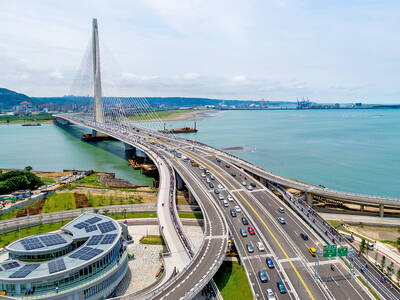
The Ministry of Transportation and Communications yesterday inaugurated the Danjiang Bridge across the Tamsui River in New Taipei City, saying that the structure would be an architectural icon and traffic artery for Taiwan. Feted as a major engineering achievement, the Danjiang Bridge is 920m long, 211m tall at the top of its pylon, and is the longest single-pylon asymmetric cable-stayed bridge in the world, the government’s Web site for the structure said. It was designed by late Iraqi-British architect Zaha Hadid. The structure, with a maximum deck of 70m, accommodates road and light rail traffic, and affords a 200m navigation channel for boats,
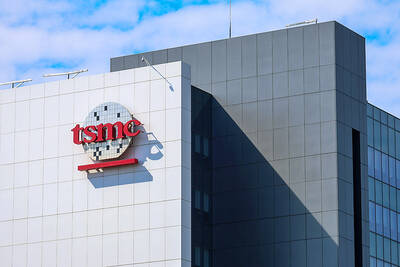
Taiwan Semiconductor Manufacturing Co (TSMC, 台積電), the world’s largest foundry service provider, yesterday said that global semiconductor revenue is projected to hit US$1.5 trillion in 2030, after the figure exceeds US$1 trillion this year, as artificial intelligence (AI) demand boosts consumption of token and compute power. “We are still at the beginning of the AI revolution, but we already see a significant impact across the whole semiconductor ecosystem,” TSMC deputy cochief operating officer Kevin Zhang (張曉強) said at the company’s annual technology symposium in Hsinchu City. “It is fair to say that in the past decade, smartphones and other mobile devices were
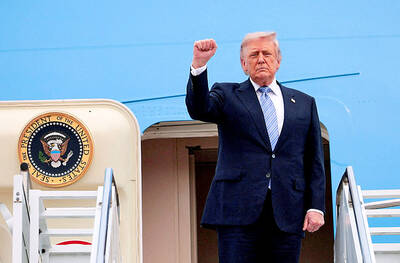
US-CHINA SUMMIT: MOFA welcomed US reassurance of no change in its Taiwan policy; Trump said he did not comment when Xi talked of opposing independence US President Donald Trump yesterday said he has not made a decision on whether to move forward with a major arms package for Taiwan after hearing concerns about it from Chinese President Xi Jinping (習近平). Trump’s comments on Taiwan came as he flew back to Washington after wrapping up critical talks in which both leaders said important progress was made in stabilizing US-China relations even as deep differences persist between the world’s two biggest powers on Iran and Taiwan. “I will make a determination,” Trump said, adding: “I’ll be making decisions. But, you know, I think the last thing we need right

TAIWAN ISSUE: US treasury secretary Scott Bessent said on the first day of meetings that ‘it wouldn’t be a US-China summit without the Taiwan issue coming up’ There were no surprises on the first day of the summit between US President Donald Trump and Chinese President Xi Jinping (習近平), the Mainland Affairs Council (MAC) said yesterday, as the government reiterated that cross-strait stability is crucial to the Asia-Pacific region, as well as the world. As the two presidents met for a highly anticipated summit yesterday, Chinese state media reported that Xi warned Trump that missteps regarding Taiwan could push their two countries into “conflict.” Trump arrived in China with accolades for his host, calling Xi a “great leader” and “friend,” and extending an invitation to visit the White House


 RSS
RSS