


Syrian forces killed at least 17 people on Friday, activists said, as protesters piled pressure on the regime to quit and the EU tightened the noose on Damascus by slapping it with an oil embargo.
Activists reported “huge demonstrations” after weekly Muslim prayers in response to calls from an Internet group that urged rallies against Syrian President Bashar al-Assad’s regime under the banner “death rather than humiliation.”
France also announced plans to further isolate Assad, saying it would boost contacts with the opposition, echoing calls from Spain for international support for the opponents of the embattled president.
The Syrian Observatory for Human Rights said eight people were killed as security forces intervened to disperse protests in the suburbs of Damascus.
Six other people died in Homs Province and three in the eastern city of Deir Ezzor, said the UK-based Observatory in an updated report, adding that a 16-year-old girl was among those killed.
State television, meanwhile, reported the security forces killed two armed men after coming under attack in Talbisseh, a town in central Homs Province.
Verification of the report was not possible because foreign media are barred from moving freely around the country.
One of Friday’s rallies was held in support of a top official who resigned this week to protest the regime’s deadly repression of dissent, while protesters also urged Russia to stop selling arms to Syria, activists said.
The Local Coordination Committees (LCC) said demonstrators rallied outside the home of Mohammed Adnan al-Bakkour, the attorney general of Hama Province who announced his resignation in a disputed YouTube video.
Bakkour said he stepped down in disgust at hundreds of killings and mass burials and thousands of arrests by Assad’s regime — claims dismissed by the regime which said he quit under duress after being kidnapped.
In addition to Friday’s ban on crude oil imports from Syria, ministers from the 27-member EU met in Poland to discuss the Syrian turmoil, the EU also expanded its list of about 50 people — including Assad himself — targeted by an asset freeze and travel ban, adding four Syrian businessmen accused of bankrolling the regime and three firms, diplomats said.
The sanctions “will go straight to the heart of the regime,” Dutch Foreign Minister Uri Rosenthal said in Poland, while EU foreign policy chief Catherine Ashton said there would be no let-up to press Assad to end the repression.
The oil embargo, to take effect yesterday, will deprive Assad’s regime of a vital source of cash as the EU buys 95 percent of Syria’s crude oil although it accounts for only 1.5 percent of the bloc’s imports.
Meanwhile several European leaders called for more action to isolate the Syrian president, after US Secretary of State Hillary Clinton on Thursday again insisted Assad “needs to step aside.”
“Right now it is crucial that we isolate the regime,” German Foreign Minister Guido Westerwelle said on Friday, insisting sanctions will force the regime to start a dialogue its opponents.
French Foreign Minister Alain Juppe said Paris would step up contacts with Syrian opposition figures, and Spanish Prime Minister Jose Luis Rodriguez Zapatero urged international support for Syrians opposed to Assad.
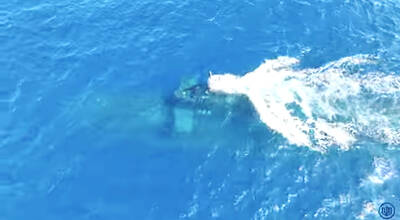
CSBC Corp, Taiwan (台灣國際造船) yesterday released the first video documenting the submerged sea trials of Taiwan’s indigenous defense submarine prototype, the Hai Kun (海鯤), or Narwhal, showing underwater navigation and the launch of countermeasures. The footage shows the vessel’s first dive, steering and control system tests, and the raising and lowering of the periscope and antenna masts. It offered a rare look at the progress in the submarine’s sea acceptance tests. The Hai Kun carried out its first shallow-water diving trial late last month and has since completed four submerged tests, CSBC said. The newly released video compiles images recorded from Jan. 29 to
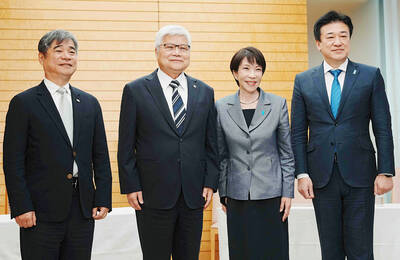
Taiwan Semiconductor Manufacturing Co (TSMC, 台積電) plans to make advanced 3-nanometer chips in Japan, stepping up its semiconductor manufacturing roadmap in the country in a triumph for Japanese Prime Minister Sanae Takaichi’s technology ambitions. TSMC is to adopt cutting-edge technology for its second wafer fab in Kumamoto, company chairman C.C. Wei (魏哲家) said yesterday. That is an upgrade from an original blueprint to produce 7-nanometer chips by late next year, people familiar with the matter said. TSMC began mass production at its first plant in Japan’s Kumamoto in late 2024. Its second fab, which is still under construction, was originally focused on
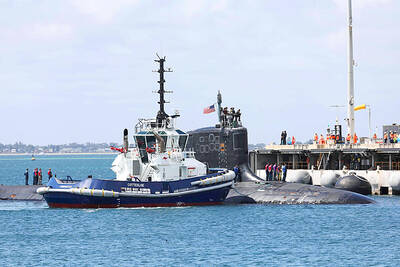
DETERRENCE EFFORTS: Washington and partners hope demonstrations of force would convince Beijing that military action against Taiwan would carry high costs The US is considering using HMAS Stirling in Western Australia as a forward base to strengthen its naval posture in a potential conflict with China, particularly over Taiwan, the Wall Street Journal reported on Saturday. As part of its Indo-Pacific strategy, Washington plans to deploy up to four nuclear-powered submarines at Stirling starting in 2027, providing a base near potential hot spots such as Taiwan and the South China Sea. The move also aims to enhance military integration with Pacific allies under the Australia-UK-US trilateral security partnership, the report said. Currently, US submarines operate from Guam, but the island could
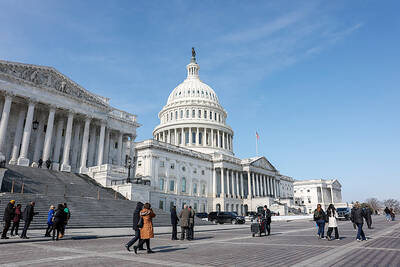
The partisan standoff over President William Lai’s (賴清德) proposed defense budget has raised questions about the nation’s ability to adequately fund its own defense, the US Congressional Research Service (CRS) said in a report released on Tuesday. The report, titled Taiwan: Defense and Military Issues, said the government has increased its defense budget at an average annual rate of 5 percent from 2019 to 2023, with about 2.5 percent of its GDP spent on defense in 2024. Lai in November last year proposed a special budget of about US$40 billion over eight years, and said he intends to increase defense spending to


 RSS
RSS