


Dozens of Tibetans and Taiwanese supporters of the Tibetan cause yesterday staged a demonstration at Taipei Zoo as Sichuan Province Governor Jiang Jufeng (蔣巨峰) visited the zoo in the afternoon.
Holding up Tibetan flags and signs reading “No freedom, no tourism in Sichuan” and “Release the 300 monks from Kirti Monastery,” while shouting “Free Tibet” and other slogans, the protestors demonstrated inside the zoo’s Panda Hall as Jiang visited Tuan Tuan (團團) and Yuan Yuan (圓圓), a pair of pandas transferred from Sichuan to Taiwan in 2008.
“We are here to ask him [Jiang] to release 300 monks arrested from the Kirti Monastery and to allow a Tibetan Youth Congress delegation to visit the prisoners there,” said Tenzin Chompel, president of the Regional Tibetan Youth Congress, Taiwan. “Part of Jiang’s mission here is to promote tourism in Sichuan, but without freedom, there’s no tourism.”

Photo: Loa Iok-sin, Taipei Times
Conflict broke out late last month when Tibetan residents and monks in the predominantly Tibetan region of Ngaba, Sichuan Province, faced a violent crackdown in response to peacefully demonstrating in March to commemorate the Tibetan uprisings against Chinese rule in 1959 and 2008.
As a result, hundreds of monks from the Kirti Monastery who participated in the demonstration were arrested and the monastery was locked down, while all foreign visitors have been banned from entering Ngaba.
Kelsang Lhundup, another participant at yesterday’s protest, said that as the top leader in Sichuan Province, Jiang should be held responsible for what has happened to Tibetans there and should solve the matter peacefully before he visits other countries.
While the demonstration was intended to be a surprise targeting Jiang, the demonstrators unveiled their signs, flags and started shouting slogans before Jiang’s arrival, after mistaking buses carrying Chinese journalists with Jiang’s convoy.
A second wave of protests broke out when Taipei Mayor Hau Lung-bin (郝龍斌) showed up at the entrance gate to the Panda Hall in preparation to greet Jiang.
The protests forced organizers of the visit to change their plans. Instead of entering the Panda Hall from the front door as planned, Jiang entered through the cargo entrance at the back, took a look at Yuan Yuan in a nursing area that is not open to the public, and went up to the briefing room on the third floor via the emergency stairs. He left directly from there.
Reacting to the change in plans, demonstrators moved to the only vehicle exit at the zoo and protested as Jiang’s convoy departed.
Jiang and a delegation of about 50 arrived on Saturday at Kaohsiung International Airport for a seven-day visit.
Although girls from a panda fan club greeted the delegation, Greater Kaohsiung officials were absent. Jiang was nevertheless given VIP treatment, with a large contingent of security personnel from Sichuan maintaining his safety. No additional security measures were taken.
To greet him and the delegation in Taipei, Hau added the visit to the zoo to Jiang’s public schedule.
Jiang lauded the zoo and the Taipei City Government for taking good care of the pandas and promised that experts from his province would continue working with the zoo to help impregnate Yuan Yuan.
Panda experts from the Wolong Giant Panda Reserve Centre in Sichuan visited Taipei in February to implement an artificial insemination program for Yuan Yuan, who the zoo said has recently shown signs of pregnancy.
Panda experts from the center returned to the zoo earlier this month upon receiving the news. Zoo director Jason Yeh (葉傑生) said Yuan Yuan has lost her appetite this month and has been sleeping more than usual, while also behaving “like a cat on hot bricks.”
While those were signs of pregnancy, Yeh said the zoo has been unable to confirm that the panda is expecting a cub because an ultrasound did not detect a fetus.
Additional reporting by CNA

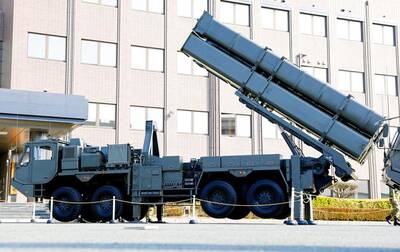
Japan has deployed long-range missiles in a southwestern region near China, the Japanese defense minister said yesterday, at a time when ties with Beijing are at their lowest in recent years. The missiles were installed in Kumamoto in the southern region of Kyushu, as Japan is attempting to shore up its military capacity as China steps up naval activity in the East China Sea. “Standoff defense capabilities enable us to counter the threat of enemy forces attempting to invade our country ... while ensuring the safety of our personnel,” Japanese Minister of Defense Shinjiro Koizumi said. “This is an extremely important initiative for

MORE POPULAR: Taiwan Pass sales increased by 59 percent during the first quarter compared with the same period last year, the Tourism Administration said The Tourism Administration yesterday said that it has streamlined the Taiwan Pass, with two versions available for purchase beginning today. The tourism agency has made the pass available to international tourists since 2024, allowing them to access the high-speed rail, Taiwan Railway Corp services, four MRT systems and four Taiwan Tourist Shuttles. Previously, five types of Taiwan Pass were available, but some tourists have said that the offerings were too complicated. The agency said only two types of Taiwan Pass would be available, starting from a three-day pass with the high-speed rail and a three-day pass with Taiwan Railway Corp. The former costs NT$2,800

NEW LOW: The council in 2024 based predictions on a pessimistic estimate for the nation’s total fertility rate of 0.84, but last year that rate was 0.69, 17 percent lower An expected National Development Council (NDC) report expects the nation’s population to drop below 12 million by 2065, with the old-age dependency ratio to top 100 percent sooner than 2070, sources said yesterday. The council is slated to release its latest population projections in August, using an ultra-low fertility model, the sources said. The previous report projected that Taiwan’s population would fall to 14.37 million by 2070, but based on a new estimate of the total fertility rate (TFR) — the average number of children born to a woman over her lifetime — the population is expected to reach 12 million by

COUNTERING HOSTILITY: The draft bill would require the US to increase diplomatic pressure on China and would impose sanctions on those who sabotage undersea cable networks US lawmakers on Thursday introduced a bipartisan bill to bolster the resilience of Taiwan’s submarine cables to counter China’s hostile activities. The proposal, titled the critical undersea infrastructure resilience initiative act, was cosponsored by Republican representatives Mike Lawler and Greg Stanton, and Democratic Representative Dave Min. US Senators John Curtis and Jacky Rosen also introduced a companion bill in the US Senate, which has passed markup at the chamber’s Committee on Foreign Relations. The House’s version of the bill would prioritize the deployment of sensors to detect disruptions or potential sabotage in real-time and enhance early warning capabilities through global intelligence sharing frameworks,


 RSS
RSS