


Former US president George W. Bush has canceled a visit to Switzerland, where he was to address a Jewish charity gala, because of the risk of legal action against him for alleged torture, rights groups said on Saturday.
Bush was to be the keynote speaker at Keren Hayesod’s annual dinner on Feb. 12 in Geneva, but pressure has been building on the Swiss government to arrest him and open a criminal investigation if he enters the Alpine country.
Criminal complaints against Bush alleging torture have been lodged in Geneva, court officials say.
Human rights groups said they had intended to submit a 2,500-page case against Bush in the Swiss city today for alleged mistreatment of suspected militants at Guantanamo Bay, the US naval base in Cuba where captives from Afghanistan, Iraq and other fronts in the so-called “war on terror” were interned.
Leftist groups had also called for a protest on the day of his visit, leading Hayesod’s organizers to announce that they were canceling Bush’s participation on security grounds — not because of the criminal complaints.
However, groups including the New York-based Human Rights Watch and International Federation of Human Rights (FIDH) said the cancellation was linked to growing moves to hold Bush accountable for torture, including waterboarding. He has admitted in his memoirs and television interviews to ordering use of the interrogation technique that simulates drowning.
“He’s avoiding the handcuffs,” said Reed Brody, counsel for Human Rights Watch.
The action in Switzerland showed Bush had reason to fear legal complaints against him if he traveled to countries that have ratified an international treaty banning torture, he said.
EXTRADITE
Brody is a US-trained lawyer who specialized in pursuing war crimes worldwide, especially those allegedly ordered by former leaders, including Chile’s late dictator Augusto Pinochet and Chad’s ousted president Hissene Habre. Habre has been charged by Belgium with crimes against humanity and torture and is -currently exiled in Senegal.
“President Bush has admitted he ordered waterboarding, which everyone considers to be a form of torture under international law. Under the Convention against Torture, authorities would have been obliged to open an investigation and either prosecute or extradite George Bush,” Brody said.
Swiss judicial officials have said that Bush would still enjoy a certain diplomatic immunity as a former head of state.
Dominique Baettig, a member of the Swiss parliament from the right-wing People’s Party, wrote to the Swiss federal government last week calling for the arrest of Bush for alleged war crimes if he came to the neutral country.
WATERBOARDING
Bush, in his Decision Points memoirs on his 2001-2009 presidency, strongly defends the use of waterboarding as key to preventing a repeat of the Sept. 11 attacks on the US.
Most human rights experts consider the practice a form of torture, banned by the Convention on Torture, an international pact prohibiting torture and other cruel, inhumane or degrading treatment or punishment. Switzerland and the US are among 147 countries to have ratified the 1987 treaty.
“Whatever Bush or his hosts say, we have no doubt he canceled his trip to avoid our case. The message from civil society is clear — If you’re a torturer, be careful in your travel plans. It’s a slow process for accountability, but we keep going,” the Paris-based FIDH and New York-based Center for Constitutional Rights said in a joint statement on Saturday.
Sami El Hadjj, a former al-Jazeera journalist and former detainee at Guantanamo, had been due to speak at their news conference in Geneva today, where they will release the 2,500-page complaint.
“I’m surprised he [Bush] would even consider visiting a country that has ratified the torture convention and which takes its responsibilities seriously,” Brody said.
“I think George Bush’s world is a very small place at the moment,” Brody said. “He may enjoy some kind of impunity in the United States, but other countries will not treat him so indulgently.”
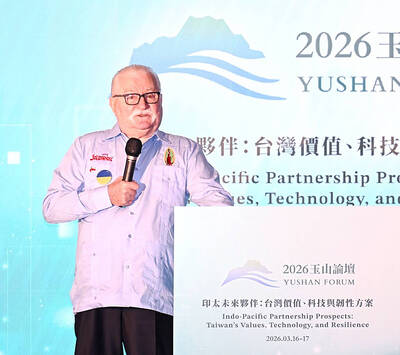
RECOGNITION: Former Fijian prime minister Mahendra Chaudhry said that Taiwan’s New Southbound Policy serves as a stabilizing force in the Indo-Pacific region Taiwan can lead the unification of the Chinese people, Nobel Peace Prize laureate and former Polish president Lech Walesa said in Taipei yesterday, adding that as the world order is changing, peaceful discussion would find good solutions, and that the use of force and coercion would always fail. Walesa made the remarks during his keynote address at a luncheon of the Yushan Forum in Taipei, titled “Indo-Pacific Partnership Prospects: Taiwan’s Values, Technology and Resilience,” organized by the Taiwan-Asia Exchange Foundation with the Ministry of Foreign Affairs. Walesa said that he had been at the forefront of a big peaceful revolution and “if
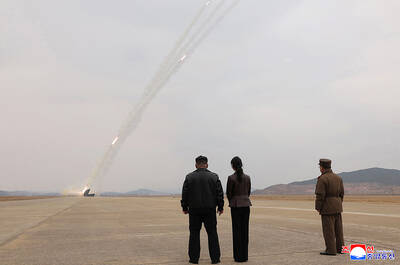
North Korea tested nuclear-capable rocket launchers, state media reported yesterday, a day after Seoul detected the launch of about 10 ballistic missiles. The test comes after South Korean and US forces launched their springtime military drills, due to run until Thursday. North Korean leader Kim Jong-un on Saturday oversaw the testing of the multiple rocket launcher system (MRLS), the Korean Central News Agency (KCNA) said. The test involved 12 600mm-caliber ultra-precision multiple rocket launchers and two artillery companies, it said. Kim said the drill gave Pyongyang’s enemies, within the 420km striking range, a sense of “uneasiness” and “a deep understanding

North Korea yesterday fired about 10 ballistic missiles to the sea toward Japan, the South Korean Joint Chiefs of Staff (JCS) said, days after Pyongyang warned of “terrible consequences” over ongoing South Korea-US military drills. Pyongyang recently dashed hopes of a diplomatic thaw with Seoul, Washington’s security ally, describing its latest peace efforts as a “clumsy, deceptive farce.” Seoul’s military detected “around 10 ballistic missiles launched from the Sunan area in North Korea toward the East Sea [Sea of Japan] at around 1:20pm,” JCS said in a statement, referring to South Korea’s name for the body of water. The missiles

‘UNWAVERING FRIENDSHIP’: A representative of a Japanese group that co-organized a memorial, said he hopes Japanese never forget Taiwan’s kindness President William Lai (賴清德) yesterday marked the 15th anniversary of the Tohoku earthquake and tsunami, urging continued cooperation between Taiwan and Japan on disaster prevention and humanitarian assistance. Lai wrote on social media that Taiwan and Japan have always helped each other in the aftermath of major disasters. The magnitude 9 earthquake struck northeastern Japan on March 11, 2011, triggering a massive tsunami that claimed more than 19,000 lives, according to data from Japanese authorities. Following the disaster, Taiwan donated more than US$240 million in aid, making it one of the largest contributors of financial assistance to Japan. In addition to cash donations and


 RSS
RSS