


President Ma Ying-jeou (馬英九) yesterday visited the family of Chiang Kuo-ching (江國慶), who was wrongfully executed by the military 14 years ago for the rape and murder of a five-year-old girl, and promised to clear Chiang’s name in a speedy manner.
Ma apologized to Chiang and his family on Monday through Presidential Office spokesman Lo Chih-chiang (羅智強), as well as a posting on his Facebook page.
After visiting the family, Ma told reporters that Chiang’s mother and uncle said they cared more about clearing his name than receiving compensation.
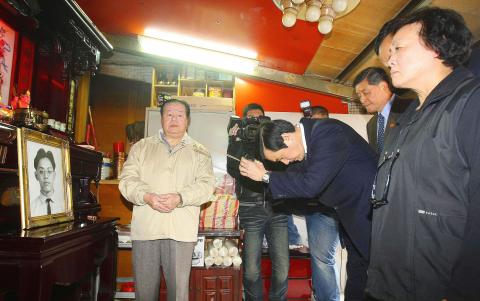
Photo: Reuters
“I have instructed the Ministry of National Defense and Ministry of Justice to fully assist the family so Chiang can be declared innocent and his family obtain compensation,” Ma said. “Minister of National Defense Kao Hua-chu (高華柱), who is also here today, will also do his best to help the family get its wish.”
Ma said his visit and apology demonstrated his administration’s willingness to help the family see its requests fulfilled.
“The public must realize that my visit today clearly indicates that Chiang is innocent,” Ma said. “This fact has been confirmed by the investigations of the Control Yuan and Taipei District Court.”
The family’s wish that Chiang’s conviction and death penalty be revoked has to proceed in accordance with the law, but he promised the process would not take five or 10 years, Ma said.
“A retrial is probably the least time-consuming, but we will do our best to shorten the process,” he said.
However, he declined to specify how long it would take, saying he would ask the justice ministry to provide an estimate.
He also dismissed speculation that Chiang could not be declared innocent until another suspect, Hsu Jung-chou (許榮洲), has been proven guilty.
Taipei prosecutors arrested Hsu, who has a record of sexual offenses, as a suspect in the case on Friday.
Ma said the new evidence discovered could be used against Hsu at a retrial and clearing Chiang’s name should be dealt with separately from proving Hsu guilty.
Chiang was executed on Aug. 13, 1997, but his family continued to fight to clear his name.
A Control Yuan report on its investigation said that in notes Chiang wrote in prison, he recounted being threatened with an electric baton, exposed to strong light and forced to undergo physical activity all night during his interrogations.
In letters Chiang sent to his family while in prison, he wrote that investigators told him “the chief [then-head of air force command Chen Chao-min (陳肇敏)] is coming to see you. When he arrives, remember to kneel before him and ask for help. The chief will save you.”
About 30 military officials involved in Chiang’s arrest, trial and execution are facing criminal and administrative investigations, including Chen.
While Chen also served as minister of national defense under Ma, the president said he was in no position to say whether Chen or other military personnel involved in Chiang’s case had been guilty of negligence or should be held legally responsible for his wrongful conviction and execution.
Chiang’s case has prompted Ma’s long-time friend C.V. Chen (陳長文), the president of Taiwan’s Red Cross Society, to urge the government to consider abolishing the death penalty.
Ma said his administration was willing to gradually try for abolition because the public remains polarized on the issue.
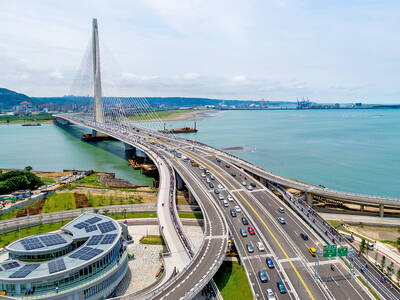
The Ministry of Transportation and Communications yesterday inaugurated the Danjiang Bridge across the Tamsui River in New Taipei City, saying that the structure would be an architectural icon and traffic artery for Taiwan. Feted as a major engineering achievement, the Danjiang Bridge is 920m long, 211m tall at the top of its pylon, and is the longest single-pylon asymmetric cable-stayed bridge in the world, the government’s Web site for the structure said. It was designed by late Iraqi-British architect Zaha Hadid. The structure, with a maximum deck of 70m, accommodates road and light rail traffic, and affords a 200m navigation channel for boats,
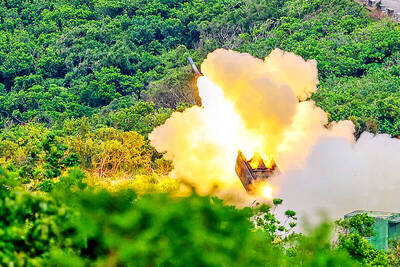
PRECISION STRIKES: The most significant reason to deploy HIMARS to outlying islands is to establish a ‘dead zone’ that the PLA would not dare enter, a source said A High Mobility Artillery Rocket System (HIMARS) would be deployed to Penghu County and Dongyin Island (東引) in Lienchiang County (Matsu) to force the Chinese military to retreat at least 100km from the coastline, a military source said yesterday. Taiwan has been procuring HIMARS and Army Tactical Missile Systems (ATACMS) from the US in batches. Once all batches have been delivered, Taiwan would possess 111 HIMARS units and 504 ATACMS, which have a range of 300km. Considering that “offense is the best defense,” the military plans to forward-deploy the systems to outlying islands such as Penghu and Dongyin so that

‘CLEAR MESSAGE’: The bill would set up an interagency ‘tiger team’ to review sanctions tools and other economic options to help deter any Chinese aggression toward Taiwan US Representative Young Kim has introduced a bill to deter Chinese aggression against Taiwan, calling for an interagency “tiger team” to preplan coordinated sanctions and economic measures in response to possible Chinese military or political action against Taiwan. “[Chinese President] Xi Jinping [習近平] has directed the People’s Liberation Army to be ready to invade Taiwan by 2027. China has a plan. America should have one too,” Kim said in a news release on Thursday last week. She introduced the “Deter PRC [People’s Republic of China] aggression against Taiwan act” to “ensure the US has a coordinated sanctions strategy ready should

Taiwan Semiconductor Manufacturing Co (TSMC, 台積電), the world’s largest foundry service provider, yesterday said that global semiconductor revenue is projected to hit US$1.5 trillion in 2030, after the figure exceeds US$1 trillion this year, as artificial intelligence (AI) demand boosts consumption of token and compute power. “We are still at the beginning of the AI revolution, but we already see a significant impact across the whole semiconductor ecosystem,” TSMC deputy cochief operating officer Kevin Zhang (張曉強) said at the company’s annual technology symposium in Hsinchu City. “It is fair to say that in the past decade, smartphones and other mobile devices were


 RSS
RSS