


In view of the chaotic scenes stirred up by Chinese tycoon Chen Guangbiao (陳光標), who was stopped by several Taiwanese begging for cash handouts yesterday, lawmakers across party lines accused the government of shaming Taiwan.
“Don’t you feel ashamed, [President] Ma Ying-jeou (馬英九)? Letting go of the local government to heap praise on Chen, letting go in the face of Chen’s display of arrogance and letting go of Taiwan so it becomes like a place full of hungry people,” Democratic Progressive Party (DPP) Legislator Pan Men- an (潘孟安) said, referring to Chen’s flamboyant style of charity, which is well-known in China.
Chen arrived in Taiwan on Wednesday night and began distributing cash to disadvantaged families yesterday in what he called a response to the outpouring of support Taiwanese showed for Chinese victims of the 2008 Sichuan Earthquake.
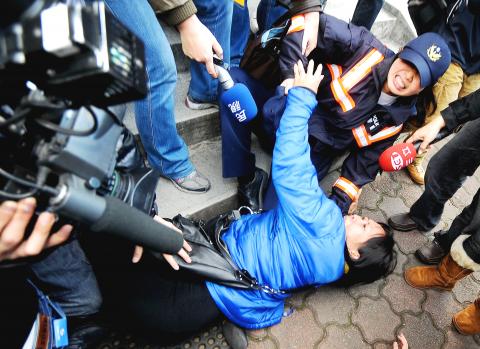
Photo: Liu Hsin-de, Taipei Times
Earlier yesterday, Chen handed three red envelopes containing a total of NT$70,000 (US$2,300) to a woman who said she had been waiting for him at his hotel in Taipei since Wednesday night.
“I’ve never counted so many banknotes. I don’t know what to do. I will use the money to take care of my 88-year-old mother,” the woman told reporters, her voice cracking with emotion.
Chen’s schedule took him to Hsinchu County later yesterday, where he donated NT$6.7 million to disadvantaged families in cooperation with the county government. A tearful woman there also attempted to get closer to Chen, saying she had traveled from Taipei to Hsinchu to ask for money to pay for her husband’s funeral.
She was stopped by police before getting near Chen.
While speaking to the Taiwanese media, Chen was seen holding up a wad of NT$2,000 notes spread out in a fan shape. Chen has said that he planned to donate up to NT$500 million to the poor in Taiwan.
Pan said Minister of the Interior Jiang Yi-huah (江宜樺) ought to be ashamed because of the government’s inadequate welfare system.
“The nation’s underprivileged are forced to surrender their dignity and beg from a hypocrite,” Pan said.
Chinese Nationalist Party (KMT) Legislator Lo Shu-lei (羅淑蕾) concurred, criticizing the Ma government for what she called inadequate preparation and not keeping Chen’s actions in Taiwan in check.
“This is utterly shameful,” Lo said. “Chen’s high-profile donation manner makes it seem as if our government cannot take good care of its people.”
The government should immediately get in touch with Chen and advise him to make his donations via local charity groups, hence avoiding a replay of Chen being bombarded by people begging for donations wherever he goes, Lo said.
Some county governments and DPP officials have voiced opposition to Chen’s donation plans in Taiwan, raising concern that his high-profile manner might hurt the recipients’ feelings or dignity.
Meanwhile, Chen canceled his business itinerary, raising further doubts, because he was granted entry to Taiwan as a business professional and was supposed to participate in business activities during his stay under the regulations governing cross-strait travel.
Responding to accusations he was promoting unification with China, 42-year-old Chen told reporters yesterday: “I don’t know anything about propaganda for Chinese reunification. I only know about charity and environmental work. I just want to do good.”
Chen is scheduled to visit Nantou County and Hualien County during the remainder of his trip.

LEVERAGE: China did not ‘need to fire a shot’ to deny Taiwan airspace over Africa when it owns ‘half the continent’s debt,’ a US official said, calling it economic warfare The EU has raised concerns about overflight rights following the delay of President William Lai’s (賴清德) planned state visit to the Kingdom of Eswatini after three African nations denied overflight clearance for his charter at the last minute. Taiwanese allies Paraguay and Saint Kitts and Nevis, as well as several US lawmakers and the Inter-Parliamentary Alliance on China (IPAC) condemned China for allegedly pressuring the countries. Lai was scheduled to fly directly to Taiwan’s only African ally from yesterday to Sunday to celebrate the 40th anniversary of King Mswati III’s accession and his 58th birthday, but Seychelles, Mauritius and Madagascar suddenly revoked
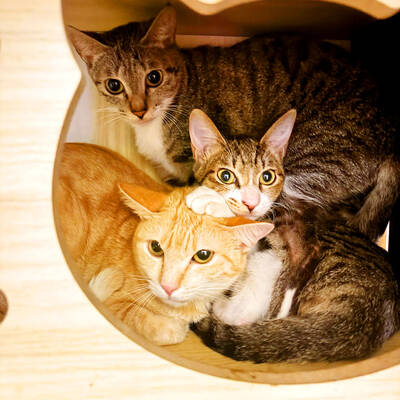
The number of pet cats in Taiwan surpassed that of pet dogs for the first time last year, reaching 1,742,033, a 32.8 percent increase from 2023, the Ministry of Agriculture said yesterday, citing a survey. By contrast, the number of pet dogs declined slightly by 1.2 percent over the same period to 1,462,528, the ministry said. Despite the shift, households with dogs still slightly outnumber those with cats by 1.2 percent. However, while the number of households with multiple dogs has remained relatively stable, households keeping more than two cats have increased, contributing to the overall rise in the feline population. The trend
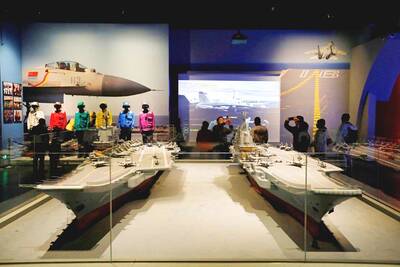
China on Wednesday teased in a video an aircraft carrier that could be its fourth, and the first using nuclear power, while making an allusion to Taiwan and vowing to further build up its islands, as it looks to boost maritime power, secure resources and bolster territorial claims. The video, issued on the eve of the 77th founding anniversary of the Chinese People’s Liberation Army Navy, featured fictional officers with names that are homophones of three commissioned aircraft carriers, the Liaoning (遼寧), Shandong (山東) and Fujian (福建). Titled Into the Deep, it showed a 19-year-old named “Hejian” (何劍) joining the group, sparking

ESWATINI TRIP: The ‘irresponsible actions’ of three African nations set a dangerous precedent and they should be held accountable, a US representative said The US Senate Foreign Relations Committee on Thursday urged Washington not to normalize Chinese pressure, while a US lawmaker called on the US government to hold countries accountable for yielding to Beijing’s pressure to block President William Lai’s (賴清德) planned trip to Eswatini. Lai had been scheduled to visit Eswatini to attend birthday events for King Mswati III of Eswatini this week, but on Tuesday, the eve of his planned departure on Wednesday, the Presidential Office said the trip was “suspended” after the Seychelles, Mauritius and Madagascar unexpectedly withdrew overflight permission. “China reportedly pressured Mauritius, Seychelles, and Madagascar to deny airspace access


 RSS
RSS