


Democratic Progressive Party (DPP) lawmakers yesterday accused the nation's representative to Japan, John Feng (馮寄台), of “humiliating Taiwanese” with the publication of an article in Japan accusing Taiwanese of behaving badly when taking part in protests.
The Japanese newspaper Sankei Biz on Wednesday carried an article written by Feng on its opinion page. The article opened with a description of hundreds of protesters crowding both sides of a road separated by police in 2001 in Houston City, Texas, when then-president Chen Shui-bian (陳水扁) was making a stop on his way back to Taiwan from a visit to allies in Central and South America. One side cheered for Chen, while the other side shouted slogans against him.
Feng wrote that protesters on both sides used neither microphones nor whistles, while police — who numbered less than 10 — stood under the trees chatting or smoking.
Feng then compared the way people behaved when protesting in Taiwan and in the US.
“Heavy police power is often necessary to maintain order during rallies [in Taiwan], and [police] need to form a human wall to prevent protesters from entering prohibited areas,” DPP Legislator Pan Men-an (潘孟安) read from the article. “Protesters ignore the government's power and the law. They throw eggs and attack one another with sticks during demonstrations. Police are often victims in these demonstrations.”
Feng also wrote that the situation in China is different, with Chinese often seen being beaten by police in front of Tiananmen Square.
He concluded that Taiwanese and Chinese people become law-abiding citizens when they are in the US, obeying the administrative power and enjoying democracy.
DPP Legislator Huang Wei-cher (黃偉哲) yesterday said Feng should not have criticized Taiwan given his status as a government official.
“In non-democratic China or democratic US, demonstrators are often more violent than demonstrators in Taiwan. Protesters in Taiwan are pretty moderate,” Huang said.
Saying that Feng, as a government official, might have broken the law for issuing false statements to attack his own country and people, Huang urged the Control Yuan to look into the matter.
Accusing Feng of looking down on Taiwanese, DPP Legislator Kuan Bi-ling (管碧玲) asked the Ministry of Foreign Affairs to immediately remove Feng from office.
In response, the ministry said the article was a translation of a piece published in the opinion page of the Chinese-language United Daily News on June 26, 2001, and collected in a book published in the same year.
Feng was at the time director-general of the ministry's Department of Protocol.
The ministry added that Sankei Biz obtained consent from Feng before publishing the article.
When approached by the press yesterday, Minister of Foreign Affairs Timothy Yang (楊進添) said he did not find the article contain anything surprising as what Feng described were facts.
The purpose of the article was to let people know what protests are like in other countries and encourage people to learn from them and contribute to the progress of democracy, Yang said.
Later yesterday, Huang said it made no difference whether Feng publicized the article now or in 2001, as it was still inappropriate for Feng, then as ministry official, to publicize an article that criticized the country he served.
Taiwan’s representative office in Japan was quoted by the Central News Agency yesterday as saying that the article was the sixth of a series of articles written by Feng that the Sankei Biz will run.
The office said that Feng sent the book to his friends in Japan after taking office. The Sankei Shimbun, a sister paper of the Sankei Biz, then expressed an interest in publishing some of his articles relating to diplomacy in the newspaper.
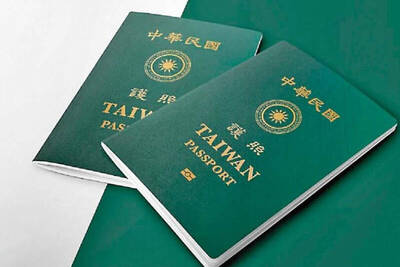
The Taiwanese passport ranked 33rd in a global listing of passports by convenience this month, rising three places from last month’s ranking, but matching its position in January last year. The Henley Passport Index, an international ranking of passports by the number of designations its holder can travel to without a visa, showed that the Taiwan passport enables holders to travel to 139 countries and territories without a visa. Singapore’s passport was ranked the most powerful with visa-free access to 192 destinations out of 227, according to the index published on Tuesday by UK-based migration investment consultancy firm Henley and Partners. Japan’s and

NATIONAL SECURITY THREAT: An official said that Guan Guan’s comments had gone beyond the threshold of free speech, as she advocated for the destruction of the ROC China-born media influencer Guan Guan’s (關關) residency permit has been revoked for repeatedly posting pro-China content that threatens national security, the National Immigration Agency said yesterday. Guan Guan has said many controversial things in her videos posted to Douyin (抖音), including “the red flag will soon be painted all over Taiwan” and “Taiwan is an inseparable part of China,” while expressing hope for expedited “reunification.” The agency received multiple reports alleging that Guan Guan had advocated for armed reunification last year. After investigating, the agency last month issued a notice requiring her to appear and account for her actions. Guan Guan appeared as required,

Japan and the Philippines yesterday signed a defense pact that would allow the tax-free provision of ammunition, fuel, food and other necessities when their forces stage joint training to boost deterrence against China’s growing aggression in the region and to bolster their preparation for natural disasters. Japan has faced increasing political, trade and security tensions with China, which was angered by Japanese Prime Minister Sanae Takaichi’s remark that a Chinese attack on Taiwan would be a survival-threatening situation for Japan, triggering a military response. Japan and the Philippines have also had separate territorial conflicts with Beijing in the East and South China
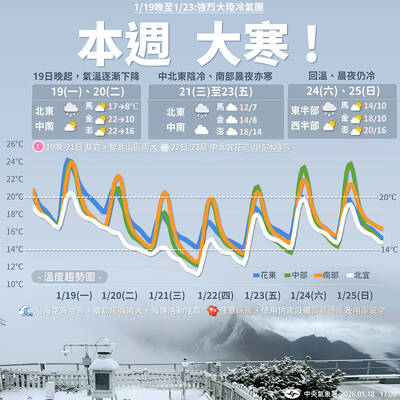
A strong cold air mass is expected to arrive tonight, bringing a change in weather and a drop in temperature, the Central Weather Administration (CWA) said. The coldest time would be early on Thursday morning, with temperatures in some areas dipping as low as 8°C, it said. Daytime highs yesterday were 22°C to 24°C in northern and eastern Taiwan, and about 25°C to 28°C in the central and southern regions, it said. However, nighttime lows would dip to about 15°C to 16°C in central and northern Taiwan as well as the northeast, and 17°C to 19°C elsewhere, it said. Tropical Storm Nokaen, currently


 RSS
RSS