


Tropical storm Conson turned into a typhoon early yesterday but poses no direct threat to Taiwan for the moment, the Central Weather Bureau said yesterday.
Conson struck the eastern part of the Philippines yesterday, bringing heavy rains and official warnings of floods and possible landslides.
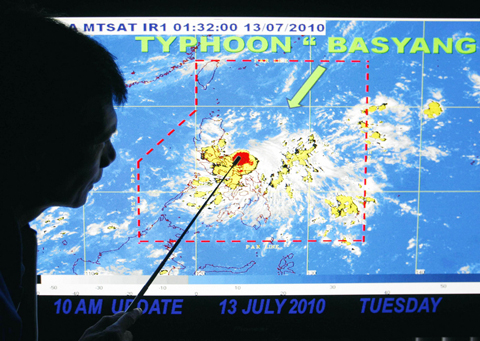
PHOTO: REUTERS
Central Weather Bureau forecaster Lee Hsiang-yuan (李湘源) said that at 2pm, Conson was about 910km southeast of Hengchun (恆春), Pingtung County. It was moving west at a speed of 21kph, with a radius of 120km.
According to the bureau’s potential track forecast, the typhoon would pass through the Philippines and head toward Guangdong Province in China.
Lee said two factors would determine Conson’s path after it passes the Philippines.
“The first will be if the center of the typhoon changes after it passes over land and the second is the strength of the air pressure in the Pacific Ocean,” he said.
Lee said the typhoon would move north toward Taiwan if high air pressure in the Pacific Ocean weakened, but would continue to move west if the air pressure remained strong. Nevertheless, Conson’s peripheral cloud system had begun to affect Taiwan, bringing rain to the southeast.
In Manila, stormy weather ahead of Conson forced schools to close, international flights to divert and ships to be barred from leaving port.
There were no immediate reports of casualties as Conson swept westward packing maximum sustained winds of 120kph.
“Definitely certain areas of Bicol have been hit,” weather forecaster Cris Perez said as the typhoon swept over a 300km front and clipped the Bicol region southeast of Manila late yesterday afternoon.
He said the eye of the typhoon passed within 40km of the city of Daet at 4pm and the weather service reported heavy rain over the area.
The typhoon was set to hit the main island of Luzon last night.
The civil defense office said yesterday there were no immediate reports of casualties in Bicol or elsewhere with the arrival of Conson.
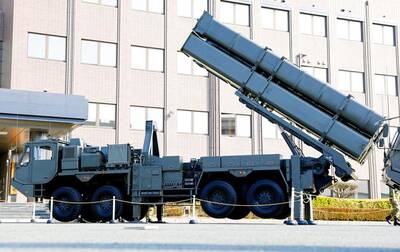
Japan has deployed long-range missiles in a southwestern region near China, the Japanese defense minister said yesterday, at a time when ties with Beijing are at their lowest in recent years. The missiles were installed in Kumamoto in the southern region of Kyushu, as Japan is attempting to shore up its military capacity as China steps up naval activity in the East China Sea. “Standoff defense capabilities enable us to counter the threat of enemy forces attempting to invade our country ... while ensuring the safety of our personnel,” Japanese Minister of Defense Shinjiro Koizumi said. “This is an extremely important initiative for

Chinese Nationalist Party (KMT) Chairwoman Cheng Li-wun (鄭麗文) today accepted an invitation from Chinese President Xi Jinping (習近平) to lead a delegation to China next month, saying she hopes to promote the peaceful development of cross-strait relations and bring stability to the Taiwan Strait. “I am grateful and happy to accept this invitation,” Cheng said in a statement from the KMT chairperson’s office. Cheng said she hopes both sides can work together to promote the peaceful development of cross-strait relations, enhance exchange and cooperation, bring stability to the Taiwan Strait and improve people’s livelihoods. At today's news conference, Cheng said any efforts to
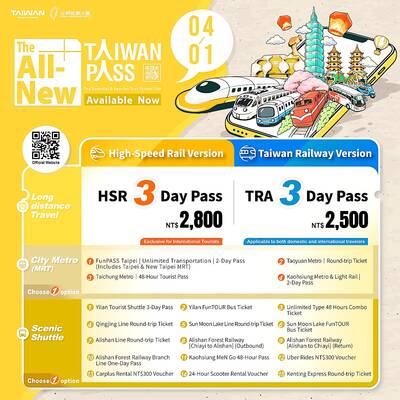
MORE POPULAR: Taiwan Pass sales increased by 59 percent during the first quarter compared with the same period last year, the Tourism Administration said The Tourism Administration yesterday said that it has streamlined the Taiwan Pass, with two versions available for purchase beginning today. The tourism agency has made the pass available to international tourists since 2024, allowing them to access the high-speed rail, Taiwan Railway Corp services, four MRT systems and four Taiwan Tourist Shuttles. Previously, five types of Taiwan Pass were available, but some tourists have said that the offerings were too complicated. The agency said only two types of Taiwan Pass would be available, starting from a three-day pass with the high-speed rail and a three-day pass with Taiwan Railway Corp. The former costs NT$2,800

The nation’s fastest supercomputer, Nano 4 (晶創26), is scheduled to be launched in the third quarter, and would be used to train large language models in finance and national defense sectors, the National Center for High-Performance Computing (NCHC) said. The supercomputer, which would operate at about 86.05 petaflops, is being tested at a new cloud computing center in the Southern Taiwan Science Park in Tainan. The exterior of the server cabinet features chip circuitry patterns overlaid with a map of Taiwan, highlighting the nation’s central position in the semiconductor industry. The center also houses Taiwania 2, Taiwania 3, Forerunner 1 and


 RSS
RSS