


President Ma Ying-jeou (馬英九) yesterday mistakenly said he would visit Costa Rica during his trip to Central American allies planned for next week.
Taiwan severed diplomatic ties with Costa Rica in June 2007 after the Central American nation switched recognition to China.
Ma said he was going to Honduras to attend the inauguration of president-elect Porfirio Lobo Sosa and that he also planned to “go to Costa Rica to see the ambassador and consul [to Haiti] who are hospitalized and have suffered serious injuries” during last week’s earthquake that devastated the Haitian capital, Port-au-Prince.
Ambassador to Haiti Hsu Mien-sheng (徐勉生) suffered a fracture to his left leg during the temblor, while Consul Chi Wang-teh (齊王德) sustained head injuries, facial lacerations, a broken rib and some chest and back injuries.
Hsu and Chi are currently hospitalized in the Dominican Republic’s capital, Santo Domingo.
They were sent there to receive medical attention after being dug out of the debris.
The pair were trapped for six hours before a rescue team discovered them.
Ma said he would consider whether his visit could result in inconvenience and that he would cancel the plan if there were signs that it could.
“The most important thing is for us to send our love and resources [to Haiti],” he said.
Ma made the remarks while meeting winners of this year’s model firefighters and volunteer firefighters at the Presidential Office yesterday morning.
Ma will visit Honduras from next Monday through Jan. 30 and is weighing the possibility of 赳isiting the Dominican Republic to express the nation’s support for quake victims.
Ma is scheduled to make a one-night stopover in San Francisco before heading to the Honduran capital of Tegucigalpa, and is expected to make a short stopover in Los Angeles on the way back to Taiwan.
Ma yesterday made yet another slip-up when he misidentified the leader of the country’s rescue team, Lin Chien-chih (林謙志), as Lin Chin-chih (林勤志).
Ma said that he was happy to have had a chance to talk with Lin on the telephone on Sunday night and that Lin told him the team had rescued a 35-year-old French UN worker.
Ma said he told Lin to stay safe, adding that “we are not afraid to risk our necks, but it will cause more trouble if accidents happen because we neglected to ensure our personal safety.”
Meanwhile, Presidential Office Spokesman Wang Yu-chi (王郁琦) said yesterday that Ma would be happy to meet US parliamentarians and local politicians during his stopovers in the US.
Wang said Legislative Speaker Wang Jin-pyng (王金平) conveyed a request by lawmakers that as fewer US senators were visiting Taiwan, they hoped Ma could invite more US parliamentarians during his stopovers in the US.
Senior officials attending yesterday’s weekly lunch hosted by Ma at the Presidential Office also said that they hoped Ma would take advantage of his transits in the US to mend fences with Washington after the US beef controversy.
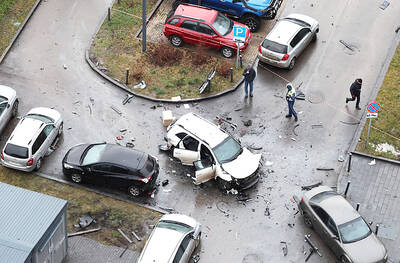
A car bomb killed a senior Russian general in southern Moscow yesterday morning, the latest high-profile army figure to be blown up in a blast that came just hours after Russian and Ukrainian delegates held separate talks in Miami on a plan to end the war. Kyiv has not commented on the incident, but Russian investigators said they were probing whether the blast was “linked” to “Ukrainian special forces.” The attack was similar to other assassinations of generals and pro-war figures that have either been claimed, or are widely believed to have been orchestrated, by Ukraine. Russian Lieutenant General Fanil Sarvarov, 56, head
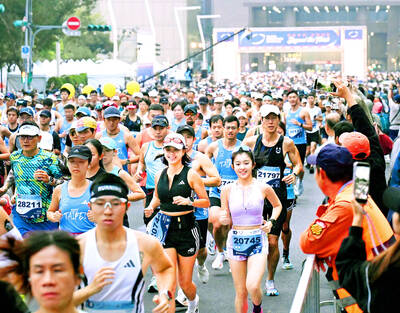
SAFETY FIRST: Double the number of police were deployed at the Taipei Marathon, while other cities released plans to bolster public event safety Authorities across Taiwan have stepped up security measures ahead of Christmas and New Year events, following a knife and smoke bomb attack in Taipei on Friday that left four people dead and 11 injured. In a bid to prevent potential copycat incidents, police deployments have been expanded for large gatherings, transport hubs, and other crowded public spaces, according to official statements from police and city authorities. Taipei Mayor Chiang Wan-an (蔣萬安) said the city has “comprehensively raised security readiness” in crowded areas, increased police deployments with armed officers, and intensified patrols during weekends and nighttime hours. For large-scale events, security checkpoints and explosives
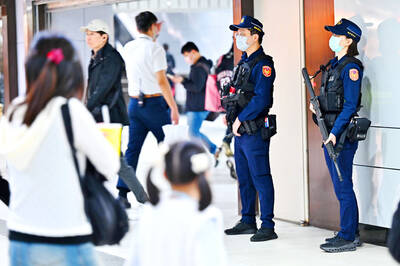
PUBLIC SAFETY: The premier said that security would be tightened in transport hubs, while President Lai commended the public for their bravery The government is to deploy more police, including rapid response units, in crowded public areas to ensure a swift response to any threats, President William Lai (賴清德) said yesterday after a knife attack killed three people and injured 11 in Taipei the previous day. Lai made the remarks following a briefing by the National Police Agency on the progress of the investigation, saying that the attack underscored the importance of cooperation in public security between the central and local governments. The attack unfolded in the early evening on Friday around Taipei Main Station’s M7 exit and later near the Taipei MRT’s Zhongshan
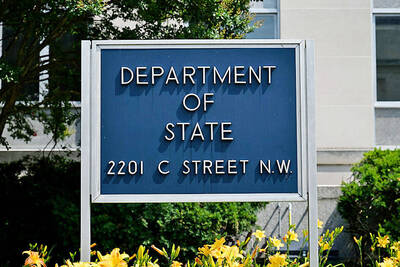
REBUFFED: In response to Chinese criticism over recent arms sales, Washington urged Beijing to engage in meaningful dialogue instead of threats and intimidation Washington’s long-term commitment to Taiwan would not change, the US Department of State said yesterday, urging Beijing to stop pressuring Taiwan and engage in meaningful bilateral dialogues. The remarks came in response to a backlash from Beijing about Washington’s latest approval of arms sales to Taiwan. The US Defense Security Cooperation Agency said in a statement on Wednesday that the Taipei Economic and Cultural Representative Office in the US has asked to purchase an arms package, including Tactical Mission Network Software; AH-1W helicopter spare and repair parts; M109A7 self-propelled howitzers; HIMARS long range precision strike systems; tube-launched, optically tracked, wire-guided missiles; Javelin


 RSS
RSS