


Shouting “incompetent government,” several hundred members of 10 labor unions yesterday threw cow dung and clashed with police during a protest in front of the Chinese Nationalist Party (KMT) headquarters as they urged President Ma Ying-jeou (馬英九) to review a proposed amendment to the Labor Union Law (工會法).
The protesters said they would never agree to the KMT caucus’ proposed version of the amendment, which suggests the government has the authority to disband unions.
“We demand the government adopt the union’s version of the amendment. We want President Ma to come out and talk to us,” group leader Chu Wei-li (朱維立) said.
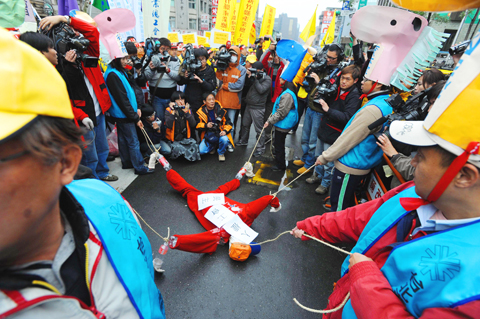
PHOTO: WANG YI-SUNG, TAIPEI TIMES
The union members also urged the government to carry out its promise of giving unions more authority over labor affairs and allowing them to supervise their own finances.
Ma, who arrived at KMT headquarters at about 2pm to preside over the KMT Central Standing Committee as party chairman, did not meet the demonstrators.
Failing to receive any response from Ma or other KMT officials, the protesters threw cow dung at the police, who stood behind barricades and shields. The police later held four protest leaders for questioning after they failed to stop the dung attack.
Shouting “Release our members,” the protesters later clashed with police as they tried to enter KMT headquarters and did not disperse until after Ma left the building.
Meanwhile, at a separate setting yesterday, representatives from civic groups criticized the government for what they said had been a year of empty promises and ineffective policies.
Representatives from a labor group, a teachers association and a banking union said this year could best be represented by the character “empty” (空), signifying a year of empty election promises on the part of the president and the loss of hope that the government would help struggling workers.
“The government has not sincerely followed up on promises that were made during the election campaign,” said Son Yu-lian (孫友聯), secretary-general of the Taiwan Labor Front. “The result is that workers on the bottom rung of the ladder can barely feel the economic recovery that is being reported in the media.”
Despite promises of stronger GDP growth and higher income per capita, this year has seen unemployment rates reach new highs, Son said.
Liu Chin-hsu (劉欽旭), secretary-general of the National Teachers’ Association, said Ma had promised to place labor-related course material on the public school curriculum, but a year had passed with no progress.
The civic groups gave the Ma administration a failing grade and said it needed to “retake the exam.”
They also said May 1 was the deadline for the “retake,” and if no significant improvement is made, the groups will take to the streets on May 20 to mark Ma’s second year in office.

LOUD AND PROUD Taiwan might have taken a drubbing against Australia and Japan, but you might not know it from the enthusiasm and numbers of the fans Taiwan might not be expected to win the World Baseball Classic (WBC) but their fans are making their presence felt in Tokyo, with tens of thousands decked out in the team’s blue, blowing horns and singing songs. Taiwanese fans have packed out the Tokyo Dome for all three of their games so far and even threatened to drown out home team supporters when their team played Japan on Friday. They blew trumpets, chanted for their favorite players and had their own cheerleading squad who dance on a stage during the game. The team struggled to match that exuberance on the field, with
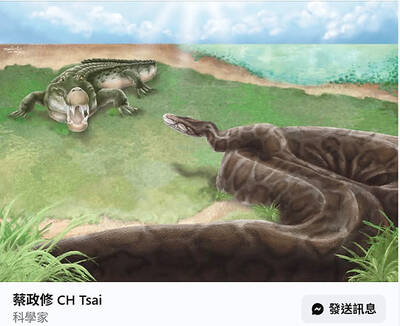
Taiwanese paleontologists have discovered fossil evidence that pythons up to 4m long inhabited Taiwan during the Pleistocene epoch, reporting their findings in the international scientific journal Historical Biology. National Taiwan University (NTU) Institute of Ecology and Evolutionary Biology associate professor Tsai Cheng-hsiu (蔡政修) led the team that discovered the largest snake fossil ever found in Taiwan. The single trunk vertebra was discovered in Tainan at the Chiting Formation, dated to between 400,000 and 800,000 years ago in the Middle Pleistocene, the paper said. The area also produced Taiwan’s first avian fossil, as well as crocodile, mammoth, saber-toothed cat and rhinoceros fossils, it said. Discoveries

Taiwanese paleontologists have discovered fossil evidence that pythons up to 4m long inhabited Taiwan during the Pleistocene epoch, reporting their findings in the international scientific journal Historical Biology. National Taiwan University (NTU) Institute of Ecology and Evolutionary Biology associate professor Tsai Cheng-hsiu (蔡政修) led the team that discovered the largest snake fossil ever found in Taiwan. A single trunk vertebra was discovered in Tainan at the Chiting Formation, dated to between 800,000 to 400,000 years ago in the Middle Pleistocene, the paper said. The area also produced Taiwan’s first avian fossil, as well as crocodile, mammoth, sabre-toothed cat and rhinoceros fossils, it said. Discoveries
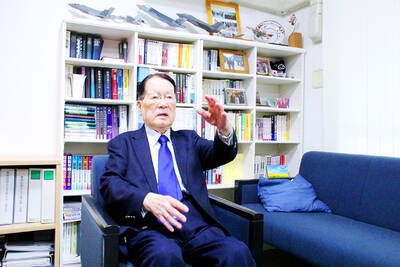
Whether Japan would help defend Taiwan in case of a cross-strait conflict would depend on the US and the extent to which Japan would be allowed to act under the US-Japan Security Treaty, former Japanese minister of defense Satoshi Morimoto said. As China has not given up on the idea of invading Taiwan by force, to what extent Japan could support US military action would hinge on Washington’s intention and its negotiation with Tokyo, Morimoto said in an interview with the Liberty Times (sister paper of the Taipei Times) yesterday. There has to be sufficient mutual recognition of how Japan could provide


 RSS
RSS