


An offshoot of a secessionist group with ties to al-Qaeda is threatening revenge for the deaths of Muslim Uighurs in clashes with Chinese earlier this month, a US group that monitors militant Web sites said.
The Washington-based SITE Intelligence Group said a video released this week by the Turkistan Islamic Party condemned the July 5 violence between Chinese and Uighurs in the Xinjiang region that stemmed from a brawl between the two sides in southern China last month.
Seyfullah, military commander of the Turkistan Islamic Party (TIP), said in the video that the two incidents were examples of “genocide” perpetrated by the Chinese government.
“Know that this Muslim people have men who will take revenge for them,” he said in the message, which was issued on jihadist forums on Thursday and translated by SITE a day later. “Soon, the horsemen of Allah will attack you, Allah willing. So lie in wait; indeed, we lie in wait with you.”
It is not the first time TIP has threatened China. Days before last year’s Beijing Olympics, it warned it would attack Chinese cities.
The July 5 unrest began in Xinjiang’s capital of Urumqi, where a peaceful protest by Uighur residents turned violent after it was stopped by police. The protesters went on a rampage, smashing windows, burning cars and beating Han Chinese.
Two days later, ethnic Han took to the streets and attacked Uighurs. The government has said the rioting killed 192 people and injured 1,721.
There is no evidence that terrorist or separatist groups were behind the clashes, although Beijing has labeled the event the work of the forces of “terrorism, separatism and extremism.”
Authorities accuse Rebiya Kadeer, a prominent exiled Uighur activist, of inciting the unrest. They have not provided evidence to back their claim, and Kadeer, who lives in Washington, has denied the accusation.
The initial protest was centered on calls for an investigation into the June 25 deaths of Uighur factory workers killed in a brawl with Han Chinese in the southern city of Shaoguan. State media reports said only two people died.
In the days that followed, however, graphic photos spread on the Internet purportedly showing at least a half-dozen dead Uighurs, with Han Chinese standing over them, arms raised in victory.
Uighurs, who allege that Han Chinese migrating to Xinjiang are stealing their jobs and complain about government restrictions on their Muslim religion, said the incident was an example of how little Beijing cares about them.
“Kill the Chinese communists wherever you find them. Capture them and besiege them and lie in wait for each and every ambush,” Seyfullah said in the video, which contained a photo of him in camouflage, his face mostly swathed in white cloth.
“We ask Allah to torture our enemies in general and the Chinese in particular with a special torture,” he said.
Chinese authorities claim TIP is an offshoot of the East Turkestan Islamic Movement (ETIM), a group fighting to end Chinese rule in Xinjiang, or what some Muslims call East Turkestan.
ETIM was based in Afghanistan before the US invasion and is listed as a terrorist organization by the US.

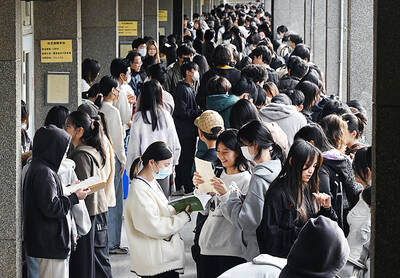
A global survey showed that 60 percent of Taiwanese had attained higher education, second only to Canada, the Ministry of the Interior said. Taiwan easily surpassed the global average of 43 percent and ranked ahead of major economies, including Japan, South Korea and the US, data from the Organisation for Economic Co-operation and Development (OECD) for 2024 showed. Taiwan has a high literacy rate, data released by the ministry showed. As of the end of last year, Taiwan had 20.617 million people aged 15 or older, accounting for 88.5 percent of the total population, with a literacy rate of 99.4 percent, the data

NEW LOW: The council in 2024 based predictions on a pessimistic estimate for the nation’s total fertility rate of 0.84, but last year that rate was 0.69, 17 percent lower An expected National Development Council (NDC) report expects the nation’s population to drop below 12 million by 2065, with the old-age dependency ratio to top 100 percent sooner than 2070, sources said yesterday. The council is slated to release its latest population projections in August, using an ultra-low fertility model, the sources said. The previous report projected that Taiwan’s population would fall to 14.37 million by 2070, but based on a new estimate of the total fertility rate (TFR) — the average number of children born to a woman over her lifetime — the population is expected to reach 12 million by
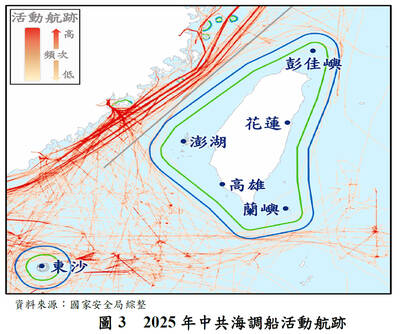
INTENSIFYING THREATS: Beijing’s tactics include massive attacks on the government service network, aircraft and naval vessel incursions and damaging undersea cables China is prepared to interfere in November’s nine-in-one local elections by launching massive attacks on the Taiwanese government’s service network (GSN), a report published by the National Security Bureau showed. The report was submitted to the Legislative Yuan ahead of the bureau’s scheduled briefing at the Foreign Affairs and National Defense Committee tomorrow. The national security team has identified about 13,000 suspicious Internet accounts and 860,000 disputed messages, the bureau said of China’s cognitive warfare against Taiwan. The disputed messages focus on major foreign affairs, national defense and economic issues, which were produced using generative artificial intelligence (AI) and distributed through Chinese

COUNTERING HOSTILITY: The draft bill would require the US to increase diplomatic pressure on China and would impose sanctions on those who sabotage undersea cable networks US lawmakers on Thursday introduced a bipartisan bill to bolster the resilience of Taiwan’s submarine cables to counter China’s hostile activities. The proposal, titled the critical undersea infrastructure resilience initiative act, was cosponsored by Republican representatives Mike Lawler and Greg Stanton, and Democratic Representative Dave Min. US Senators John Curtis and Jacky Rosen also introduced a companion bill in the US Senate, which has passed markup at the chamber’s Committee on Foreign Relations. The House’s version of the bill would prioritize the deployment of sensors to detect disruptions or potential sabotage in real-time and enhance early warning capabilities through global intelligence sharing frameworks,


 RSS
RSS