


President Ma Ying-jeou (馬英九) said yesterday he hoped the economy would improve this year, but acknowledged that it would not be easy.
“It will take a lot of effort and maybe some luck, because much of it cannot be changed by our efforts alone,” Ma said while speaking at the Presidential Office’s Lunar New Year greetings ceremony yesterday morning.
Ma said the public might have the impression that he did not jump to the “front line” in responding to public concerns, but that was because his constitutional duty is to set policy for cross-strait relations, national defense and foreign affairs.
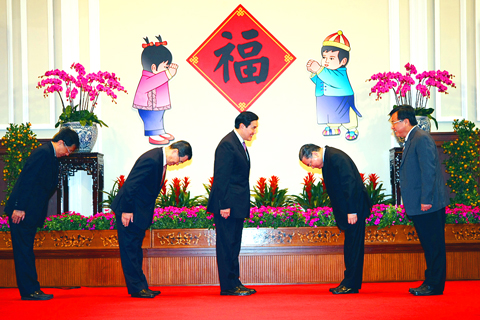
PHOTO: CNA
There is no such thing as a “front line” or “second line,” Ma said, because he and Vice President Vincent Siew (蕭萬長) participated in the decision-making process for major government policies, such as providing 100 percent guarantees on bank deposits, issuing consumer vouchers, implementing economic stimulus measures and creating jobs.
Ma also lauded his policies on national defense, cross-strait affairs and other foreign affairs, saying his approach had yielded positive effects and received “universal welcome” from the international community.
Ma said Beijing’s gift of two giant pandas demonstrated the improved atmosphere in the Taiwan Strait. What mattered was not that the public had the opportunity to see the rare animals, he said, but that Taiwan had reached the global standard in conserving endangered species.
“First, the Convention on International Trade in Endangered Species [CITES] was not against the matter,” Ma said. “And second, both sides of the Taiwan Strait look at the pandas from a humane point of view, rather than from a political viewpoint.”
The secretariat of CITES considered the importation of the pandas from China as “domestic trade” and as such did not need to be reported to CITES.
Ma said that eased cross-strait tensions not only took a lot of pressure off his administration, but also “pushed forward government policies in the right direction.”
“There won’t be any unexpected or strange situation,” he said. “That is the normal thing that a normal country and a normal government should do.”
Ma said that he expected to see a challenge on the economic front, but that a clean, efficient, proactive and friendly government would help resolve the problem.
Later, speaking at the Chinese Nationalist Party (KMT) Lunar New Year greeting ceremony, Ma said the direction of government policy to combat the global financial crisis was correct and that the Executive Yuan deserved recognition for formulating good policies, including the consumer vouchers.

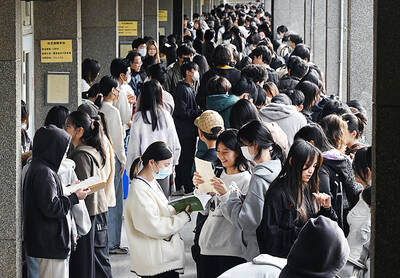
A global survey showed that 60 percent of Taiwanese had attained higher education, second only to Canada, the Ministry of the Interior said. Taiwan easily surpassed the global average of 43 percent and ranked ahead of major economies, including Japan, South Korea and the US, data from the Organisation for Economic Co-operation and Development (OECD) for 2024 showed. Taiwan has a high literacy rate, data released by the ministry showed. As of the end of last year, Taiwan had 20.617 million people aged 15 or older, accounting for 88.5 percent of the total population, with a literacy rate of 99.4 percent, the data

NEW LOW: The council in 2024 based predictions on a pessimistic estimate for the nation’s total fertility rate of 0.84, but last year that rate was 0.69, 17 percent lower An expected National Development Council (NDC) report expects the nation’s population to drop below 12 million by 2065, with the old-age dependency ratio to top 100 percent sooner than 2070, sources said yesterday. The council is slated to release its latest population projections in August, using an ultra-low fertility model, the sources said. The previous report projected that Taiwan’s population would fall to 14.37 million by 2070, but based on a new estimate of the total fertility rate (TFR) — the average number of children born to a woman over her lifetime — the population is expected to reach 12 million by
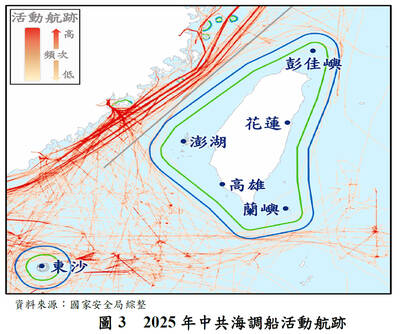
INTENSIFYING THREATS: Beijing’s tactics include massive attacks on the government service network, aircraft and naval vessel incursions and damaging undersea cables China is prepared to interfere in November’s nine-in-one local elections by launching massive attacks on the Taiwanese government’s service network (GSN), a report published by the National Security Bureau showed. The report was submitted to the Legislative Yuan ahead of the bureau’s scheduled briefing at the Foreign Affairs and National Defense Committee tomorrow. The national security team has identified about 13,000 suspicious Internet accounts and 860,000 disputed messages, the bureau said of China’s cognitive warfare against Taiwan. The disputed messages focus on major foreign affairs, national defense and economic issues, which were produced using generative artificial intelligence (AI) and distributed through Chinese
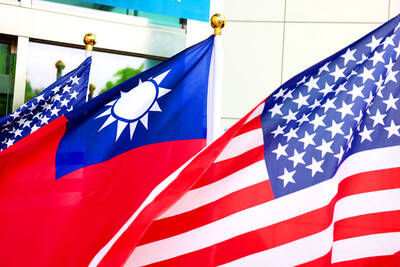
COUNTERING HOSTILITY: The draft bill would require the US to increase diplomatic pressure on China and would impose sanctions on those who sabotage undersea cable networks US lawmakers on Thursday introduced a bipartisan bill to bolster the resilience of Taiwan’s submarine cables to counter China’s hostile activities. The proposal, titled the critical undersea infrastructure resilience initiative act, was cosponsored by Republican representatives Mike Lawler and Greg Stanton, and Democratic Representative Dave Min. US Senators John Curtis and Jacky Rosen also introduced a companion bill in the US Senate, which has passed markup at the chamber’s Committee on Foreign Relations. The House’s version of the bill would prioritize the deployment of sensors to detect disruptions or potential sabotage in real-time and enhance early warning capabilities through global intelligence sharing frameworks,


 RSS
RSS