


Kenyan runners won both the men’s and women’s titles in the 2008 ING Taipei International Marathon yesterday.
Sammy Chumba won the men’s title with a time of 2 hours, 15 minutes and 37 seconds, while Caroline Kilel took the women’s title, clocking 2:30:44 and knocking 26 seconds off her previous personal best in the process.
Chumba’s countrymen Chelimo Luka Kipkemboi (2:15:43) and Lawrence Kiptoo Saina (2:16:32) came in second and third respectively in the men’s race, while Tabitha Tsatsa of Zimbabwe came second with a time of 2hrs 35mins 46secs and Suzuki Junko of Japan came in third at 2hrs 45 minutes and 25 seconds in the women’s.
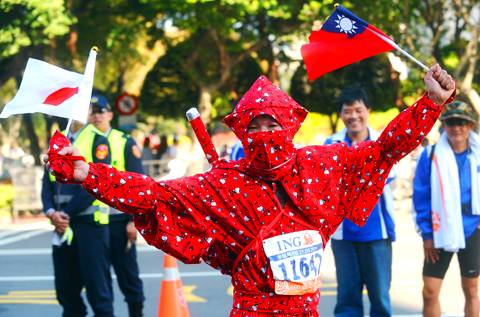
PHOTO: LIN CHENG-KUNG, TAIPEI TIMES
Kilel took home NT$1.33 million (US$41,000) in prize money after breaking the 151-minute Taipei marathon women’s record set by her countrywoman Jane Auro in 2006. Chumba collected the first prize of NT$100,000 for his win.
Kilel said she would use her prize money to buy a piece of land in her home country. As a professional athlete, Kilel said, she depends entirely on her sport for a living.
Chumba said he would use his prize money to make improvements to his home and improve his family’s living conditions.
Local marathoner Wu Wen-chien (吳文騫) won the Taiwanese men’s title in a time of 2:17:24, while Hsu Yu-fang (�?�) won the Taiwanese women’s title in 2:47:00. Wu finished fourth in the men’s marathon and Hsu finished 19th in the women’s.
The 2008 ING Taipei International Marathon kicked off at 7am at the plaza in front of Taipei City Hall, with 121,000 runners from 40 countries taking part in five categories of road racing, said ING Antai Insurance Co, a key sponsor of the event.
A record 27,000-plus runners competed this year, representing a year-on-year increase of 30 percent, the ING said.
This year also marked the last time that the annual road race is held under the title of the “ING Taipei International Marathon,” as the company is now owned by Fubon Financial Holding Co (富邦金控), which in October announced it would acquire ING Life Insurance (Taiwan) for US$600 million.
The new owner is expected to continue holding the race, as ING had previously signed a three-year contract with the Taipei City Government, which is still valid next year.
The title, however, may have to be changed.
“We are confident that we will do it well, of course,” Fubon president Victor Kung (龔天行) said in a TV news interview yesterday. “The company is also known for its healthy image.”
ADDITIONAL REPORTING BY SHELLEY SHAN

The nation’s fastest supercomputer, Nano 4 (晶創26), is scheduled to be launched in the third quarter, and would be used to train large language models in finance and national defense sectors, the National Center for High-Performance Computing (NCHC) said. The supercomputer, which would operate at about 86.05 petaflops, is being tested at a new cloud computing center in the Southern Taiwan Science Park in Tainan. The exterior of the server cabinet features chip circuitry patterns overlaid with a map of Taiwan, highlighting the nation’s central position in the semiconductor industry. The center also houses Taiwania 2, Taiwania 3, Forerunner 1 and

FIRST TRIAL: Ko’s lawyers sought reduced bail and other concessions, as did other defendants, but the bail judge denied their requests, citing the severity of the sentences Former Taipei mayor Ko Wen-je (柯文哲) was yesterday sentenced to 17 years in prison and had his civil rights suspended for six years over corruption, embezzlement and other charges. Taipei prosecutors in December last year asked the Taipei District Court for a combined 28-year, six-month sentence for the four cases against Ko, who founded the Taiwan People’s Party (TPP). The cases were linked to the Core Pacific City (京華城購物中心) redevelopment project and the mismanagement of political donations. Other defendants convicted on separate charges included Chinese Nationalist Party (KMT) Taipei City Councilor Angela Ying (應曉薇), who was handed a 15-year, six-month sentence; Core Pacific
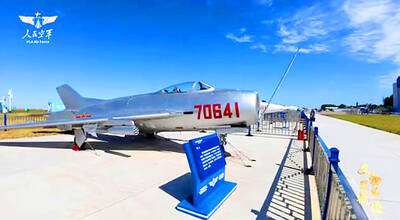
J-6 REMODEL: The converted drones are part of Beijing’s expanding mix of airpower weapons, including bombers with stand-off missiles and UAV swarms, the report said China has stationed obsolete supersonic fighters converted to attack drones at six air bases close to the Taiwan Strait, a report published this month by the Arlington, Virginia-based Mitchell Institute for Aerospace Studies said. Satellite imagery of the airfields from the institute’s “China Airpower Tracker” shows what appear to be lines of stubby, swept-winged aircraft matching the shape of J-6 fighters that first flew with the Chinese People’s Liberation Army (PLA) Air Force in the 1960s. Since their conversion to drones, the aircraft have been identified at five bases in China’s Fujian Province and one in Guangdong Province, the report said. J.

China used fake LinkedIn profiles to harvest sensitive data from NATO and EU institutions by soliciting information from staff, a European security source said on Friday. The operation, allegedly orchestrated by the Chinese Ministry of State Security, targeted dozens of employees at the military alliance or EU organizations through fictitious accounts, the source said, confirming reports in French and Belgian media. Posing as recruiters on the online professional networking platform, Chinese spies would initially request paid reports before later soliciting non-public or even classified information. One particularly active fake profile used the name “Kevin Zhang,” claiming to be the head


 RSS
RSS