


Helicopter-borne French troops swooped in on Somali pirates after they released 30 hostages from a yacht, seizing six of the pirates and recovering sacks of money — apparently ransom paid by the yacht’s owners to win the captives’ release.
The pirates had boarded the 88m French luxury yacht Ponant a week ago, capturing its crew off the coast of Somalia.
General Jean-Louis Georgelin, the chief of staff of France’s armed forces, said the pirates released the hostages on Friday after negotiations with the ship’s owner. That phase of the operation was calm, with no weapons fired and the hostages brought smoothly to safely, he said.
Afterward, however, a French attack helicopter chased a vehicle belonging to the pirates as it fled the scene, firing to destroy its engine, he said. There were conflicting reports about what happened next.
Dahir Abdulqadir, a governor in the region where the yacht was held, said officials had heard “reports over VHF radio that at least eight people were killed.” The office of French President Nicolas Sarkozy “categorically denied” that any pirates died in the raid.
Georgelin said six pirates — half the total — were brought into French custody with clearance from Somalia. He said they would be tried in French courts.
The pirates “gave themselves up without too much difficulty,” he said.
While insisting the French state did not pay a ransom, the general hinted heavily that the boat’s owners did.
“Naturally, absolutely no public money was paid in this affair,” Georgelin said.
“Check with the ship owner. In capturing the pirates, we also recovered some interesting bags. We recovered part of the ransom that was probably paid,” he said
An official in Somalia’s semiautonomous Puntland region, near where the yacht was held, had warned France earlier this week against paying a ransom, saying it would encourage pirates to continue taking hostages.
The chief of the company that owns the ship declined to comment on the issue.
“It’s obviously a very delicate and difficult context, and so the only thing you should take from this is the outcome — crew members who are going to be able to go home to their families,’’ Jean-Emmanuel Sauvee told reporters after meeting with Sarkozy and families of the freed hostages.
Karim Meghoufel, the brother-in-law of a pastry chef on board the boat, said, “We don’t know how much they paid, and in any case, we don’t want to know.”
The hostages, including six Filipinos and a Ukrainian, were in good condition on Friday, officials said.
After the hostages were freed, they were put on a French military vessel and sent toward Djibouti. Family members said they were expected back in France today.
According to the shipowner’s Web site, the three-mast, 64-passenger Ponant features four decks, two restaurants and indoor and outdoor luxury lounges. About a dozen pirates stormed the yacht on April 4 as it was returning without passengers from the Seychelles, in the Indian Ocean, toward the Mediterranean Sea.
France’s military quickly mobilized, sending in military vessels and a commando force that conducts anti-terrorist and hostage rescue operations.
Somalia has been wracked by more than a decade of violence and anarchy and does not have its own navy. A transitional government formed in 2004 with UN help has struggled to assert control.
Sarkozy’s chief diplomatic aide, Jean-David Levitte, said France planned to pitch anti-piracy measures to the UN Security Council.
One suggestion is for states that can afford it to help with maritime patrols in waters where pirate attacks are a problem, he said.
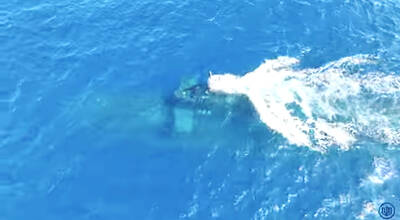
CSBC Corp, Taiwan (台灣國際造船) yesterday released the first video documenting the submerged sea trials of Taiwan’s indigenous defense submarine prototype, the Hai Kun (海鯤), or Narwhal, showing underwater navigation and the launch of countermeasures. The footage shows the vessel’s first dive, steering and control system tests, and the raising and lowering of the periscope and antenna masts. It offered a rare look at the progress in the submarine’s sea acceptance tests. The Hai Kun carried out its first shallow-water diving trial late last month and has since completed four submerged tests, CSBC said. The newly released video compiles images recorded from Jan. 29 to
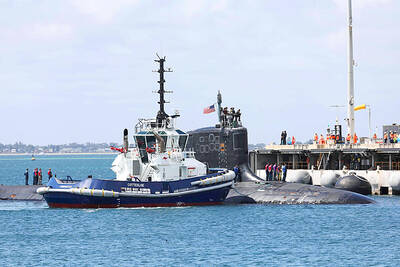
DETERRENCE EFFORTS: Washington and partners hope demonstrations of force would convince Beijing that military action against Taiwan would carry high costs The US is considering using HMAS Stirling in Western Australia as a forward base to strengthen its naval posture in a potential conflict with China, particularly over Taiwan, the Wall Street Journal reported on Saturday. As part of its Indo-Pacific strategy, Washington plans to deploy up to four nuclear-powered submarines at Stirling starting in 2027, providing a base near potential hot spots such as Taiwan and the South China Sea. The move also aims to enhance military integration with Pacific allies under the Australia-UK-US trilateral security partnership, the report said. Currently, US submarines operate from Guam, but the island could
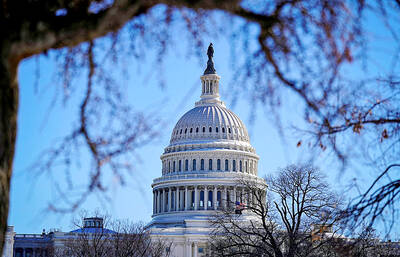
RESTRAINTS: Should China’s actions pose any threat to Taiwan’s security, economic or social systems, China would be excluded from major financial institutions, the bill says The US House of Representatives on Monday passed the PROTECT Taiwan Act, which states that Washington would exclude China from participating in major global financial organizations if its actions directly threaten Taiwan’s security. The bill, proposed by Republican Representative Frank Lucas, passed with 395 votes in favor and two against. It stipulates that if China’s actions pose any threat to Taiwan’s security, economic or social systems, the US would, “to the maximum extent practicable,” exclude Beijing from international financial institutions, including the G20, the Bank for International Settlements and the Financial Stability Board. The bill makes it clear that China must be prepared

Taiwanese trade negotiators told Washington that Taipei would not relocate 40 percent of its semiconductor production to the US, and that its most advanced technologies would remain in the nation, Vice Premier Cheng Li-chiun (鄭麗君) said on Sunday. “I told the US side very clearly — that’s impossible,” Cheng, who led the negotiation team, said in an interview that aired on Sunday night on Chinese Television System. Cheng was referring to remarks last month by US Secretary of Commerce Howard Lutnick, in which he said his goal was to bring 40 percent of Taiwan’s chip supply chain to the US Taiwan’s almost


 RSS
RSS