


President Chen Shui-bian (陳水扁) instructed the Coast Guard Administration (CGA) yesterday to turn itself into a "three-dimensional" force to upgrade its ability to safeguard security and maintain order along the nation's coastlines and offshore areas.
Addressing the opening of a maritime anti-hijacking drill held at the eastern fishing port of Suao (
Chen said that yesterday's drill, designed from a global antiterrorism perspective, was mainly aimed at examining the coast guard's preparedness to deal with contingencies and honing its response capabilities to handle situations such as fishing boat hijackings.
connection
With the Taiwan Strait on one side and the Pacific Ocean on the other, nearly every aspect of the nation, from national security, economic development and daily activities, is inextricably connected with the ocean, Chen said.
Maritime affairs and related matters have therefore been among the areas the government has worked hardest to address, he said.
Chen praised the CGA for its commendable performance since Wang Chin-wang (
In a sweeping operation initiated in March, he said, a total of 134 smuggled handguns, 86 modified firearms and nearly 20,000 rounds of ammunition, as well as some 900kg of illicit narcotics, have been seized.
In another operation conducted by the CGA, the Council of Agriculture and other agencies between last November and March, a total of 557 tonnes of smuggled agricultural products, 700 tonnes of fishery products, some 5 million packs of cigarettes and more than 7,600 head of livestock were confiscated and destroyed.
Yesterday's drill involved 27 patrol craft, three helicopters and 780 CGA officers and crew who demonstrated the coast guard's abilities in anti-hijacking, rescue at sea and environmental protection operations.
illegal dredging
Meanwhile, Kinmen coast guard officials said yesterday they had intercepted a Chinese boat that was engaging in illegal sea sand dredging off the outlying island.
Ten Chinese suspects were arrested, the officials said.
The arrests came just a week after officials caught a Chinese ship conducting similar activities in Kinmen waters, the officials said.
Dredging destroys the ecological landscape, posing a threat to ocean creatures and other boats, the officials said, adding they would continue the crackdown to protect the area's natural resources.
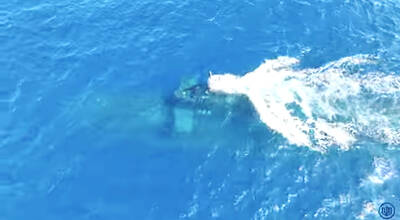
CSBC Corp, Taiwan (台灣國際造船) yesterday released the first video documenting the submerged sea trials of Taiwan’s indigenous defense submarine prototype, the Hai Kun (海鯤), or Narwhal, showing underwater navigation and the launch of countermeasures. The footage shows the vessel’s first dive, steering and control system tests, and the raising and lowering of the periscope and antenna masts. It offered a rare look at the progress in the submarine’s sea acceptance tests. The Hai Kun carried out its first shallow-water diving trial late last month and has since completed four submerged tests, CSBC said. The newly released video compiles images recorded from Jan. 29 to
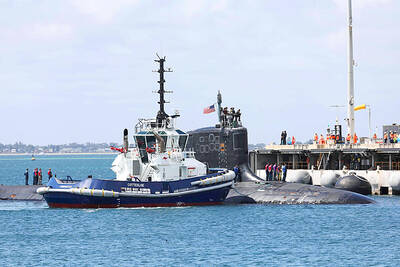
DETERRENCE EFFORTS: Washington and partners hope demonstrations of force would convince Beijing that military action against Taiwan would carry high costs The US is considering using HMAS Stirling in Western Australia as a forward base to strengthen its naval posture in a potential conflict with China, particularly over Taiwan, the Wall Street Journal reported on Saturday. As part of its Indo-Pacific strategy, Washington plans to deploy up to four nuclear-powered submarines at Stirling starting in 2027, providing a base near potential hot spots such as Taiwan and the South China Sea. The move also aims to enhance military integration with Pacific allies under the Australia-UK-US trilateral security partnership, the report said. Currently, US submarines operate from Guam, but the island could
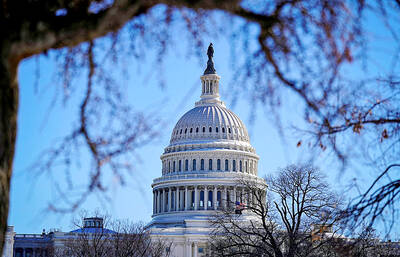
RESTRAINTS: Should China’s actions pose any threat to Taiwan’s security, economic or social systems, China would be excluded from major financial institutions, the bill says The US House of Representatives on Monday passed the PROTECT Taiwan Act, which states that Washington would exclude China from participating in major global financial organizations if its actions directly threaten Taiwan’s security. The bill, proposed by Republican Representative Frank Lucas, passed with 395 votes in favor and two against. It stipulates that if China’s actions pose any threat to Taiwan’s security, economic or social systems, the US would, “to the maximum extent practicable,” exclude Beijing from international financial institutions, including the G20, the Bank for International Settlements and the Financial Stability Board. The bill makes it clear that China must be prepared

Taiwanese trade negotiators told Washington that Taipei would not relocate 40 percent of its semiconductor production to the US, and that its most advanced technologies would remain in the nation, Vice Premier Cheng Li-chiun (鄭麗君) said on Sunday. “I told the US side very clearly — that’s impossible,” Cheng, who led the negotiation team, said in an interview that aired on Sunday night on Chinese Television System. Cheng was referring to remarks last month by US Secretary of Commerce Howard Lutnick, in which he said his goal was to bring 40 percent of Taiwan’s chip supply chain to the US Taiwan’s almost


 RSS
RSS