


Premier Su Tseng-chang (
The Central Deposit Insurance Corp (CDIC) was instructed by the Financial Supervisory Commission (FSC) to take over The Chinese Bank -- a member of the Rebar Asia Pacific Group -- on Saturday in the wake of a bank run triggered by the insolvency of two other companies.
Su said the government had stepped in to take care of the crisis to ensure that not a dollar of clients' money would be affected. He urged the public to stop withdrawing deposits from The Chinese Bank, stressing that their savings were secure and that depositors "will not lose even a dime [from The Chinese Bank.]"
An advertisement was placed on the front page of several local newspapers yesterday, endorsed by FSC Chairman Shih Jun-ji (施俊吉), Minister of Finance Ho Chih-chin (何志欽) and central bank Governor Perng Fai-nan (彭淮南).
The advertisement read: "The government has taken over The Chinese Bank. It has become a bank owned by the government. The national treasury guarantees all types of deposits, regardless of the amount."
Su also outlined principles for handling the financial crisis of the Rebar Asia Pacific Group and investigating whether there was premeditation behind insolvency claims made by the group's two units.
"We will deal with the case in accordance with three principles -- banning responsible persons from the group from leaving the country, freezing their assets and punishing their irregularities severely," Su told the press yesterday morning.
A Cabinet official later said that Su had suggested that some aspects of the insolvency claims may have broken the law.
"The reasons why [China Rebar Co (
Later yesterday, Shih, Ho and Perng along with President of the Central Deposit Insurance Corp (CDIC) Johnson Chen (
"Today the CDIC withdrew NT$11 billion from the central bank and injected it into The Chinese Bank. Another NT$20 billion [US$613.2 million] is to be allotted to The Chinese Bank tomorrow [today], which will be enough for withdrawals," Chen said.
During the press conference, Shih said that there would be no crisis triggered by Rebar Group's financial troubles because the government had "more than NT$100 billion" in funds at its disposal in case of problems.
also see stories:
Rebar chief fled to China before insolvency claims
New bank runs not likely, analysts say

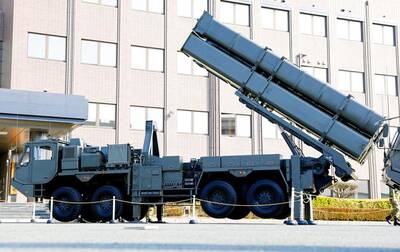
Japan has deployed long-range missiles in a southwestern region near China, the Japanese defense minister said yesterday, at a time when ties with Beijing are at their lowest in recent years. The missiles were installed in Kumamoto in the southern region of Kyushu, as Japan is attempting to shore up its military capacity as China steps up naval activity in the East China Sea. “Standoff defense capabilities enable us to counter the threat of enemy forces attempting to invade our country ... while ensuring the safety of our personnel,” Japanese Minister of Defense Shinjiro Koizumi said. “This is an extremely important initiative for

MORE POPULAR: Taiwan Pass sales increased by 59 percent during the first quarter compared with the same period last year, the Tourism Administration said The Tourism Administration yesterday said that it has streamlined the Taiwan Pass, with two versions available for purchase beginning today. The tourism agency has made the pass available to international tourists since 2024, allowing them to access the high-speed rail, Taiwan Railway Corp services, four MRT systems and four Taiwan Tourist Shuttles. Previously, five types of Taiwan Pass were available, but some tourists have said that the offerings were too complicated. The agency said only two types of Taiwan Pass would be available, starting from a three-day pass with the high-speed rail and a three-day pass with Taiwan Railway Corp. The former costs NT$2,800
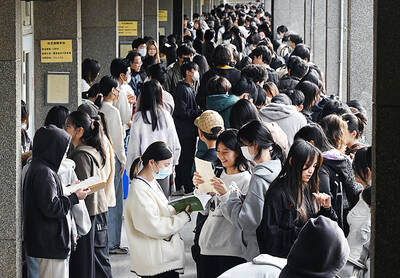
A global survey showed that 60 percent of Taiwanese had attained higher education, second only to Canada, the Ministry of the Interior said. Taiwan easily surpassed the global average of 43 percent and ranked ahead of major economies, including Japan, South Korea and the US, data from the Organisation for Economic Co-operation and Development (OECD) for 2024 showed. Taiwan has a high literacy rate, data released by the ministry showed. As of the end of last year, Taiwan had 20.617 million people aged 15 or older, accounting for 88.5 percent of the total population, with a literacy rate of 99.4 percent, the data

NEW LOW: The council in 2024 based predictions on a pessimistic estimate for the nation’s total fertility rate of 0.84, but last year that rate was 0.69, 17 percent lower An expected National Development Council (NDC) report expects the nation’s population to drop below 12 million by 2065, with the old-age dependency ratio to top 100 percent sooner than 2070, sources said yesterday. The council is slated to release its latest population projections in August, using an ultra-low fertility model, the sources said. The previous report projected that Taiwan’s population would fall to 14.37 million by 2070, but based on a new estimate of the total fertility rate (TFR) — the average number of children born to a woman over her lifetime — the population is expected to reach 12 million by


 RSS
RSS