


Britons and other Europeans who fly to the US could have their credit-card transactions as well as e-mail messages inspected by US officials, a British newspaper reported yesterday.
Under a US-EU deal struck in October, the Daily Telegraph said passengers face having other transactions on their credit cards inspected by US authorities if they use the card to reserve flights.
Under the headline "license to snoop" on flying Britons, the daily added that passengers who provide an e-mail address to an airline could see other messages sent or received on that account studied by the US government.
The paper said the details were revealed in "undertakings" given by the US Department of Homeland Security to the EU and published by Britain's Department for Transport following a Freedom of Information request.
A department spokesman told the Telegraph: "Every airline is obliged to conform with these rules if they wish to continue flying. As part of the terms of carriage, it is made clear to passengers what these requirements are."
"The US government has given undertakings on how this data will be used and who will see it," he said.
However, Shami Chakrabarti, the director of the human-rights group Liberty, was quoted as telling the newspaper she was horrified at the extent of the information made available.
"It is making the act of buying a ticket a gateway to a host of personal e-mail and financial information. While there are safeguards, it appears you would have to go to a US court to assert your rights," Chakrabarti said.
With the security clampdown that followed the Sept. 11 attacks on the US, Washington demanded that airlines yield full details about passengers before allowing them to land, the newspaper said.
However, EU governments threatened to impose heavy fines on the airlines for breaches of European data protection legislation.
In October, the EU agreed to remove the "bureaucratic hurdles" preventing airlines handing over such information after the US authorities threatened to bar European carriers. Washington meanwhile promised to "encourage" US airlines to make similar information available to EU governments rather than force them to do so, the newspaper said.

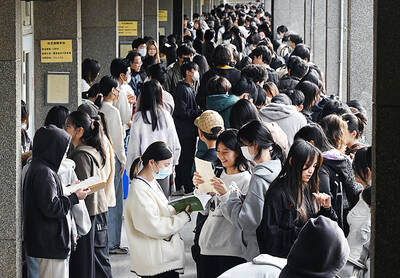
A global survey showed that 60 percent of Taiwanese had attained higher education, second only to Canada, the Ministry of the Interior said. Taiwan easily surpassed the global average of 43 percent and ranked ahead of major economies, including Japan, South Korea and the US, data from the Organisation for Economic Co-operation and Development (OECD) for 2024 showed. Taiwan has a high literacy rate, data released by the ministry showed. As of the end of last year, Taiwan had 20.617 million people aged 15 or older, accounting for 88.5 percent of the total population, with a literacy rate of 99.4 percent, the data

NEW LOW: The council in 2024 based predictions on a pessimistic estimate for the nation’s total fertility rate of 0.84, but last year that rate was 0.69, 17 percent lower An expected National Development Council (NDC) report expects the nation’s population to drop below 12 million by 2065, with the old-age dependency ratio to top 100 percent sooner than 2070, sources said yesterday. The council is slated to release its latest population projections in August, using an ultra-low fertility model, the sources said. The previous report projected that Taiwan’s population would fall to 14.37 million by 2070, but based on a new estimate of the total fertility rate (TFR) — the average number of children born to a woman over her lifetime — the population is expected to reach 12 million by
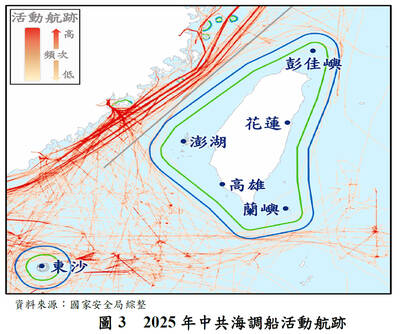
INTENSIFYING THREATS: Beijing’s tactics include massive attacks on the government service network, aircraft and naval vessel incursions and damaging undersea cables China is prepared to interfere in November’s nine-in-one local elections by launching massive attacks on the Taiwanese government’s service network (GSN), a report published by the National Security Bureau showed. The report was submitted to the Legislative Yuan ahead of the bureau’s scheduled briefing at the Foreign Affairs and National Defense Committee tomorrow. The national security team has identified about 13,000 suspicious Internet accounts and 860,000 disputed messages, the bureau said of China’s cognitive warfare against Taiwan. The disputed messages focus on major foreign affairs, national defense and economic issues, which were produced using generative artificial intelligence (AI) and distributed through Chinese

COUNTERING HOSTILITY: The draft bill would require the US to increase diplomatic pressure on China and would impose sanctions on those who sabotage undersea cable networks US lawmakers on Thursday introduced a bipartisan bill to bolster the resilience of Taiwan’s submarine cables to counter China’s hostile activities. The proposal, titled the critical undersea infrastructure resilience initiative act, was cosponsored by Republican representatives Mike Lawler and Greg Stanton, and Democratic Representative Dave Min. US Senators John Curtis and Jacky Rosen also introduced a companion bill in the US Senate, which has passed markup at the chamber’s Committee on Foreign Relations. The House’s version of the bill would prioritize the deployment of sensors to detect disruptions or potential sabotage in real-time and enhance early warning capabilities through global intelligence sharing frameworks,


 RSS
RSS