


After months of speculation and innuendo, People First Party (PFP) Chairman James Soong (
The KMT, which nominated its own Taipei mayoral candidate Hau Lung-bin (
Pledging to run as a candidate "transcending party affiliations," Soong shrugged off the KMT's concerns by declaring that he would temporarily leave his position as PFP chairman to run as an independent candidate, while urging Taipei residents to choose their future mayor according to the candidates' abilities.
"We should not depend on `faction politics' in Taiwan ... In choosing the future Taipei mayor, residents should consider candidates' abilities, instead of asking what a candidate's father or his party chairman can do," Soong said while releasing his new book at the Mayor's Arts Residence Salon.
To chants of "Go, go Chairman Soong," the PFP chairman promised that if elected mayor he would visit the city's districts on a regular basis to better understand residents' concerns.
Soong dismissed claims that he was running for mayor to retain his visibility prior to the 2008 presidential election, saying he would be satisfied with a four-year term as mayor and would not seek re-election thereafter.
"Taipei City Hall is not a springboard to the Presidential Office ... [Serving as mayor] would represent the conclusion of my political career," he said.
Legislative Speaker Wang Jin-pyng (
"Chairman Soong has put all his effort into understanding Taipei City's issues ... Given an opportunity, I believe that he will transform Taipei into a brand new city," Wang said.
Soong promised that if elected he would focus his efforts on issues such as urban regeneration and water resource projects.
Incumbent Taipei Mayor and KMT Chairman Ma Ying-jeou (
"We will continue to try every possible means to ensure that there is only one candidate representing the pan-blue alliance," Ma said at Taipei City Hall.
In addition to Hau and Soong, independent Legislator Lee Ao (
Ma said the pan-blue camp could not afford another split such as it suffered in the March 2000 presidential election and the 1994 Taipei mayoral race. He added that he would do whatever he could to avoid such a scenario, including meeting with Lee or Soong.
Hau said he respected Soong's decision to run and vowed to compete in a gentlemanly manner.
"Pan-blue voters should join forces and not be split. As the KMT candidate, the most important thing for me is to spare no effort to earn voters' support," Hau said while registering his candidacy for the election with the Taipei Municipal Election Commission.
Hau promised that if elected mayor he would work to develop Taipei as a friendly, safe and truly international city.
Meanwhile, Democratic Progressive Party (DPP) Taipei mayoral candidate Frank Hsieh (謝長廷), who brought cheerleaders and baseball players with him to the Central Election Commission, told the press that hosting the Olympic Games in Taipei in 2020 was a possibility.
Calling rival KMT candidate Hau Lung-bin (郝龍斌) "pessimistic," Hsieh said: "Taipei needs a mayor who can make the impossible possible."
Taiwan Solidarity Union candidate Clara Chou (
In Kaohsiung, the DPP's Chen Chu (
Chen said she would implement 10 major policies to establish Kaohsiung as a "happy, oceanic capital."
Additional reporting by Flora Wang, with CNA

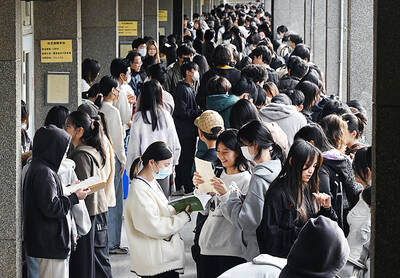
A global survey showed that 60 percent of Taiwanese had attained higher education, second only to Canada, the Ministry of the Interior said. Taiwan easily surpassed the global average of 43 percent and ranked ahead of major economies, including Japan, South Korea and the US, data from the Organisation for Economic Co-operation and Development (OECD) for 2024 showed. Taiwan has a high literacy rate, data released by the ministry showed. As of the end of last year, Taiwan had 20.617 million people aged 15 or older, accounting for 88.5 percent of the total population, with a literacy rate of 99.4 percent, the data

NEW LOW: The council in 2024 based predictions on a pessimistic estimate for the nation’s total fertility rate of 0.84, but last year that rate was 0.69, 17 percent lower An expected National Development Council (NDC) report expects the nation’s population to drop below 12 million by 2065, with the old-age dependency ratio to top 100 percent sooner than 2070, sources said yesterday. The council is slated to release its latest population projections in August, using an ultra-low fertility model, the sources said. The previous report projected that Taiwan’s population would fall to 14.37 million by 2070, but based on a new estimate of the total fertility rate (TFR) — the average number of children born to a woman over her lifetime — the population is expected to reach 12 million by
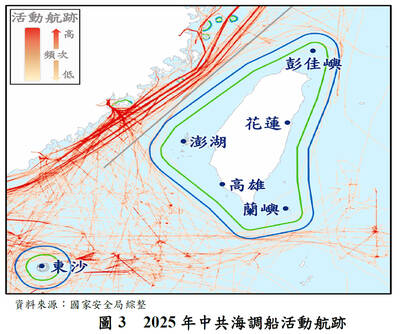
INTENSIFYING THREATS: Beijing’s tactics include massive attacks on the government service network, aircraft and naval vessel incursions and damaging undersea cables China is prepared to interfere in November’s nine-in-one local elections by launching massive attacks on the Taiwanese government’s service network (GSN), a report published by the National Security Bureau showed. The report was submitted to the Legislative Yuan ahead of the bureau’s scheduled briefing at the Foreign Affairs and National Defense Committee tomorrow. The national security team has identified about 13,000 suspicious Internet accounts and 860,000 disputed messages, the bureau said of China’s cognitive warfare against Taiwan. The disputed messages focus on major foreign affairs, national defense and economic issues, which were produced using generative artificial intelligence (AI) and distributed through Chinese

COUNTERING HOSTILITY: The draft bill would require the US to increase diplomatic pressure on China and would impose sanctions on those who sabotage undersea cable networks US lawmakers on Thursday introduced a bipartisan bill to bolster the resilience of Taiwan’s submarine cables to counter China’s hostile activities. The proposal, titled the critical undersea infrastructure resilience initiative act, was cosponsored by Republican representatives Mike Lawler and Greg Stanton, and Democratic Representative Dave Min. US Senators John Curtis and Jacky Rosen also introduced a companion bill in the US Senate, which has passed markup at the chamber’s Committee on Foreign Relations. The House’s version of the bill would prioritize the deployment of sensors to detect disruptions or potential sabotage in real-time and enhance early warning capabilities through global intelligence sharing frameworks,


 RSS
RSS