

A Chinese online encyclopedia has closed down due to government pressure as China continues to crack down on Internet information it sees as dangerous, an international rights group said.
e-Wiki, a collaborative Internet encyclopedia modeled on the hugely successful Wikipedia, closed itself down late last month, Reporters Without Borders said in a statement received yesterday.
e-Wiki decided to close after it called Taiwan the "Republic of China" and posted information on James Lung (
"It is regrettable that government threats forced e-Wiki's editor to censor himself," Reporters Without Borders said. "We understand that he felt in danger in the current context, as the authorities have significantly stepped up their control over online publications."
A notice on e-Wiki's now otherwise non-functioning Web site appeared to confirm the media watchdog's assertions.
"We all aspire to freedom, but we live in the embrace of the motherland so we have to be subjected to relevant restraints and cannot cause trouble for others," the notice said. "e-Wiki has temporarily shut down and we apologize for the inconvenience."
Wikipedia has been blocked in China since late last year, although a similar but heavily censored online encyclopedia was launched by popular Chinese Web portal Baidu this year.
The Chinese-language version of Wikipedia, which relies on voluntary users and contributors, was enjoying soaring popularity until Beijing blocked access to the site.
The government maintains a tight grip over information flow on the Internet, fearing it could sow the seeds of thoughts and ideas it regards as dangerous.
Reporters Without Borders ranks China 159th on a list of 167 countries in its global press freedom index and describes the Chinese government as an "enemy" of the Internet.

SOFT TENNIS: Yu Kai-wen and Huang Shih-yuan narrowly defeated their Japanese rivals to capture Taiwan’s first gold at the Asian Games in Nagoya Yu Kai-wen (余凱文) and Huang Shih-yuan (黃詩媛) won Taiwan’s first gold of this year’s Asian Games, defeating a Japanese duo in a nail-biter in the soft tennis mixed doubles final in Nagoya, Japan, while Johnny Sun (孫家閎) won silver in wushu and Shih Cheng-chung (石政中) won bronze in men’s kumite. Yu and Huang narrowly defeated Japan’s Toshiki Uematsu and Rena Temma 5-4 (2-4, 5-3, 4-2, 1-4, 1-4, 4-0, 1-4, 4-1, 7-5) to give Taiwan its first gold in soft tennis mixed doubles at an Asian Games since 2018. Sun secured Taiwan’s first wushu medal at this year’s game, with a combined score
CALL FOR CHANGE: They urged the UN to facilitate Taiwan’s involvement in the body, recognize its peace efforts and to work with members in preventing military conflict Representatives to the UN from five of Taiwan’s diplomatic allies sent a joint letter to UN Secretary-General Antonio Guterres on Friday, calling for the country’s inclusion in the body. Allies in the letter sent ahead of the 81st session of the UN General Assembly General Debate made three demands in support of Taiwan: inclusion, recognition and camaraderie. They implored the UN to seek an appropriate way to facilitate Taiwan’s meaningful involvement in the world governing body, saying that UN Resolution 2758, which accepted the People’s Republic of China (PRC) as a member of the UN, does not exclude Taiwan. Beijing claims that the

AT-RISK GROUPS: Of the accumulated 1,586 severe cases and 304 related deaths in this flu season, 65.8% were older people and 83.2% had chronic diseases, an official said The Centers for Disease Control (CDC) yesterday said that 165 severe flu cases and 30 flu-related deaths were reported last week, the highest weekly numbers in this flu season, and that cases might continue to increase, urging people to take precautions. Medical visits for flu-like illnesses increased by 1.4 percent to 141,374 last week, with 11.8 percent being emergency visits, showing that the seasonal flu is still in its epidemic period, CDC Epidemic Intelligence Center Director Guo Hung-wei (郭宏偉) said. From Tuesday last week to Monday, 165 severe flu cases and 30 flu-related deaths were confirmed, the highest weekly numbers
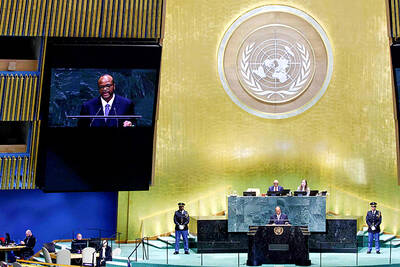
UNITY: Lai thanked the nations who spoke up for Taiwan, saying that democracies must stand together to face global authoritarian expansion Taiwan yesterday thanked eight European and Indo-Pacific countries for opposing unilateral changes to the “status quo” in the Taiwan Strait in a joint statement earlier this week, as well as three of Taiwan’s allies for speaking up for the nation’s participation in the UN at the body’s General Assembly in New York. Minister of Foreign Affairs Lin Chia-lung (林佳龍) welcomed the support and expressed his appreciation for the countries’ stance, the Ministry of Foreign Affairs said in a statement. Foreign ministers and senior representatives of Australia, France, Germany, Japan, New Zealand, Poland, South Korea and the UK issued a statement on Tuesday


 RSS
RSS