


Authorities warned residents to remain at home yesterday after heavy rains began falling again across Mumbai and the surrounding state, which were hammered last week by devastating floods.
Cleanup efforts and the distribution of food supplies to needy residents were badly slowed by the renewed monsoon rains, which began early yesterday morning, and aviation officials ordered the city's airports, the busiest in the country, closed because of poor visibility. The airports reopened at around noon after a seven-hour shutdown.
Officials, meanwhile, said the death toll from the recent rains could reach 1,000.
The recovery over the weekend of more than 100 bodies pushed the official death toll to 899. Yesterday, officials said more bodies were likely to be recovered from the flood-devastated Raigad district.
"The bodies are still coming out. There will be another 100 or so," said K. Vatsa, state rehabilitation secretary. "The toll will definitely be around 1,000."
With renewed rains pounding the city, the Mumbai police issued an alert cautioning people to stay home because of rising water levels.
"We're asking people to travel only if essential," said Mumbai's police chief A.N. Roy.
Five days after crippling rains pounded western India -- reaching a record 94cm in suburban Mumbai -- soldiers, civil defense teams and aid workers continued to find bodies from the state's worst-affected districts: Raigad, Ratnagiri, Thane, Parbhani, Nanded and Kolhapur.
But incessant rainfall and mounds of debris, boulders and mud tangled into the wooden and tin remains of people's homes were making it a challenge to pull out the remaining bodies.
"The rains are making retrieval difficult," Vatsa said.
Nearly 200 medical teams from Mumbai have set out for more than 300 villages across the state. Civic authorities have deployed health workers in the Mumbai suburbs to distribute medicines and disinfectants to guard against the spread of waterborne diseases.
As many as 418 people were killed in Mumbai -- most of them drowned, buried by landslides or electrocuted.
Government and relief officials say there is little likelihood of finding more survivors.
Yesterday, electricity was gradually restored to many northern Mumbai neighborhoods a day after angry demonstrators blocked traffic demanding restoration of clean drinking water, power and the cleanup of garbage and decomposing animal carcasses.
Residents in five Mumbai neighborhoods shouted anti-government slogans and demanded an immediate cleanup. Some shielded themselves from the rain with plastic sheets, while others simply got drenched as they demonstrated outside civic offices.
"For so many days we have been lifting the bodies of the dead and now we are clearing animals from the roads. Is this our work?" asked a furious Hafeez Irani, his face covered with a handkerchief against the stench.

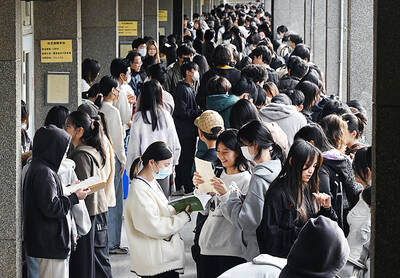
A global survey showed that 60 percent of Taiwanese had attained higher education, second only to Canada, the Ministry of the Interior said. Taiwan easily surpassed the global average of 43 percent and ranked ahead of major economies, including Japan, South Korea and the US, data from the Organisation for Economic Co-operation and Development (OECD) for 2024 showed. Taiwan has a high literacy rate, data released by the ministry showed. As of the end of last year, Taiwan had 20.617 million people aged 15 or older, accounting for 88.5 percent of the total population, with a literacy rate of 99.4 percent, the data

NEW LOW: The council in 2024 based predictions on a pessimistic estimate for the nation’s total fertility rate of 0.84, but last year that rate was 0.69, 17 percent lower An expected National Development Council (NDC) report expects the nation’s population to drop below 12 million by 2065, with the old-age dependency ratio to top 100 percent sooner than 2070, sources said yesterday. The council is slated to release its latest population projections in August, using an ultra-low fertility model, the sources said. The previous report projected that Taiwan’s population would fall to 14.37 million by 2070, but based on a new estimate of the total fertility rate (TFR) — the average number of children born to a woman over her lifetime — the population is expected to reach 12 million by

COUNTERING HOSTILITY: The draft bill would require the US to increase diplomatic pressure on China and would impose sanctions on those who sabotage undersea cable networks US lawmakers on Thursday introduced a bipartisan bill to bolster the resilience of Taiwan’s submarine cables to counter China’s hostile activities. The proposal, titled the critical undersea infrastructure resilience initiative act, was cosponsored by Republican representatives Mike Lawler and Greg Stanton, and Democratic Representative Dave Min. US Senators John Curtis and Jacky Rosen also introduced a companion bill in the US Senate, which has passed markup at the chamber’s Committee on Foreign Relations. The House’s version of the bill would prioritize the deployment of sensors to detect disruptions or potential sabotage in real-time and enhance early warning capabilities through global intelligence sharing frameworks,
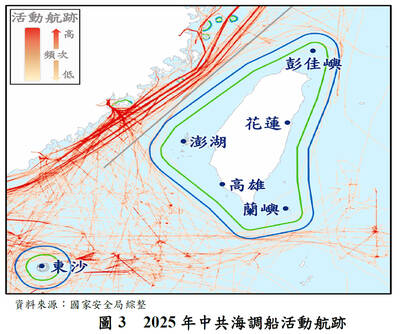
INTENSIFYING THREATS: Beijing’s tactics include massive attacks on the government service network, aircraft and naval vessel incursions and damaging undersea cables China is prepared to interfere in November’s nine-in-one local elections by launching massive attacks on the Taiwanese government’s service network (GSN), a report published by the National Security Bureau showed. The report was submitted to the Legislative Yuan ahead of the bureau’s scheduled briefing at the Foreign Affairs and National Defense Committee tomorrow. The national security team has identified about 13,000 suspicious Internet accounts and 860,000 disputed messages, the bureau said of China’s cognitive warfare against Taiwan. The disputed messages focus on major foreign affairs, national defense and economic issues, which were produced using generative artificial intelligence (AI) and distributed through Chinese


 RSS
RSS