


Indonesian police received threats of an attack against a Western embassy in Jakarta 45 minutes before the deadly car bombing of Australia's mission, Prime Minister John Howard said yesterday.
Howard said police received a message at 9:30am demanding the release of Abu Bakar Bashir, an elderly Islamic cleric accused of guiding the Al-Qaeda-linked Jemaah Islamiyah group, who is awaiting trial in Jakarta.
Foreign Minister Alexander Downer, who was in Jakarta to follow up on the attack, said the message was an SMS (short message service) text sent to a police mobile phone.
"Apparently at 9:30 yesterday morning, the Indonesian police received a message to the effect that if Bashir were not released, Western embassies would be threatened with bombs," Howard said.
The car bombing of Australia's embassy occurred about 10:15am, killing nine Indonesians and wounding more than 180 people, including a five-year-old Australian girl entering the embassy to get her first passport, Howard said.
The message was not passed on to Australian Federal Police working with the Indonesians until nearly 6:00pm, Howard said.
Indonesian police denied there had been an SMS warning, but said they were checking Howard's claim.
"No, it's not true, and at the moment we're trying to investigate the information regarding this," Indonesia's chief detective Suyitno Landung said.
Howard declined to blame Indonesian authorities for the delay in passing on the threat.
"Let's understand, you get something at 9:30am and a bomb goes off 45 minutes later, it's not necessarily reasonable to condemn the Indonesian police for that," he said.
"In fairness to the Indonesian police, they get a lot of messages. I don't even know whether it was in any way a bona fide message. The source of it, I'm sure, is being checked," he said.
Howard, who spent the day receiving briefings from Australian police and intelligence agencies as well as from Downer, said there was mounting evidence the attack was a suicide bombing carried out by Jemaah Islamiyah and that the group planned further attacks.
He said traces of explosives indicate the bomb was similar to that used by Jemaah Islamiyah to blow up two nightclubs in Bali in October 2002, when 202 people were killed, including 88 Australians, and again last year in an attack on the Marriott Hotel in Jakarta that killed 12 people.
"The intelligence agencies have warned that there is the possibility of another attack of this kind in Jakarta," Howard told reporters in Canberra.
The US and Australia issued warnings last week of a possible terrorist threat against Western hotels in Jakarta, but they made no mention of embassies.
Howard said yesterday that new intelligence reports on Wednesday indicated the threat had shifted from hotels to other targets, but they did not specify what these might be.
Also see story:

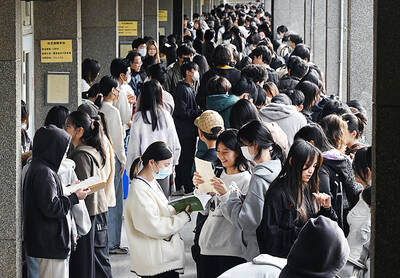
A global survey showed that 60 percent of Taiwanese had attained higher education, second only to Canada, the Ministry of the Interior said. Taiwan easily surpassed the global average of 43 percent and ranked ahead of major economies, including Japan, South Korea and the US, data from the Organisation for Economic Co-operation and Development (OECD) for 2024 showed. Taiwan has a high literacy rate, data released by the ministry showed. As of the end of last year, Taiwan had 20.617 million people aged 15 or older, accounting for 88.5 percent of the total population, with a literacy rate of 99.4 percent, the data

NEW LOW: The council in 2024 based predictions on a pessimistic estimate for the nation’s total fertility rate of 0.84, but last year that rate was 0.69, 17 percent lower An expected National Development Council (NDC) report expects the nation’s population to drop below 12 million by 2065, with the old-age dependency ratio to top 100 percent sooner than 2070, sources said yesterday. The council is slated to release its latest population projections in August, using an ultra-low fertility model, the sources said. The previous report projected that Taiwan’s population would fall to 14.37 million by 2070, but based on a new estimate of the total fertility rate (TFR) — the average number of children born to a woman over her lifetime — the population is expected to reach 12 million by
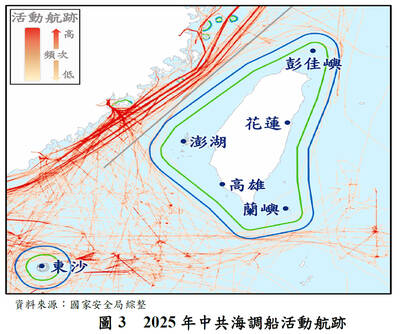
INTENSIFYING THREATS: Beijing’s tactics include massive attacks on the government service network, aircraft and naval vessel incursions and damaging undersea cables China is prepared to interfere in November’s nine-in-one local elections by launching massive attacks on the Taiwanese government’s service network (GSN), a report published by the National Security Bureau showed. The report was submitted to the Legislative Yuan ahead of the bureau’s scheduled briefing at the Foreign Affairs and National Defense Committee tomorrow. The national security team has identified about 13,000 suspicious Internet accounts and 860,000 disputed messages, the bureau said of China’s cognitive warfare against Taiwan. The disputed messages focus on major foreign affairs, national defense and economic issues, which were produced using generative artificial intelligence (AI) and distributed through Chinese

COUNTERING HOSTILITY: The draft bill would require the US to increase diplomatic pressure on China and would impose sanctions on those who sabotage undersea cable networks US lawmakers on Thursday introduced a bipartisan bill to bolster the resilience of Taiwan’s submarine cables to counter China’s hostile activities. The proposal, titled the critical undersea infrastructure resilience initiative act, was cosponsored by Republican representatives Mike Lawler and Greg Stanton, and Democratic Representative Dave Min. US Senators John Curtis and Jacky Rosen also introduced a companion bill in the US Senate, which has passed markup at the chamber’s Committee on Foreign Relations. The House’s version of the bill would prioritize the deployment of sensors to detect disruptions or potential sabotage in real-time and enhance early warning capabilities through global intelligence sharing frameworks,


 RSS
RSS