


Despite China's audacious political maneuvers, Taiwan has managed to change its national title at the International Association of Chiefs of Police (IACP) from "Taiwan, China" to "Taiwan."
"Due to China's pressure and maneuvers, our group members at the IACP were forced to change the name of their country of origin from the `Republic of China' to `Taiwan, China' in November, 2001," said a Cabinet official who asked not to be named.
"The use of our national flag was also denied at all occasions," he said.
To voice the nation's utmost displeasure with China's audacity, the official said that the Cabinet ordered a boycott of the organization's annual conference in 2002 and filed a letter of protest.
After months of haggling and negotiations, members finally managed to change the national title and the use of national flags was restored during the IACP's last annual conference in Philadelphia in October last year, the official said.
"We've been keeping a very low profile in a bid to avert any further unnecessary hassles from China," the Cabinet official said.
Founded in 1893, the IACP is the world's oldest and largest non-profit organization of police executives. The organization has over 19,000 members and its membership now represents 101 countries.
The organization holds observer status with the International Criminal Police Organization, or Interpol, and consultative status with the UN.
Taiwan joined the IACP in 1985, one year after the nation was elbowed out of Interpol by China in September, 1984 when China became a member state.
Established in 1923, Interpol's headquarters was located in Vienna and comprised of the General Assembly, the Executive Committee, the General Secretariat, the National Central Bureaus, and the Advisers.
The headquarters of Interpol moved to Paris, France in 1946 and then relocated to Lyons in October, 1989, where it remains to this day. The number of its member states has reached more than 181.
Taiwan joined Interpol in 1961 and formed the Criminal Investigation Bureau under the National Police Administration in 1979.
Despite the upsetting withdrawal from Interpol, the Criminal Investigation Bureau is still in close contact with the organization.
Interpol's fundamental role is to facilitate communication, which is accomplished by fostering a continuing exchange between countries and circulating new messages, memos and notices on a daily basis.
According to Chris Chang (章文正), International Criminal Affairs Division chief of the Criminal Investigation Bureau under the National Police Administration, the administration is a member of two international organizations: the IACP and the International Association of Airport and Seaport Police (IAASP).
The IAASP was formed in 1969 as a non-governmental and non-profit association. It is registered in the province of British Columbia, Canada and Washington state in the US.
The organization is dedicated to bringing together representatives of police administrations, other enforcement agencies and sectors of the transportation industry involved in the movement of cargo at airports and seaports around the world.
The association has served in a consultative capacity with the UN, the US Senate and the Canadian Ministry of Transport as well as other organizations.

Right-wing political scientist Laura Fernandez on Sunday won Costa Rica’s presidential election by a landslide, after promising to crack down on rising violence linked to the cocaine trade. Fernandez’s nearest rival, economist Alvaro Ramos, conceded defeat as results showed the ruling party far exceeding the threshold of 40 percent needed to avoid a runoff. With 94 percent of polling stations counted, the political heir of outgoing Costa Rican President Rodrigo Chaves had captured 48.3 percent of the vote compared with Ramos’ 33.4 percent, the Supreme Electoral Tribunal said. As soon as the first results were announced, members of Fernandez’s Sovereign People’s Party
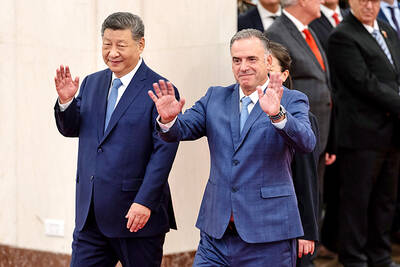
EMERGING FIELDS: The Chinese president said that the two countries would explore cooperation in green technology, the digital economy and artificial intelligence Chinese President Xi Jinping (習近平) yesterday called for an “equal and orderly multipolar world” in the face of “unilateral bullying,” in an apparent jab at the US. Xi was speaking during talks in Beijing with Uruguayan President Yamandu Orsi, the first South American leader to visit China since US special forces captured then-Venezuelan president Nicolas Maduro last month — an operation that Beijing condemned as a violation of sovereignty. Orsi follows a slew of leaders to have visited China seeking to boost ties with the world’s second-largest economy to hedge against US President Donald Trump’s increasingly unpredictable administration. “The international situation is fraught
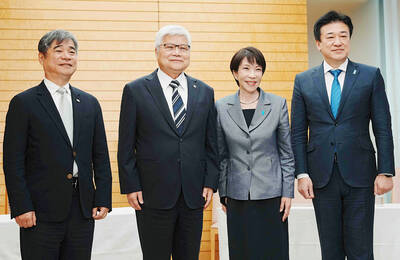
Taiwan Semiconductor Manufacturing Co (TSMC, 台積電) plans to make advanced 3-nanometer chips in Japan, stepping up its semiconductor manufacturing roadmap in the country in a triumph for Japanese Prime Minister Sanae Takaichi’s technology ambitions. TSMC is to adopt cutting-edge technology for its second wafer fab in Kumamoto, company chairman C.C. Wei (魏哲家) said yesterday. That is an upgrade from an original blueprint to produce 7-nanometer chips by late next year, people familiar with the matter said. TSMC began mass production at its first plant in Japan’s Kumamoto in late 2024. Its second fab, which is still under construction, was originally focused on

GROWING AMBITIONS: The scale and tempo of the operations show that the Strait has become the core theater for China to expand its security interests, the report said Chinese military aircraft incursions around Taiwan have surged nearly 15-fold over the past five years, according to a report released yesterday by the Democratic Progressive Party’s (DPP) Department of China Affairs. Sorties in the Taiwan Strait were previously irregular, totaling 380 in 2020, but have since evolved into routine operations, the report showed. “This demonstrates that the Taiwan Strait has become both the starting point and testing ground for Beijing’s expansionist ambitions,” it said. Driven by military expansionism, China is systematically pursuing actions aimed at altering the regional “status quo,” the department said, adding that Taiwan represents the most critical link in China’s


 RSS
RSS