


Former US president Bill Clinton and former vice president Al Gore are expected to visit Taipei during the next two months, the Ministry of Foreign Affairs said yesterday.
The Taiwan Foundation for Democracy, which was founded by senior government officials to promote democracy, will be hosting Clinton's visit, scheduled for November. The exact date of Clinton's visit has yet to be finalized.
The foundation is inviting Clinton to give a speech on the development of democracy and human rights in East Asia.
"He [Clinton] is interested," a high-ranking ministry official said.
According to the official, Clinton will also be exchanging opinions with government officials on various issues. Further details about Clinton's visit will be released when the arrangements have been settled, the official said.
"The ministry is delighted to see Clinton will be visiting," a ministry spokesman said.
The ministry declined to reveal how much the foundation will be paying for Clinton's visit. However, it said the payment for Clinton's speech might be donated to a Clinton memorial library currently under construction in Arkansas.
Clinton reportedly receives US$100,000 for each speech.
In September 2001, a local Chinese-language newspaper invited Clinton to Taiwan for a four-day visit, but the trip was cancelled because of the Sept. 11 terrorist attacks.
Clinton visited Taiwan four times when he was governor of Arkansas. This year's visit will be his fifth visit and the first since he stepped down from presidency in 2001.
Two other former US presidents have visited Taiwan.
Jimmy Carter came in 1999 and George Bush, President George W. Bush's father, visited in 1992.
Gore is scheduled to arrive in Taiwan on Oct. 13, mainly to deliver a keynote speech at the 2003 International Institute of Electrical and Electronics Engineers Carnahan Conference on Security Technology slated for Oct. 14 to Oct. 16 in Taipei, foreign ministry officials said.
The conference, the 37th of its kind, will be sponsored by the US International Institute of Electrical and Electronics Engineers Lexington Section, the institute's Aerospace and Electronic Systems Society, Taiwan's National Central University, the Chung Shan Institute of Science and Technology and a number of other organizations from the two countries.
The Central News Agency quoted a conference sponsor in Taipei as saying sponsors have made "E-security" the theme of this year's conference because of the significance and urgency of this issue in modern society.
The democracy foundation, which will be holding a seminar to discuss other countries' experiences of referendums in the middle of October, said it wants to invite Gore to join its workshops.
The foundation has yet to arrange Gore's participation in the seminar and said it would not reveal the details until nearer the time, as referendums are a politically sensitive issue.
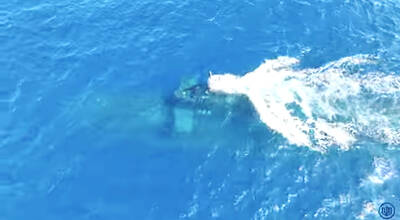
CSBC Corp, Taiwan (台灣國際造船) yesterday released the first video documenting the submerged sea trials of Taiwan’s indigenous defense submarine prototype, the Hai Kun (海鯤), or Narwhal, showing underwater navigation and the launch of countermeasures. The footage shows the vessel’s first dive, steering and control system tests, and the raising and lowering of the periscope and antenna masts. It offered a rare look at the progress in the submarine’s sea acceptance tests. The Hai Kun carried out its first shallow-water diving trial late last month and has since completed four submerged tests, CSBC said. The newly released video compiles images recorded from Jan. 29 to
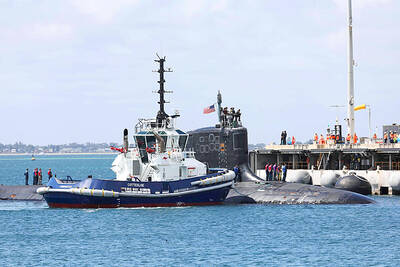
DETERRENCE EFFORTS: Washington and partners hope demonstrations of force would convince Beijing that military action against Taiwan would carry high costs The US is considering using HMAS Stirling in Western Australia as a forward base to strengthen its naval posture in a potential conflict with China, particularly over Taiwan, the Wall Street Journal reported on Saturday. As part of its Indo-Pacific strategy, Washington plans to deploy up to four nuclear-powered submarines at Stirling starting in 2027, providing a base near potential hot spots such as Taiwan and the South China Sea. The move also aims to enhance military integration with Pacific allies under the Australia-UK-US trilateral security partnership, the report said. Currently, US submarines operate from Guam, but the island could
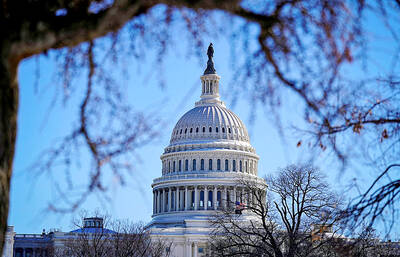
RESTRAINTS: Should China’s actions pose any threat to Taiwan’s security, economic or social systems, China would be excluded from major financial institutions, the bill says The US House of Representatives on Monday passed the PROTECT Taiwan Act, which states that Washington would exclude China from participating in major global financial organizations if its actions directly threaten Taiwan’s security. The bill, proposed by Republican Representative Frank Lucas, passed with 395 votes in favor and two against. It stipulates that if China’s actions pose any threat to Taiwan’s security, economic or social systems, the US would, “to the maximum extent practicable,” exclude Beijing from international financial institutions, including the G20, the Bank for International Settlements and the Financial Stability Board. The bill makes it clear that China must be prepared

Taiwanese trade negotiators told Washington that Taipei would not relocate 40 percent of its semiconductor production to the US, and that its most advanced technologies would remain in the nation, Vice Premier Cheng Li-chiun (鄭麗君) said on Sunday. “I told the US side very clearly — that’s impossible,” Cheng, who led the negotiation team, said in an interview that aired on Sunday night on Chinese Television System. Cheng was referring to remarks last month by US Secretary of Commerce Howard Lutnick, in which he said his goal was to bring 40 percent of Taiwan’s chip supply chain to the US Taiwan’s almost


 RSS
RSS