


The DPP is set to enter a new era as President Chen Shui-bian (
Chen will be sworn in with 11 newly appointed Arbitration Committee members, 11 newly elected Central Review Committee members, 35 newly elected Central Executive Committee members and 15 Central Standing Committee members during the inauguration ceremony.
The ceremony is scheduled for 5:30pm at the International Convention Center in Taipei City.
According to Michael You (游盈隆), deputy secretary-general of the DPP, Chen is scheduled to give a 20-minute speech during the ceremony and the theme of his speech will focus on party reforms and his vision for the party and the nation.
Commenting on the achievements made by outgoing chairman Frank Hsieh (
"He faced an overwhelming amount of difficulties from the opposition parties because he's the first party chairman after the peaceful transfer of power," You said. "However, he not only led the party to become the largest in the legislature but also successfully helped push for party reforms."
Speaking on behalf of the party, You said that the DPP has great expectations for the new chairman.
"The president's doubling up as the party chairman ushers in a new chapter of the party's history," he said. "I hope it'll help better integrate the opinions of the Presidential Office, the Executive Yuan and the party and I believe the president himself will manage to strike a balance between his two roles."
To drum up support for the year-end mayoral race, a pep rally will be held at 10:30am for Hsieh, who is seeking his second term as Kaohsiung mayor; and Lee Ying-yuan (李應元), who is running against the KMT's candidate, incumbent Taipei Mayor Ma Ying-jeou (馬英九).
The race for Kaohsiung and Taipei mayors is slated for Dec. 7.
In the afternoon, the National Congress will approve the 11 Arbitration Committee members, who are recommended by the Central Standing Committee and need to be approved by the National Congress. The National Congress will also elect 11 Central Review Committee members.
Central Review Committee members are elected from National Congress members who have served at local chapters, county or city governments, or as local representatives at provincial or city councils, judges or prosecutors, or lawyers or accountants.
The National Congress will also elect 30 new members of the Central Executive Committee.
Membership of the Central Standing Committee is 15 and that of the Central Executive Committee is 35.
Thirty of the 35 Central Executive Committee members are elected from the ranks of the National Congress. The remaining five positions are reserved for the leader of the legislative caucus and the party chairman -- who in turn must appoint the remaining three committee members.
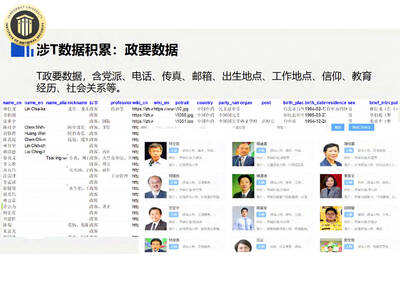
NETWORK-MAPPING PROJECT: The database contains 170 detailed files of Taiwanese politicians and about 23 million records of household registration data in Taiwan China has developed a network-mapping project targeting political figures and parties in Taiwan to monitor public opinion during elections and to craft tailored influence campaigns aimed at dividing Taiwanese society, according to documents leaked by Chinese technology firm GoLaxy (中科天璣). The documents, collected by Taipei-based Doublethink Lab, showed a database was specifically created to gather detailed information on Taiwanese political figures, including their political affiliations, job histories, birthplaces, residences, education, religion and a brief biography about them. Several notable Taiwanese politicians are in the database, including President William Lai (賴清德), former president Tsai Ing-wen (蔡英文), Minister of Foreign Affairs Lin Chia-lung (林佳龍),
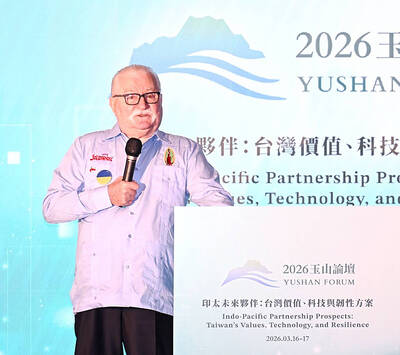
RECOGNITION: Former Fijian prime minister Mahendra Chaudhry said that Taiwan’s New Southbound Policy serves as a stabilizing force in the Indo-Pacific region Taiwan can lead the unification of the Chinese people, Nobel Peace Prize laureate and former Polish president Lech Walesa said in Taipei yesterday, adding that as the world order is changing, peaceful discussion would find good solutions, and that the use of force and coercion would always fail. Walesa made the remarks during his keynote address at a luncheon of the Yushan Forum in Taipei, titled “Indo-Pacific Partnership Prospects: Taiwan’s Values, Technology and Resilience,” organized by the Taiwan-Asia Exchange Foundation with the Ministry of Foreign Affairs. Walesa said that he had been at the forefront of a big peaceful revolution and “if
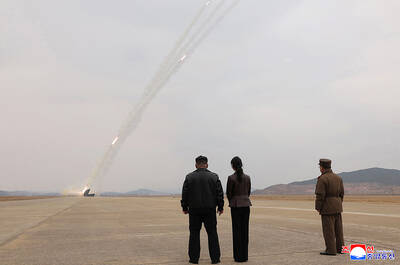
North Korea tested nuclear-capable rocket launchers, state media reported yesterday, a day after Seoul detected the launch of about 10 ballistic missiles. The test comes after South Korean and US forces launched their springtime military drills, due to run until Thursday. North Korean leader Kim Jong-un on Saturday oversaw the testing of the multiple rocket launcher system (MRLS), the Korean Central News Agency (KCNA) said. The test involved 12 600mm-caliber ultra-precision multiple rocket launchers and two artillery companies, it said. Kim said the drill gave Pyongyang’s enemies, within the 420km striking range, a sense of “uneasiness” and “a deep understanding

North Korea yesterday fired about 10 ballistic missiles to the sea toward Japan, the South Korean Joint Chiefs of Staff (JCS) said, days after Pyongyang warned of “terrible consequences” over ongoing South Korea-US military drills. Pyongyang recently dashed hopes of a diplomatic thaw with Seoul, Washington’s security ally, describing its latest peace efforts as a “clumsy, deceptive farce.” Seoul’s military detected “around 10 ballistic missiles launched from the Sunan area in North Korea toward the East Sea [Sea of Japan] at around 1:20pm,” JCS said in a statement, referring to South Korea’s name for the body of water. The missiles


 RSS
RSS