


DPP heavyweights announced yesterday that they intend to propose amendments to the party's charter that would remove its founding pro-independence principles.
Senior officials said the proposal would be taken up at the party's central advisory committee meeting today, where they would put the removal of the "independence guidelines" on the table in an attempt to counter claims made during the election that the DPP's policies were dangerous.
"The independence guidelines should be regarded as a historical document and words such as `establishing the Republic of Taiwan' should be deleted," said Chen Chao-nan (
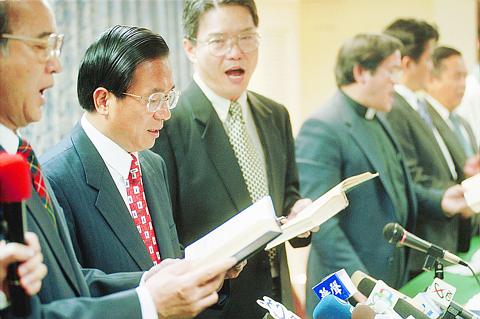
PHOTO: CHEN CHENG-CHANG, TAIPEI TIMES
He stressed that Taiwan's independent sovereignty has already been carried out by democratic developments, under which Taiwan-ese can now elect their own president freely and have already established a democratic legislature.
Chen said that the independence guidelines had become a weakness for the DPP, forcing its candidates onto the defensive in elections.
It is also a thorny issue in President-elect Chen Shui-bian's (
"The main point of our guidelines is `to use plebiscite measures' to establish an independent sovereign Republic of Taiwan," Chen said.
"Now we only need to delete `Republic of Taiwan' and `to rewrite the constitution' and then add `to firmly establish an independent sovereign and autonomous country, while any changes to the status quo should be decided by plebiscite.'"
Vice President-elect Annette Lu (
"It proves that the DPP is not a rigid party and realizes the importance of changing in order to face both the rest of the world and Taiwan's own society," Lu said.
President-elect Chen, meanwhile, made an appeal to Chinese leaders yesterday during a Presbyterian Church service in Taipei, saying that only with a considerate, humble heart can they truly seek peace in the Taiwan Strait.
Leaders of the DPP's Justice Alliance faction, organized by the president-elect in 1993, said that they agreed with the proposal to modify the pro-independence guidelines, but that the proper thing to do would be to revise all the party's guidelines, instead of focusing on one particular part.
"We should not only solve problems after they occur," said DPP legislator Chen Chi-mai (陳其邁).
"We should offer a complete plan to modify our party guidelines in order to create a new image," he said.

The National Chungshan Institute of Science and Technology yesterday showcased its locally developed variants of the Vision 60 robotic patrol dog, which it plans to deploy on the nation’s outlying territories in the South China Sea. The variants were produced under the Joint Lab project — created by the institute and domestic companies — and assembled with domestically produced motors, lenses and artificial intelligence (AI) systems alongside licensed tech from the US, Missile and Rocket Systems Research Division deputy director Jen Kuo-kang (任國光) told the media event at a military base in Taipei’s Dazhi (大直) area. Taiwan has built up its strengths

RIGHT DIRECTION: Taiwan’s efforts to prevent forced labor include a proposal to ‘fully prohibit’ employers from withholding workers’ documents, an official said Taiwan is to establish a mechanism to restrict imports of goods linked to forced labor, the Executive Yuan said yesterday, after the US proposed imposing additional tariffs on Taiwanese goods over labor concerns. “The Ministry of Labor and the Ministry of Economic Affairs are to establish an interministerial review procedure,” Executive Yuan spokesperson Michelle Lee (李慧芝) said at a news briefing in Taipei. “The government is to use the Foreign Trade Act [貿易法] as the legal basis to restrict imports of goods produced with forced labor” and bring its supply chain governance more in line with international standards on human rights, resilience

NOT IMMEDIATE: Taiwan has a chance to appeal the proposed 10 percent tariff before it starts, while other countries face a 12.5 percent tariff from the trade office Taiwan is among 60 economies determined by the US to have failed to impose or enforce a ban on the importation of goods produced with forced labor, according to a notice released on Tuesday by the Office of the US Trade Representative (USTR), which proposed imposing an additional 10 percent or more tariff on them. The USTR in a statement said that following an investigation, it had determined under Section 301 of the Trade Act of 1974 that the failure of the 60 economies to impose and effectively enforce a prohibition on the importation of goods produced with forced labor is
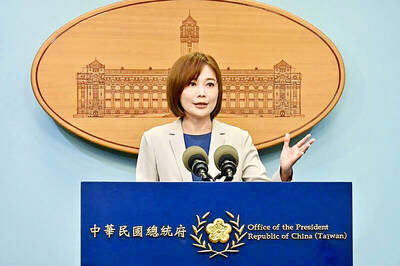
TIT-FOR-TAT: The US allegedly revoked the visa of a Chinese national working at Xinhua News Agency in the US in response to Beijing’s expulsion of Vivian Wang The Presidential Office yesterday condemned China for expelling a New York Times correspondent from Beijing following the newspaper’s interview with President William Lai (賴清德), saying the move highlighted Beijing’s suppression of press freedom and its threat to international news media. Taiwan has noted a series of recent incidents in which Beijing used similar tactics to “threaten and pressure international media outlets and journalists,” Presidential Office spokeswoman Karen Kuo (郭雅慧) said in a statement. “This concerns not only press freedom and freedom of expression, but also the safety of journalists, and Taiwan and relevant partners are paying close attention to the situation,” she


 RSS
RSS