


Taiwan accused China yesterday of exploiting its misfortune in trying to assert sovereignty over the island and accused Beijing of slowing international aid efforts by political meddling.
"Their words and deeds violate international humanitarian principles ... and will be condemned and regarded with shame and regret by the international community," Foreign Minister Jason Hu said, referring to Beijing.
Taipei has thanked Beijing for its offers of aid, but has chafed at reports that it was expecting foreign countries to seek its blessing when dispatching emergency relief on the grounds that Taiwan was a province under Chinese sovereignty.
"In many cases this delayed foreign rescuers in carrying out their relief work in Taiwan," Hu said.
Taiwan's Red Cross urged international donors to contact Taipei directly -- not Beijing -- if they wanted to help.
Mainland Affairs Council deputy chairman Sheu Ke-sheng said China was "making political gestures at the expense of one country's disaster" and added: "This is extremely inappropriate."
Meanwhile, political commentators here said that while China is trying hard to "politicize" international humanitarian aid to Taiwan in the aftermath of earthquake, Taipei should seize the opportunity to help transform cross-strait relations.
Following the killer quake early Tuesday morning, Chinese President Jiang Zemin (
However, China's goodwill gesture was replaced by a series of attempts to push its "one-China policy" among the international community during the past few days.
First came China's political meddling at the UN, which had delayed sending a relief mission to Taiwan while waiting for "permission" from China.
The UN's Office of Coordination of Humanitarian Affairs in Geneva reportedly decided to send a six-member team to help with relief efforts only after close consultation with China.
To make matters worse, UN Secretary-General Kofi Annan sent his sympathies to the people of the "Taiwan province of China."
China's Foreign Minister Tang Jiaxuan (唐家璇) also took advantage of an opportunity during a UN meeting on Sept. 22 to promote its position that Taiwan is a part of China by expressing gratitude for international humanitarian aid "on behalf of the Taiwan people."
In addition, China's Red Cross chapter asked other international chapters to "consult" with it before they decided to offer help to quake-stricken Taiwan, and a Russian earthquake relief mission en route to Taiwan was forced to make a lengthy detour over Siberia because China refused to allow the Russian plane carrying the team to pass through its airspace.
In response to China's actions, Foreign Minister Jason Hu (
"Their behavior has violated international humanitarian principles," Hu said. "Such actions won't be accepted by the people of Taiwan, and they will be condemned by members of the international community."
Hu also criticized the way Annan worded his letter and said he filed a letter of protest with the UN.
Although some members of the international press, legislators and students have also protested against China's recent statements and actions, observers acknowledge that criticism is unlikely to come from official authorities of foreign countries.
"There is no question which issues are more important, humanitarian or political considerations. But yet don't expect any strong attacks from any official authorities, which have chosen to stick to the `one-China' policy," David Chou (
Although the Straits Exchange Foundation politely rebuffed China's offer to send medical teams to help relief efforts here, Taiwan is prepared to accept China's offer of US$100,000, sources said.
In view of the government's prudence in accepting aid from China, political commentators said yesterday that a friendly response from Taiwan might help transform its image as a troublemaker on cross-strait issues.

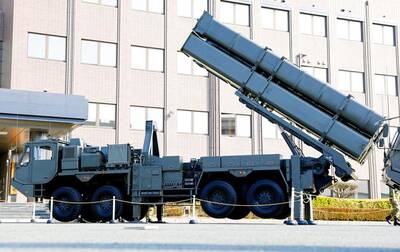
Japan has deployed long-range missiles in a southwestern region near China, the Japanese defense minister said yesterday, at a time when ties with Beijing are at their lowest in recent years. The missiles were installed in Kumamoto in the southern region of Kyushu, as Japan is attempting to shore up its military capacity as China steps up naval activity in the East China Sea. “Standoff defense capabilities enable us to counter the threat of enemy forces attempting to invade our country ... while ensuring the safety of our personnel,” Japanese Minister of Defense Shinjiro Koizumi said. “This is an extremely important initiative for

MORE POPULAR: Taiwan Pass sales increased by 59 percent during the first quarter compared with the same period last year, the Tourism Administration said The Tourism Administration yesterday said that it has streamlined the Taiwan Pass, with two versions available for purchase beginning today. The tourism agency has made the pass available to international tourists since 2024, allowing them to access the high-speed rail, Taiwan Railway Corp services, four MRT systems and four Taiwan Tourist Shuttles. Previously, five types of Taiwan Pass were available, but some tourists have said that the offerings were too complicated. The agency said only two types of Taiwan Pass would be available, starting from a three-day pass with the high-speed rail and a three-day pass with Taiwan Railway Corp. The former costs NT$2,800

NEW LOW: The council in 2024 based predictions on a pessimistic estimate for the nation’s total fertility rate of 0.84, but last year that rate was 0.69, 17 percent lower An expected National Development Council (NDC) report expects the nation’s population to drop below 12 million by 2065, with the old-age dependency ratio to top 100 percent sooner than 2070, sources said yesterday. The council is slated to release its latest population projections in August, using an ultra-low fertility model, the sources said. The previous report projected that Taiwan’s population would fall to 14.37 million by 2070, but based on a new estimate of the total fertility rate (TFR) — the average number of children born to a woman over her lifetime — the population is expected to reach 12 million by

COUNTERING HOSTILITY: The draft bill would require the US to increase diplomatic pressure on China and would impose sanctions on those who sabotage undersea cable networks US lawmakers on Thursday introduced a bipartisan bill to bolster the resilience of Taiwan’s submarine cables to counter China’s hostile activities. The proposal, titled the critical undersea infrastructure resilience initiative act, was cosponsored by Republican representatives Mike Lawler and Greg Stanton, and Democratic Representative Dave Min. US Senators John Curtis and Jacky Rosen also introduced a companion bill in the US Senate, which has passed markup at the chamber’s Committee on Foreign Relations. The House’s version of the bill would prioritize the deployment of sensors to detect disruptions or potential sabotage in real-time and enhance early warning capabilities through global intelligence sharing frameworks,


 RSS
RSS