


Oct. 1 to Oct. 7
Kuo Pai-nian (郭百年) and his fellow Han Chinese settlers were locked in a stalemate with the Aboriginal warriors of Shuishalian (水沙連, the area around today’s Puli Township) for over a month until they decided to revert to trickery. Kuo offered to leave the area in exchange for deer antlers. When the Aboriginal men went to hunt for the antlers, Kuo and his cohorts invaded the village, burning, slaughtering and stealing. They even overturned all of the community’s graves and took the weapons inside to bolster their forces. The Aborigines had no choice but to flee. This was the beginning of the Kuo Pai-nian Incident of 1814.
As Chung You-lan (鍾幼蘭) shows in a study, Pingpu Peoples and the Puli Basin (平埔族群與埔里盆地), such instances of Han Chinese brutality toward Aborigines were not uncommon, and that the incident was a microcosm of the way in which Han Chinese violently expanded into Aboriginal territory. This expansion would in turn cause the affected Aboriginal group to encroach on the land of others.
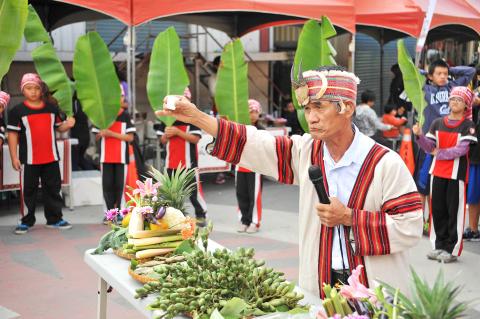
Photo: Chen Feng-li, Taipei Times
What makes this incident unique, however, is that despite Kuo’s success in driving out the area’s inhabitants, the result of this conflict was not Han Chinese domination, but a mass migration of Aboriginal groups from the west coast into Puli. Many of whose descendants still live there today.
BLOOD IN THE MOUNTAINS
Chung writes that various Aboriginal groups lived in Shuishalian during the 17th and 18th centuries, but the exact ethnic composition isn’t clear because Han Chinese and even the coastal Siraya Aborigines were unable to enter the area.
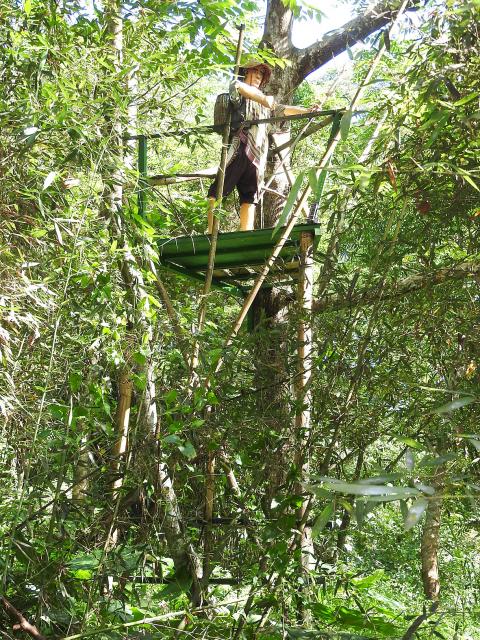
Photo: Tung Chen-kuo, Taipei Times
At the turn of the 19th century, the Puli basin, which was a part of Shuishalian, was still considered an “untouched paradise” by the Han Chinese settlers of the western plains of Taiwan. In fact, the Qing Empire forbade Han Chinese to enter these mountain areas, and employed shou (熟) — “civilized” Aborigines who lived on the plains and largely cooperated with the Qing and had a high degree of contact with Han Chinese — to guard the border. The ones beyond the border were sheng (生), “uncivilized” Aborigines who were often hostile. This policy officially began in 1791.
However, since these “civilized” guards often did not farm land close to the border, they would rent it to Han settlers, who then became aware of the valuable land controlled by the “uncivilized” Aborigines. Consequently, illegal border crossings were common.
Additionally, the Qing court awarded Shuishalian Aborigines border guard positions because they had helped pacify an earlier Han Chinese rebellion.
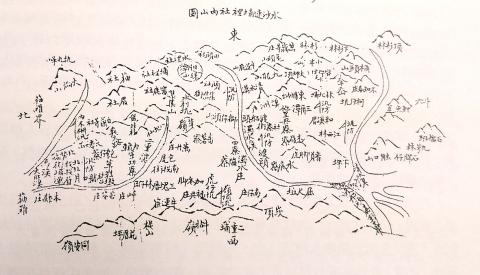
Photo courtesy of National Central Library
By 1800, the Han Chinese settlers around today’s Changhua County were running out of land to cultivate; newcomers could only look towards the mountainous area to the east. So when a Shuishalian border guard approached Kuo and told him that his community had valuable land to farm, they devised a plan to obtain a permit from Qing officials to cultivate it. The pair applied for and received the permit in the name of a dead local chief, claiming that he wanted to rent the land to Han Chinese settlers.
Using this permit, Kuo and about 1,000 followers entered the area and immediately started encroaching on Aboriginal land, farming way beyond what they were allowed to.
Finally, Kuo and company pushed their way towards today’s Puli. The Aborigines there were powerful enough to resist him, leading to the stalemate that finally ended with the massacre.
Qing officials in Tainan sent agents to investigate, but Kuo bribed them off. It was only a matter of time, however, before officials caught on, immediately revoking his permit, sentencing him to a beating, evicting all Han Chinese and threatening to decapitate any non-Aborigines who dared to enter the area. It was clear that officials not only wanted to avoid any conflict with the Aborigines, but were also concerned that Han Chinese rebellions would be harder to quell if they gained access to the rugged mountains.
PINGPU MIGRATION
While the Puli Aborigines were now free to return home, they were greatly weakened by the ordeal. This not only rendered them vulnerable to encroachment from the west, they also suffered attacks by Atayal tribes from the north.
In January 1823, they invited Pingpu settlers from the west coast, who were also facing pressure from the ever-increasing numbers of Han Chinese, to move to Puli to farm and help defend the territory. This was a highly organized migration as the two sides signed agreements and the newcomers had to give presents to the original inhabitants upon arrival. This process took place in several waves over the next few decades.
There were some Han Chinese who pretended to be Aborigines and took Aboriginal names so as to settle in the area. Records show, however, that the numbers remained low for a few decades.
Ironically, the influx of Pingpu settlers — whether legally or illegally — eventually led to the demise of the original inhabitants, who were either assimilated or pushed out. By 1847, Qing records show there were more than 2,000 immigrant Aborigines in Puli compared to 150 or so natives. A Japanese survey in 1900 shows that only eight remained, with their mother tongue completely lost.
Meanwhile, the Qing realized that they could not stop Han Chinese from illegally crossing the borders as arable land became increasingly scarce, and abolished the demarcations in 1875. In 1887, the Qing set up an Aboriginal affairs office in Puli, officially taking the area under control. Just eight years later, the Qing ceded Taiwan to Japan.
Today, the descendants of these settlers trace their lineage back to six tribes who are fighting for recognition today: Taokas, Pazeh, Kahabu, Papora, Babuza and Hoanya.
Taiwan in Time, a column about Taiwan’s history that is published every Sunday, spotlights important or interesting events around the nation that have anniversaries this week.

Yesterday, the Democratic Progressive Party (DPP) nominated legislator Puma Shen (沈伯洋) as their Taipei mayoral candidate, the Chinese Nationalist Party (KMT) put their stamp of approval on Wei Ping-cheng (魏平政) as their candidate for Changhua County commissioner and former legislator Tsai Pi-ru (蔡壁如) of the Taiwan People’s Party (TPP) has begun the process to also run in Changhua, though she has not yet been formally nominated. All three news items are bizarre. The DPP has struggled with settling on a Taipei nominee. The only candidate who declared interest was Enoch Wu (吳怡農), but the party seemed determined to nominate anyone

In a sudden move last week, opposition lawmakers of the Chinese Nationalist Party (KMT) and Taiwan People’s Party (TPP) passed a NT$780 billion special defense budget as a preemptive measure to stop either Chinese leader Xi Jinping (習近平) or US President Donald Trump from blocking US arms sales to Taiwan at their summit in Beijing, said KMT heavyweight Jaw Shaw-kong (趙少康), speaking to the Taipei Foreign Correspondents Club on Wednesday night in Taipei. The 76-year-old Jaw, a political talk show host who ran as the KMT’s vice presidential candidate in 2024, says that he personally brokered the deal to resolve
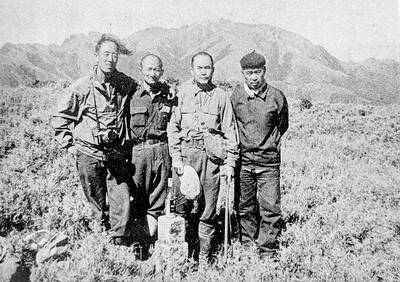
May 18 to May 24 Gathered on Yangtou Mountain (羊頭山) on Dec. 5, 1972, Taiwan’s hiking enthusiasts formally declared the formation of the “100 Peaks Club” (百岳俱樂部) and unveiled the final list of mountains. Famed mountaineer Lin Wen-an (林文安) led this effort for the Chinese Alpine Association (中華山岳協會). Working with other experienced climbers, he chose 100 peaks above 10,000 feet (3,048m) that featured triangulation points and varied in difficulty and character. The list sparked an alpine hiking craze, inspiring many to take up mountaineering and competing to “conquer” the summits. A common misconception is that the 100 Peaks represent Taiwan’s 100 tallest

The Chinese Nationalist Party (KMT), alongside their smaller allies the Taiwan People’s Party (TPP), are often accused of acting on behalf of the Chinese Communist Party (CCP). Some go so far as to call them “traitors.” It is not hard to see why. They regularly pass legislation to stymie the normal functioning of the ruling Democratic Progressive Party’s (DPP) administration, and they have yet to pass this year’s annual budget. They slashed key elements of the government’s proposed NT$1.25 trillion (US$40 billion) special military budget, and in the smaller NT$780 billion package they did pass, it is riddled with provisions that


 RSS
RSS